
Tanzania: Authorities formalize forced repatriation of Burundian refugees
SOS Media Burundi
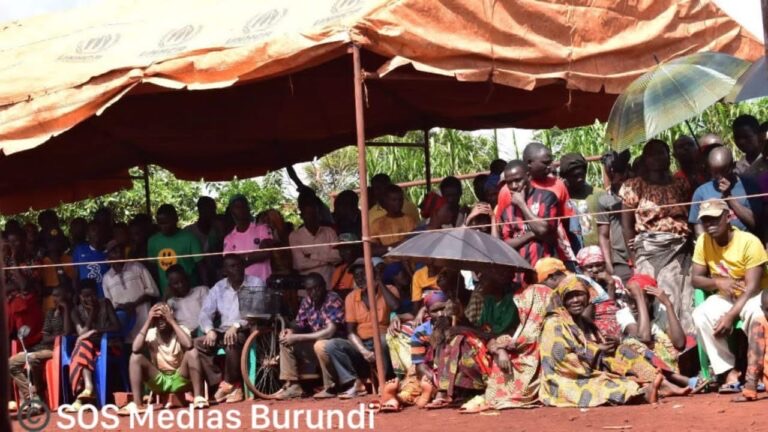
Kigoma, November 14, 2025 — The Tanzanian Ministry of the Interior and UNHCR posted a long list of Burundian refugees on Tuesday, November 11, 2025, urging them to register to return home before November 30. According to several sources, more than 99% of the refugees in the Nduta and Nyarugusu camps are on these lists, sparking panic and outrage within the refugee community.
“Almost all of us failed.”
On the notice boards, reactions are a mixture of irony and dismay.
“This is the announcement of a test conducted last May.” “We’ve almost all failed,” some refugees remarked ironically, standing in front of the notice board in Zone IV of the Nduta camp.
They expressed surprise that nearly all the refugees in the camp were being ordered to register immediately for their return before the end of the month. The notice, posted in Swahili, Kirundi, and English, confirmed the mandatory nature of the measure, according to a Burundian community leader.
These lists were initially displayed in Zones I, II, III, IV, V, and VII, before being distributed throughout the camp by the DRC (Danish Refugee Council), an NGO partnered with UNHCR.
Controversial Interviews
Last May, several interviews were conducted in refugee camps in Tanzania. Each Burundian had to resubmit their asylum application and justify the reasons for their prolonged stay in the country. Presented as a tool to assess “the need and willingness” to retain international protection, this process had already sparked incomprehension and suspicions of coercion among refugees.
A forced return “willingly or by force”
Last October, the UNHCR Country Representative, Barbara Bentum Williams Dotse, accompanied by Sudi Mwakibasi, Permanent Secretary for Refugees at the Tanzanian Ministry of the Interior, and the Burundian Consul in Kigoma, Jérémie Kekenwa, declared during a visit to Nduta and Nyarugusu that more than 97% of Burundian refugees no longer have valid reasons to retain their refugee status and must therefore “return willingly or by force.”
Multiple pressures and contested lists
According to several witnesses, this announcement was preceded by acts of intimidation: arbitrary arrests of community leaders, market closures, food ration cuts, and awareness-raising sermons in churches.
In the Nyarugusu camp, the posted lists contain serious irregularities: they include the names of deceased refugees, others who were repatriated months ago, and even students who have gone abroad.
“This shows that these lists were made hastily, out of malice, or to tell us that even the dead must return!” laments a refugee contacted by SOS Médias Burundi.
According to the UNHCR, the results of interviews indicate that Burundian refugees are now primarily motivated by economic reasons, considering that the political motives cited in 2015 “are no longer relevant.”
The CDH/VICAR raises the alarm
The Coalition for the Defense of Human Rights Living in Refugee Camps (CDH/VICAR) strongly condemned this measure, which it describes as forced repatriation disguised as a voluntary process, contrary to international conventions.
According to its president, Léopold Sharangabo, some refugees have been warned that those who refuse to register will be removed from the humanitarian assistance lists.
“By imposing mass registration without consultation, the Tanzanian government is violating its international obligations and endangering the lives of thousands of Burundians who remain at risk in their country of origin,” he stated.
A worrying deadline
The tripartite commission formed by UNHCR, Tanzania, and Burundi has set March 31, 2026, as the deadline for the definitive closure of the Nduta and Nyarugusu camps.
This decision affects more than 110,000 Burundian refugees still in Tanzania.
“We fled and found refuge here. But now, the host country and the UN, which were providing our protection, have abandoned us. Some refugees would rather die than return to Burundi to face death or imprisonment,” confided a refugee rights advocate.
A Recurring Policy of Firmness
Over the past two years, Tanzanian authorities have repeatedly threatened to close Burundian refugee camps, before temporarily suspending their decisions. In December 2021, the closure of the Mtendeli camp was carried out with unprecedented brutality, marked by the destruction of homes, crop fields, markets and shops.
Tanzania, although considered since the 1970s as a land of refuge for Burundian refugees, still today hosts more than 110,000 Burundians who fled the 2015 political crisis, triggered by the controversial third term of the late President Pierre Nkurunziza.
You might also like
Tanzania – Nduta camp : a Burundian trader victim of armed robbery
An armed attack rocked the Burundian refugee camp of Nduta on Wednesday night, plunging residents into growing concern over the rising insecurity. A Burundian trader, who was also a money
Kakuma and Kalobeyei (Kenya) : food aid suspended, the refugees’ anger mounts
SOS Médias Burundi Kakuma, August 8, 2025 – The World Food Program (WFP) announced on Thursday, August 8, the indefinite suspension of food ration distribution in the Kakuma and Kalobeyei

Cibitoke : forced closure of the Congolese refugee transit site in Rugombo – a risky return to the DRC
The Congolese refugee transit site in Rugombo, in Cibitoke province (northwestern Burundi), was abruptly closed on Tuesday, March 25. Faced with their refusal to be relocated to Musenyi, in Rutana