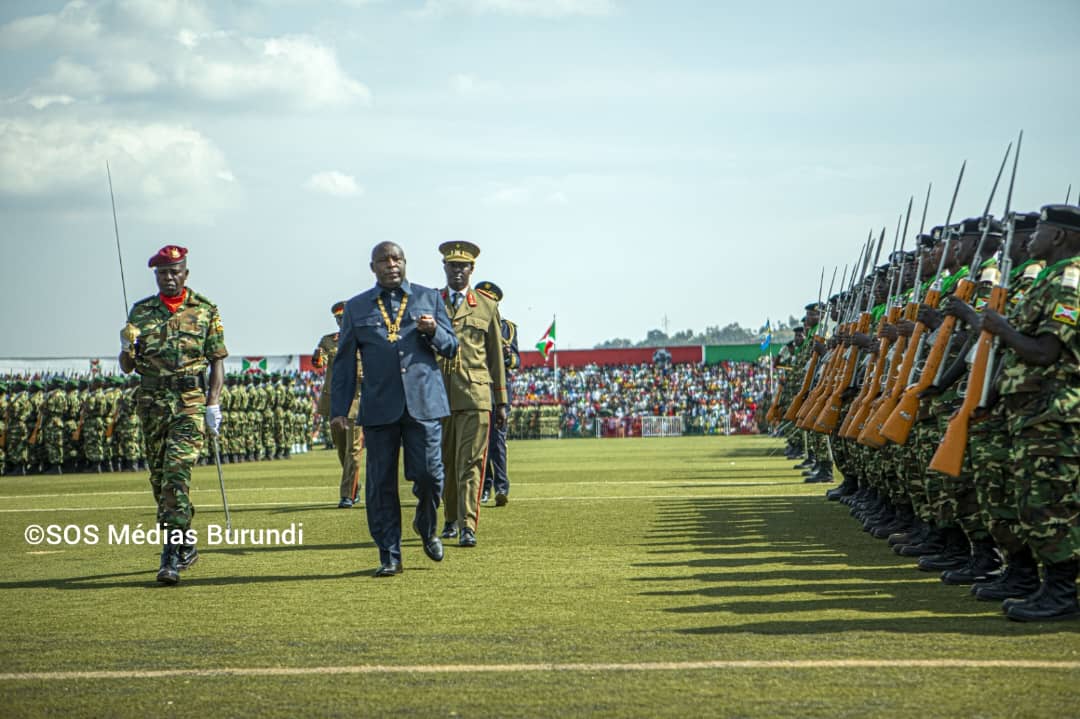
How is the Burundian army, long renowned for its bravery, in decline in North Kivu?
The Burundian army was reformed in 2004, with a new name of the Burundi National Defense Force (FDNB) replacing the old army, Burundian Armed Forces (FAB), which had been created in the 1960s. The FDNB is the outcome of a long process of negotiations which resulted in the various ceasefire agreements which were reached after the Arusha Peace and Reconciliation Accords in Tanzania on August 28, 2000. This army is mainly composed of ex-FAB soldiers and soldiers from armed political parties and movements, the ex-PMPA. The latter being the CNDD-FDD, CNDD of Nyangoma, the FNL and its various branches: Icanzo, Agathon Rwasa, Gatayeri as well as the Florina. (Analysis by Bonfils Niyongere, journalist). INFO SOS Médias Burundi
Let us immediately point out a detail that is worth the detour: officials of the former regular army hid the punishment sheets of ex-FAB soldiers in the prison, thus causing the dismissal of thousands of combat-hardened ex-FAB soldiers.
Nevertheless, the heterogeneity of this new army did not prevent it from building and solidifying itself to demonstrate its bravery in Somalia in front of the Al Shabaab terrorists since 2007, only three years after its creation.
His professionalism was also noted in the Central African Republic in MISCA and after MINUSCA since 2013.
Despite the efforts of certain military officials deployed for the professionalization of the army, they came up against a divisionist policy of the CNDD-FDD which was always nourished during the rebellion mainly against the ex-FAB soldiers.
Between 2005 and 2010, there was the creation of Nonoka clubs for officers and another for non-commissioned officers, whose members are exclusively former CNDD-FDD, the former Hutu rebellion which became the presidential party in 2005 thanks to the Arusha agreement.
The impunity of serious crimes committed by army officials from the CNDD-FDD, such as Colonel Bangirinama’s case who commanded the fourth military region in Muyinga (north-eastern Burundi), has not been without effect.
From 2010 to 2015, the situation already portended disaster.
With the post-election crisis of 2010 and the assassination of members of opposition political parties including the FNL and the MSD parties, the ruling CNDD-FDD party shifted into high gear.
Seeing the defection of certain FNL officers such as Aloys Nzabampema who has since set up his rebellion in South Kivu (Eastern Congo), the government immediately felt threatened by the birth of a rebellion.
He then proceeded to train his youth into a parallel army whose crimes prompted the United Nations to label it a militia. One of the chapters of its history is the paramilitary formation of the Imbonerakure in the Rusizi plain, in Kiliba Ondes in the Democratic Republic of Congo.
At the end of this training, the Imbonerakure were established as untouchables with all-risk insurance.
They could even arrogate to themselves the right to attack and manhandle soldiers and police officers without fear of being prosecuted.
Let us cite a few cases: Kanyosha and Gihosha in Bujumbura, the economic capital, as well as in Kirundo (north).
The Imbonerakure perpetrators of these acts have never been worried.
Kiliba’s paramilitary formation created monsters like the famous Rukoti gangs in Bujumbura town hall and in the Mugongo Manga, Rusaka and Gisozi communes, respectively in Bujumbura and Mwaro provinces (central-west).
In addition to these young people from the ruling party, soldiers from the CNDD-FDD also distinguished themselves in acts of barbarity where we saw them mistreating or even killing their ex-FAB brothers in arms.
This was the case in Karusi (central-east), an officer named Wakwanza killed a company non-commissioned officer of the rank of first sergeant major native of Ryarusera in Muramvya (center).
Officer Wakwanza was never prosecuted.
Achievements passed over in silence
Despite the efforts and sacrifice of Burundian soldiers, the CNDD-FDD regime has never paid the honors that the Burundian soldiers who fell on the battlefield on a peacekeeping mission, deserved.
Like Major General Juvénal Niyoyunguruza, Brigadier General Salum Ndikumana, Colonel Nayubu, their doctor as well as hundreds of Burundian soldiers killed in Somalia from 2015 to 2020.
Demonstrations and failed military coup, repressed in blood
Protests against another controversial mandate of the late President Nkurunziza have been suppressed with disproportionate force. Demonstrations which, however, were peaceful.
The failed putsch of May 13 also revealed the failed merger of the Burundian army even though it was considered by some observers to be professional.
After this failed coup, some officers were arrested with their subordinates, others went into exile.
Soldiers were victims of enforced disappearances after being kidnapped by agents of the National Intelligence Service and others killed by the infamous Colonel Darius Ikurakure and his henchmen like First Sergeant Major Ndayishimiye and many others.
General officers and colonels were killed in broad daylight without follow-up and without the courts investigating.
This was the case with the assassination of General Adolphe Nshimirimana, General Athanase Kararuza and even retired colonels Jean Bikomagu and Rufyiri.
Exceptionally, the death of General Adolphe Nshimirimana seemed to shake the regime and received Nkurunziza’s honore of a press release to the nation.
During his third term, Nkurunziza played a lot on the ethnic rope to maintain his base and break the unity which had nevertheless characterized the demonstrations and the failed putsch.
The rot in the army was palpable, but it owes a great debt to the dedication of its soldiers and to peacekeeping missions abroad, mainly in Somalia in the AMISOM contingent.
From 2020 to now
The army is beginning to sense the end of the peacekeeping mission in Somalia with the gradual reduction of its troops and the change in the name of the mission from AMISOM to ATMIS.
In the meantime, deep dissatisfaction is observed among soldiers who return from the mission, since they can return empty-handed after a whole year of service, or even more, without their compensation having been paid into their account.
In 2023, President Ndayishimiye revised upwards the salaries of military personnel, all categories combined.
An action which aroused a feeling of satisfaction among the latter, but this feeling will only last as long as the dew with the high cost of living and missions in North Kivu to fight the M23 movement for the benefit of personal agreements between Tshisekedi and Ndayishimiye.
Burundian soldiers are falling like flies on the battlefield and some are taken hostage by the M23 rebels.
How can we explain this decadence of the Burundian army which, however, was considered brave and professional?
First the mission is secret
Some soldiers sent to Congo do not recognize each other because they are grouped in different divisions.
In addition, they will fight alongside the FARDC (Armed Forces of the Democratic Republic of Congo) with the Congolese outfit and the Interahamwe FDLR and Wazalendo militiamen (local militias backed by the Congolese authorities).
The FARDC, FDLR and Wazalendo are better equipped than them and when they go to fight the M23 movement, there is no cohesion and interoperability of the forces. As a result, the soldiers on mission feel betrayed.
A betrayal first of all for having been sent without a moral discussion briefing, and a betrayal for finding themselves in the Congolese FARDC uniform which is also worn by the FDLR and Wazalendo.
A betrayal also due to the fact that neither the government nor the Burundian army assume their presence in North Kivu despite the dead, the wounded and the captives and the missing, proving the extremely secret nature of this mission.
Those who refused to fight the M23 are currently undergoing inhumane treatment in jails in Burundi.
But the consequences of the destruction of this army composed, today, of discontented and frustrated individuals will not spare its leaders who today believe themselves to be overpowering.
It’s just a matter of time.
You might also like

Ituri: Ugandan-ADF rebels kill two civilians in Mayalibo
The Mayalibo village, about 1km on the national road N° 4 in the Bandavilemba groupment, Walese-Vontuku chiefdom, Ituri province, Eastern DRC was targeted by an attack in the Wednesday –
Makamba : taxi drivers on strike against untimely police fines
Drivers of so-called probox transport vehicles have been on strike since Monday. They are protesting against untimely fines imposed on them. They are either accused of improper loading or exceeding
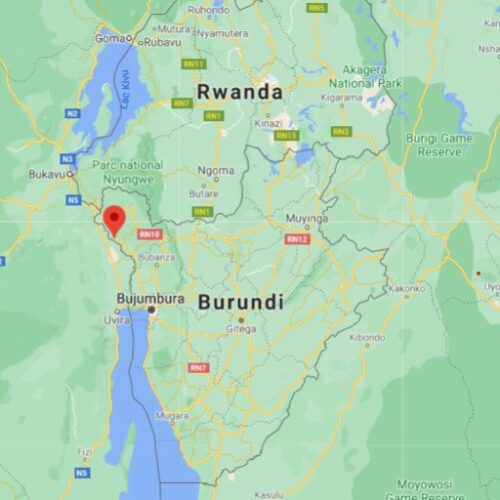

Rugombo: three bodies found in less than a week
The resurgence of murder cases on the hills of the commune of Rugombo, in the province of Cibitoke (north-west of Burundi) spark worries among the population. Three bodies were found