North Kivu (DRC): displaced journalists try to meet challenges of difficult working conditions
Since war broke out in the eastern Democratic Republic of Congo, many journalists fled as regions behind were falling under the control of M23 rebels, and a number of radio stations closing following insecurity in the areas. These journalists took refuge in various displaced sites in Goma and were trained on media coverage of humanitarian activities in an emergency context.This training was held by the United Nations High Commissioner for Refugees (UNHCR) on Wednesday and Thursday, last week. INFO SOS Médias Burundi
Most of the involved journalists worked for media outlets in Masisi and Rutshuru before leaving for Goma city, the capital of North Kivu in eastern Congo.
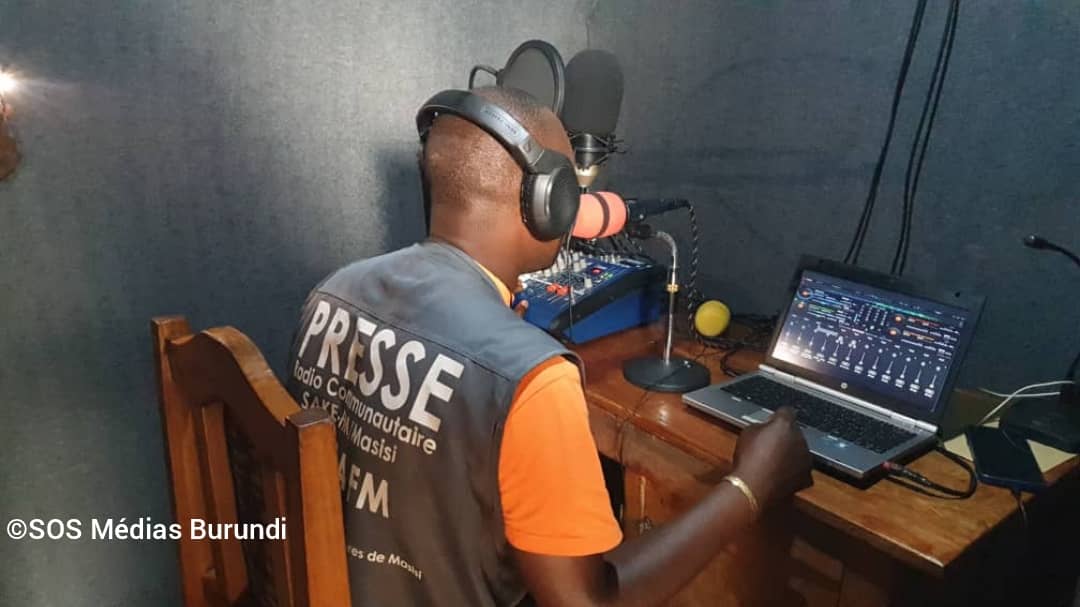
Ismaël Matungulu, Sake community radio director, in Masisi and his collaborators left with some of their radio equipment.
Today, that radio station operates in the Lushagala displaced persons camp, in the Mugunga district of Goma.
The radio’s journey to Goma was long and difficult.
“We fled with some of our equipment from Masisi up to here in Goma. The journey was not easy as some equipment got stolen by rebel groups. We saw fit to install our radio here in the displaced person site,” said Ismaël Matungulu.
He noted that despite the fact that all radio programs are running, “one of the challenges we face is the lack of resources.”
Like many other journalists, Ismaël Matungulu and his colleagues worry about the sustainability of their work.
“We are asking different organizations to help us so we can keep on operating in this context of crisis.”
UNHCR tries to supervise journalists
It is in this context that several displaced journalists participated in a training session on media coverage of humanitarian activities in an emergency context.
Abdoulaye Barry, head of UNHCR office in North Kivu, expressed compassion for the displaced journalists and underlined UNHCR’s continued commitment to supporting these media professionals.
“UNHCR therefore reiterates its continued commitment to helping the synergy of displaced journalists,” he said.
For her part, Rosalie Zawadi, president of the National Press Union of Congo (UNPC), North Kivu section, encouraged displaced journalists to become more professional.
She insisted on the importance of continuing to train to improve the quality of their work in complex and dangerous situations.
You might also like

North Kivu: OCHA calls for civilians to be spared during fighting
The UN Office for the Coordination of Humanitarian Affairs issued a statement, last weekend, on the humanitarian situation in North Kivu (eastern DRC). It depicts a situation of the population
: displaced journalists try to meet challenges of difficult working conditions)
2023, a nightmarish year for Burundian refugees living in camps
From the assassination in Kenya and Malawi to a possible end to refugee status in Tanzania, including a considerable reduction in assistance in Rwanda, the SOS Médias Burundi microphone went
Nyarugusu (Tanzania): ban on animal husbandry in the camp, a new binding measure for refugees
The Nyarugusu camp administration has banned all animal husbandry. All cattle and small stock must be sold or driven out of camp. Farmers complain. INFO SOS Médias Burundi At the