Bonesha FM on the verge of financial asphyxiation : 500 million Burundian francs needed to avoid further disappearance
SOS Médias Burundi
Bujumbura, November 3, 2026 —After being silenced for almost six years following the political crisis of 2015, the independent radio station Bonesha FM faces a new threat : financial asphyxiation. Its director, Léon Masengo, launched a 45-day fundraising campaign, with a goal of 500 million Burundian francs. This call for solidarity raises signs of support, but also questions about the management of contributions and the prospects for survival of the media.
Bonesha FM is in difficulty and its management no longer hides its concerns. To prevent financial problems from further compromising its activities, the radio is turning to its listeners, its former collaborators, its partners and the entire community.
The official launch of the campaign took place on Friday October 30. On this occasion, Léon Masengo announced that the radio had 45 days to mobilize the 500 million Burundian francs sought.
The call is addressed to citizens, organizations, embassies, partners, the diaspora and friends of the station. Everyone is invited to make a financial contribution or other support likely to enable the radio to continue its activities.
According to its director, Bonesha FM plays an important role in informing the public, promoting citizen debate and broadcasting programs of community interest. But the economic difficulties it faces are now weighing on its ability to regularly ensure its broadcasts and operate its services.
For Léon Masengo, this collection goes beyond the sole question of financing a media outlet. It constitutes a collective commitment in favor of the right to information and the maintenance of an independent media space.
“A radio station that informs needs a community that supports it,” he said.
The director also promises to communicate transparently on the amounts collected and their use. A significant commitment, even though the amount sought is considerable and the trust of the contributors will be decisive for the success of the operation.
From Radio Umwizero to Bonesha FM, a history marked by crises
The appeal currently launched takes on a particular dimension in view of the history of this station.
Bonesha FM was established on February 19, 1996 under the name Radio Umwizero, which means “Hope” in Kirundi, the national language of Burundi. At its beginnings, in Burundi deeply marked by the political and security crisis, the radio had the particular ambition of contributing to dialogue, reconciliation and peace. The project benefited from the support of the Association for Humanitarian Action (AAH) and international partners.
On January 29, 2001, Radio Umwizero changed its name to Radio Sans Frontières Bonesha FM. Over the years, it has established itself in the Burundian media landscape thanks to its information broadcasts, debates and awareness programs.
But its journey was brutally interrupted by the political crisis of 2015, triggered by the decision of the late President Pierre Nkurunziza to run for a controversial third term, deemed contrary to the Constitution and the Arusha Agreement by his opponents.
Signed on August 28, 2000 in Tanzania, the Arusha Agreement for Peace and Reconciliation constituted a major step in the search for an end to a decade of civil war in Burundi, a conflict which left more than 300,000 dead, according to the United Nations. In particular, he had established a framework for sharing power between the main political and ethnic components of the country and opened the way for a period of transition.
The agreement also helped lay the foundations of the new political order which allowed, after the conclusion of subsequent ceasefire agreements, the integration of the former Hutu rebellion of the National Council for the Defense of Democracy – Forces for the Defense of Democracy (CNDD-FDD) into the institutions. Transformed into a political party, the movement won the 2005 elections and its leader, Pierre Nkurunziza, became President of the Republic.
On May 14, 2015, the day after the attempted coup against Pierre Nkurunziza, men in police and army uniforms burst into the radio’s premises while it was broadcasting live. The facilities were ransacked and the equipment destroyed. Like several other Burundian media, Bonesha FM was then forced to stop broadcasting.
The station was silent for 2,115 days. It returned to the airwaves on February 26, 2021, after almost six years of interruption.
On the occasion of this resumption, Léon Masengo had already mentioned the extent of the reconstruction plan, including equipment and personnel requirements. The return to the air was an important step, but did not yet allow the radio to immediately regain all of its previous capabilities.
Five years after this reopening, Bonesha FM finds itself faced with another test. This time, it is not destroyed equipment which prevents its operation, but financial difficulties which threaten the continuity of its activities.
A call for solidarity which also gives rise to reservations
The decision to make Bonesha FM’s financial difficulties public does not leave the public opinion indifferent.
Some observers salute the courage of its director, believing that he had the merit of bringing into the public arena a reality often overlooked : the economic precariousness of independent media in Burundi. For them, publicly recognizing the difficulties of an editorial team also constitutes a way of warning of the threats weighing on the freedom to inform.
Others believe that such an approach could have taken more discreet routes. According to them, management could have favored negotiations with financial partners, without publicly exposing the radio’s internal difficulties.
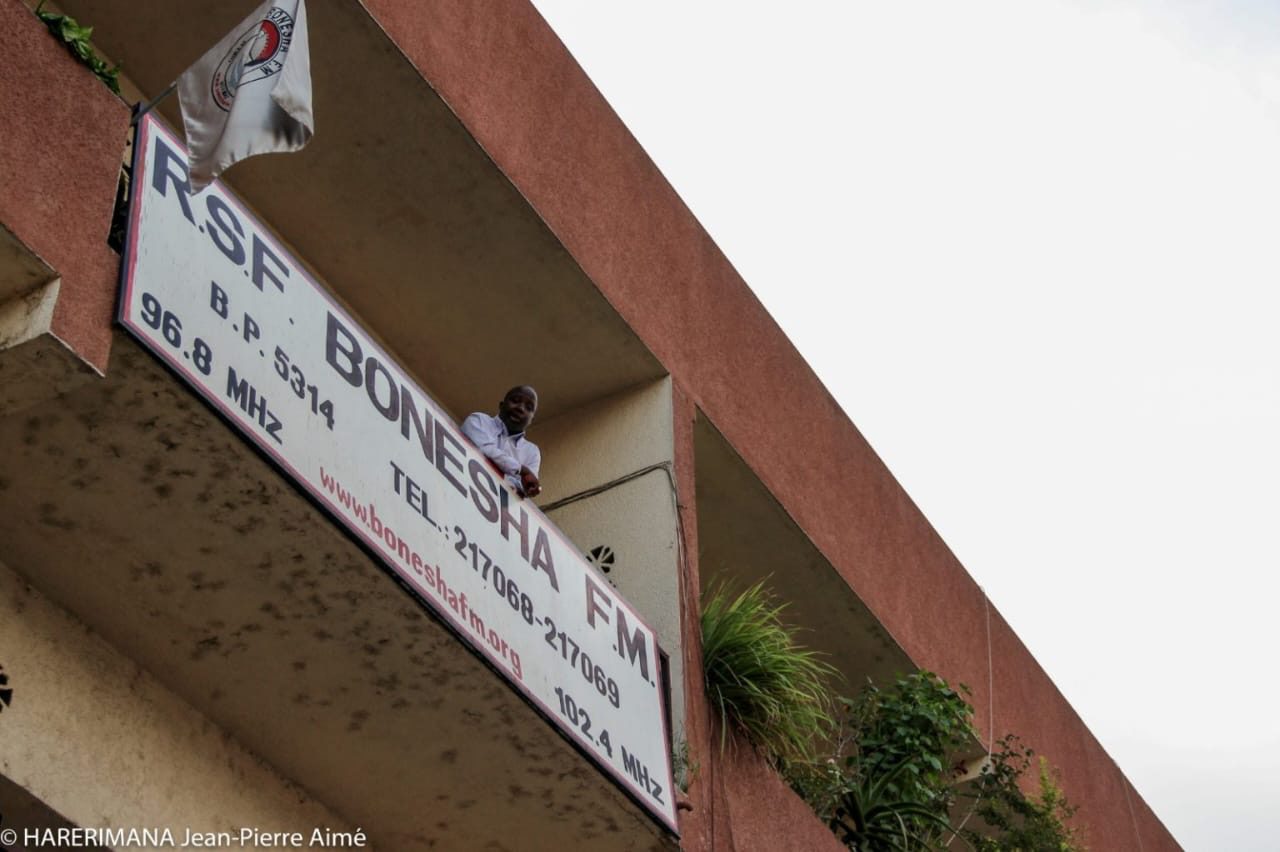
The balcony of the premises of the independent radio station Bonesha FM, in Bujumbura, where its director, Léon Masengo, and his collaborators resumed their activities when the station reopened on February 26, 2021, after almost six years of silence. Five years later, the radio launched a campaign to collect 500 million Burundian francs to avoid a further interruption of its activities (Jean-Pierre Aimée Harerimana via SOS Médias Burundi)
There are also concerns about the possible consequences of this announcement for the future of Bonesha FM. Some fear that the media coverage of its financial situation will expose it to new vulnerabilities.
The management of the expected funds constitutes another source of questions. Contributors will want to know how the sums will be recorded, who will control them and what mechanisms will verify their actual use.
The promise of transparency made by Léon Masengo must therefore be translated into concrete and regularly accessible information. For a campaign of this magnitude, confidence cannot be based solely on a call for solidarity.
Economic survival, another challenge for the Burundian press
Bonesha FM’s difficulties go beyond the case of a single radio station. They highlight the economic fragility of part of the Burundian media landscape.
Private media must contend with limited financial resources, a restricted advertising market and difficulties in obtaining sustainable financing. These constraints affect their ability to pay journalists, renew equipment and maintain regular content production.
Added to these economic difficulties are the consequences of the political crisis of 2015, which deeply disrupted the sector. Media outlets had been destroyed or suspended and many journalists had gone into exile. The reopening of certain editorial offices has not erased the difficulties inherited from this period.
In its 2026 world press freedom rankings, published on April 30, Reporters Without Borders (RSF) places Burundi 119th out of 180 countries, compared to 125th place in 2025, an increase of six positions.
This improvement in the ranking does not mean that all obstacles to practicing journalism have disappeared. RSF continues to identify difficulties linked to the political environment, the safety of journalists and the economic conditions in which the media operate.
Burundi’s economic indicator is in 95th position out of 180 countries. It refers in particular to the difficulties of financial viability of press companies and their capacity to preserve their economic independence.
The story of Bonesha FM thus illustrates different challenges that an independent media outlet can face : the destruction of its facilities, an interruption of several years and, today, the difficulty of gathering the resources necessary for its survival.
The 500 million Burundian franc campaign will therefore be an important test for the station. Its outcome will depend on the mobilization of contributors, but also on the ability of its management to guarantee transparent management and present sustainable perspectives for the media.
After surviving almost six years of silence, Bonesha FM is once again playing for its future. It remains to be seen whether solidarity will prevent it from disappearing again and whether the Burundian media sector will be able to find lasting solutions to its financial precariousness.
……….
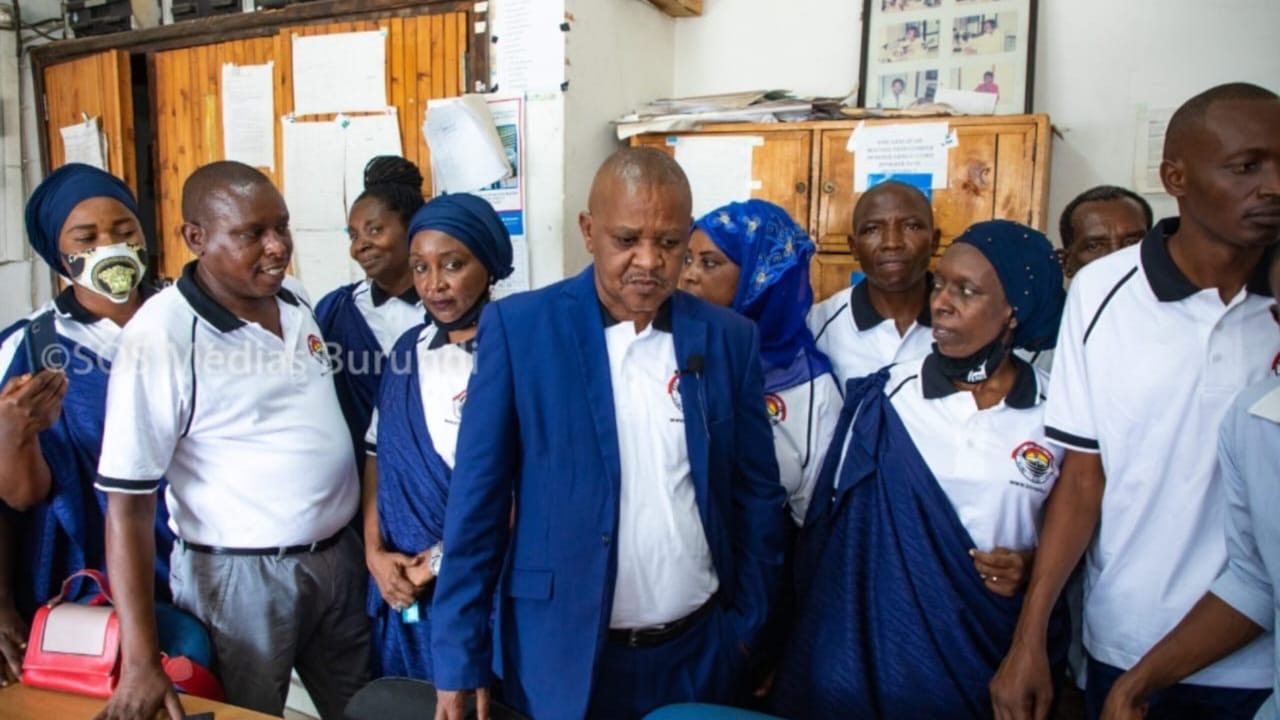
Léon Masengo, director of Bonesha FM radio, surrounded by his collaborators during the reopening of the station in 2021 (SOS Médias Burundi)
You might also like
Bujumbura : the National Communication Council temporarily suspends Yaga Burundi
The National Communication Council (CNC), Burundi’s media regulatory body, announced on Thursday the temporary suspension of the Yaga Burundi coalition, known for its media productions and critical content on the

Bujumbura : journalist Willy Kwizera appears before the prosecutor’s office, but his perpetrators remain at large
SOS Médias Burundi | Bujumbura, July 3, 2025 Journalist Willy Kwizera, of Radio Bonesha FM, appeared on Thursday before the Mukaza prosecutor’s office in Bujumbura, the commercial capital of Burundi,

Bubanza : Regideso’s open manholes become “gravelands” for passersby
SOS Médias Burundi Bubanza, August 13, 2026 — Several manholes belonging to the Water and Electricity Production and Distribution Authority (Regideso), located on public roads in the center of Bubanza,