Twenty-nine years after his assassination, the shadow of Bishop Joachim Ruhuna still hangs over Burundi
SOS Médias Burundi
Gitega, September 10, 2025 — Twenty-nine years after the assassination of Bishop Joachim Ruhuna, former Archbishop of Gitega, his relatives continue to demand justice. The prelate was killed on September 9, 1996, on the Mubarazi River, while returning from a mission at the Burasira Major Seminary, passing through the parish of Gitongo. Two other people, including a Catholic nun, were killed in the same vehicle. At that time, several areas of Gitega province (central Burundi)—including Bugendana, Mutaho, and Gihogazi (formerly Karusi province, currently incorporated into Gitega under the new administrative divisions)—were under the control of rebels from the FDD (Forces for the Defense of Democracy), which later became the CNDD-FDD, the former Hutu rebel group that had ruled Burundi since 2005 thanks to the Arusha Peace and Reconciliation Agreement signed in Tanzania in August 2000.
A few weeks before his assassination on July 23, 1996, Bishop Ruhuna had publicly called the rebels responsible for the massacre of 648 Tutsis in a camp for displaced persons in Bugendana, an attack attributed to the FDD, “cursed.” These victims had fled the killings that followed the assassination of the first democratically elected Hutu president, Melchior Ndadaye, in October 1993.
In the aftermath, Bishop Bernard Bududira, then president of the Burundi Catholic Bishops’ Conference, openly accused the FDD of being responsible for the archbishop’s death.
The voice of a witness to history
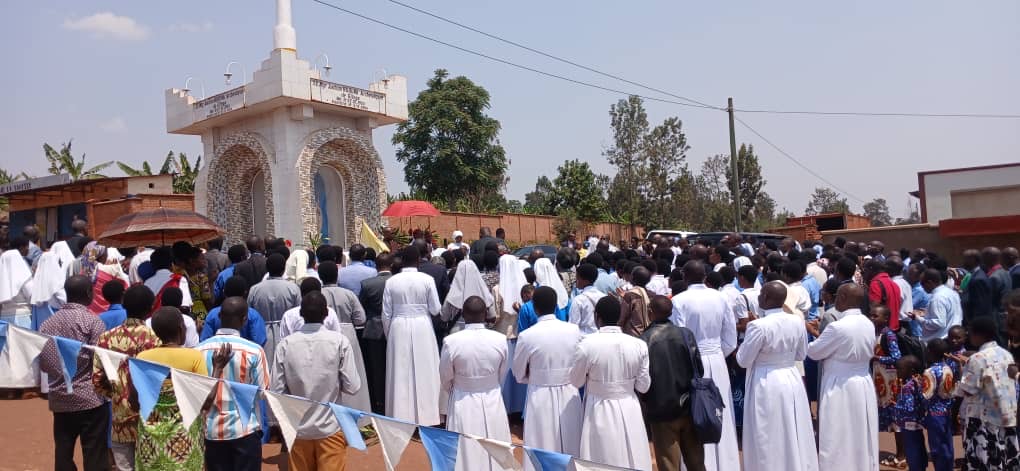
During his homily on Tuesday at Christ Roi Cathedral in Mushasha, Bishop Simon Ntamwana, Archbishop Emeritus of Gitega, strongly denounced “the shame of the massacres that Burundi has experienced.” He recalled the assassinations of religious figures—Archbishop Gabriel Gihimbare in 1965, Archbishop Joachim Ruhuna in 1996, and Archbishop Michael Courtney, Apostolic Nuncio to Burundi, in 2003—as well as the large-scale massacres of 1972, 1988 in Ntega and Marangara in northern Burundi, and 1993.
While calling on the faithful to embrace love, unity, forgiveness, and reconciliation, Archbishop Ntamwana expressed deep shock at “the massive human rights violations in Burundi and the obstacles to freedom of expression.” “Does Burundi belong to humans, or to savage elements, or to those who shout insults from the villages over banana plantations?” he asked, visibly indignant.
A living legacy
For many, Bishop Ruhuna remains an unforgettable figure. At the height of the 1993 crisis, he opened the doors of the Archdiocese of Gitega to protect Hutu intellectuals and businessmen threatened by Tutsi militias. His loved ones still demand today that full light be shed on his assassination and that the perpetrators finally be held accountable for their actions before the courts.
“We are not asking for revenge, but for truth and justice, so that our country can finally move towards lasting peace,” confided a member of the faithful we met at the end of the commemorative mass – a prayer that resonates like an echo of Burundi’s still-open wounds.
You might also like
In Gitega, Ndayishimiye warns Kigali as its army retreats in eastern DRC
SOS Médias Burundi Gitega, December 22, 2025 — As the Burundian army retreats from South Kivu after heavy defeats at the hands of the M23, President Évariste Ndayishimiye issued a
Rugombo: a fuel trafficker killed in Rusizi
Richard Dusabe’s body was collected in the Rusizi River on Thursday at the Mparambo 2 hill in Rugombo commune in Cibitoke province (north-west of Burundi). The suspect of the murder

Burundi: refugee fighters accused of terrorizing civilians in Bujumbura border province
SOS Médias Burundi Bujumbura, January 22, 2026 – In December 2025, Burundian soldiers, accompanied by elements of the Armed Forces of the Democratic Republic of Congo (FARDC), Kinshasa-backed Wazalendo militias,