Monsignor Joachim Ruhuna : 30 years after his assassination, his family still seeks justice
SOS Médias Burundi
Gitega, September 10, 2026 — Thirty years after the assassination of Monsignor Joachim Ruhuna, the former Archbishop of Gitega in central Burundi, his family continues to demand that the perpetrators be identified and brought to justice. The prelate was killed on September 9, 1996, in an ambush near the Mubarazi River while returning from the Burasira major seminary in the north of the country. To date, no verdict has been reached in the case.
Testimony from Msgr. Ntamwana
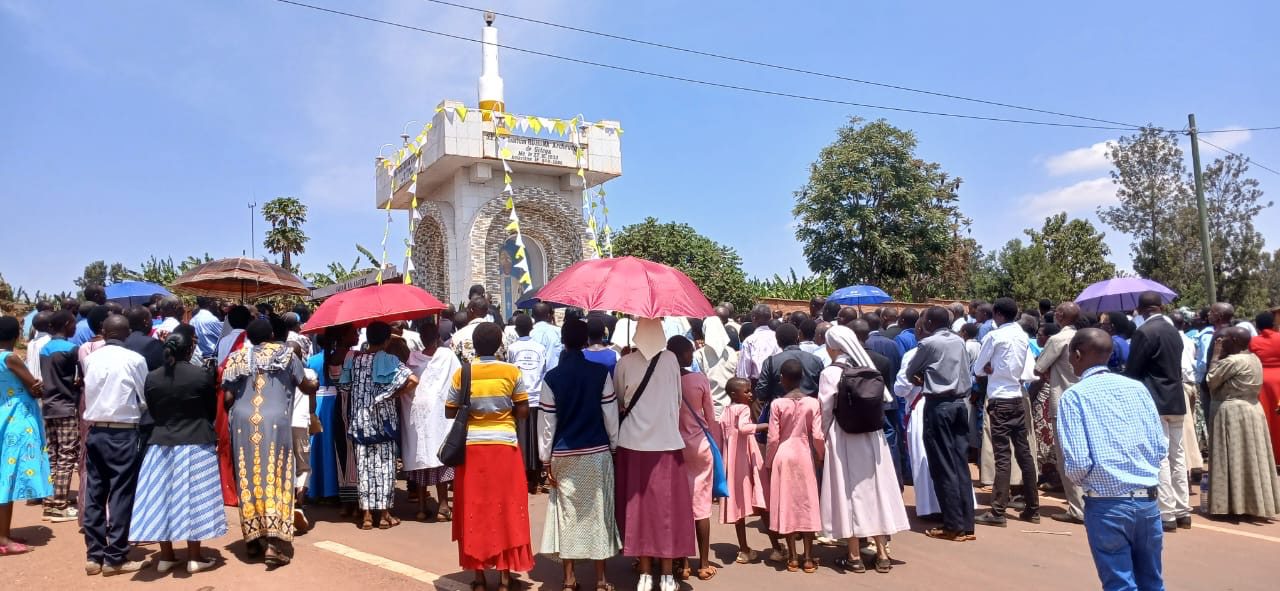
Marking the 30th anniversary of his predecessor’s death, Msgr. Simon Ntamwana, Archbishop Emeritus of Gitega, reflected on the circumstances of the killing. In a homily delivered on Wednesday at Christ the King Cathedral in Mushasha—located in Burundi’s political capital—he spoke specifically about what happened to Msgr. Ruhuna’s body following the assassination.
“Msgr. Joachim Ruhuna was brutally killed amidst total humiliation. His body had been hidden in the Mwumbu Valley and was discovered a week after his assassination,” Msgr. Ntamwana recounted.
Discussing possible motives for the murder, the former Archbishop of Gitega also pointed to a public stance Msgr. Ruhuna had taken just weeks before his death, following the massacre of 648 Tutsis at the Bugendana displacement camp.
“Indeed, one of the motives was the speech he delivered at the burial of the 648 Tutsis from the Bugendana displacement camp,” he stated. An ambush near the Mubarazi
On September 9, 1996, Archbishop Joachim Ruhuna was returning from the major seminary in Burasira, in the north of the country. After passing through the parish of Gitongo, he was ambushed near the Mubarazi River, between the communes of Mutaho and Bugendana in what is now Gitega Province.
Two other people in the same vehicle, including a Catholic nun, were also killed.
At the time, Bugendana and Mutaho—in present-day Gitega Province—as well as Gihogazi (in the former Karusi Province), were under the control of FDD rebels (Forces for the Defence of Democracy).
Archbishop Ruhuna’s body was subsequently hidden in the Mwumbu Valley. According to Archbishop Ntamwana, it was not found until a week after his assassination.
A voice denouncing the massacres
A few weeks before his assassination, Archbishop Ruhuna had publicly condemned the massacre committed in Bugendana against Tutsis who had taken refuge at a displacement site.
On July 23, 1996, the prelate had branded as “cursed” the rebels accused of massacring 648 Tutsis at that site. The attack had been attributed to the FDD.
The victims had fled the violence that followed the assassination of Melchior Ndadaye—Burundi’s first democratically elected Hutu president—in October 1993.
A few months after the prelate’s assassination, Archbishop Bernard Bududira, then president of the Burundi Catholic Bishops’ Conference, openly accused the FDD of responsibility for his death.
A war-torn Burundi
Archbishop Ruhuna’s assassination occurred during one of the bloodiest periods in Burundi’s history. Following the assassination of Melchior Ndadaye in October 1993, the country plunged into a civil war pitting government forces against several predominantly Hutu rebel movements. The violence led to massacres of Tutsi civilians, massive population displacements, and a deep rift between Hutus and Tutsis.
The FDD, the armed wing of the CNDD, was then one of the main rebel movements active in the country. It would later become the CNDD-FDD, a former Hutu-dominated rebellion that became the ruling party in Burundi in 2005, following the peace process stemming from the Arusha Agreement, signed in August 2000 in Tanzania.
In this context, Archbishop Ruhuna emerged as a religious figure committed to peace, the protection of civilians, and reconciliation.
An archbishopric that became a refuge
At the height of the 1993 crisis, the Archbishopric of Gitega notably served as a refuge for Hutu intellectuals and businesspeople threatened by the violence.
Those who benefited from this protection have testified over the years to their gratitude towards the prelate. This attitude contributed to making Archbishop Ruhuna a respected figure, transcending the divisions that were then tearing Burundian society apart.
His commitment to protecting those under threat was part of a broader approach to peace, unity, and reconciliation.
A memory that lives on
Thirty years after his death, Bishop Joachim Ruhuna remains associated with the values of peace, unity, forgiveness, and reconciliation.
During ceremonies held in his memory, Catholic Church leaders regularly recall his commitment to peace and the protection of those under threat.
Bishop Simon Ntamwana also denounced the massacres that have marked Burundi’s recent history, particularly the assassinations of several religious figures and the violence perpetrated against civilians. He called on Burundians to prioritize love, unity, forgiveness, peaceful coexistence, and reconciliation.
Thirty years without justice
Since September 9, 1996, no judgment has been rendered against those responsible for the assassination of Bishop Joachim Ruhuna. For three decades, his family has been demanding that those responsible be identified and brought to justice.
The case remains marked by the absence of a definitive legal response. Testimonies gathered over the years have helped to document the context in which the prelate was killed, but the legal truth about those who ordered and carried out the assassination is still awaited.
Thirty years later, Bishop Simon Ntamwana’s testimony revives a question that has remained unanswered: who killed Bishop Joachim Ruhuna, why was he targeted, and why has no justice system yet established responsibility for his assassination?
For his family and many Catholic faithful, the passage of time must not diminish this demand for truth and justice.
You might also like
A man found dead in Ngozi : gray areas surrounding a possible murder
SOS Médias Burundi Ngozi, July 11, 2025 – The Kigarama neighborhood, in Ngozi district in Butanyerera province (northern Burundi), woke up to shock on Thursday, July 10. The lifeless body
Bukavu : journalist Honneur David Safari missing
SOS Médias Burundi Bukavu, December 29, 2025 — Journalist Honneur David Safari, editor-in-chief and founder of the media outlet La Prunelle RDC, has been missing since the evening of Saturday,

Nakivale (Uganda) : refugees arrested amid electoral tensions
SOS Médias Burundi Nakivale, January 21, 2026 – The recent presidential and legislative elections in Uganda have had direct repercussions in several refugee camps, particularly in Nakivale, one of the