
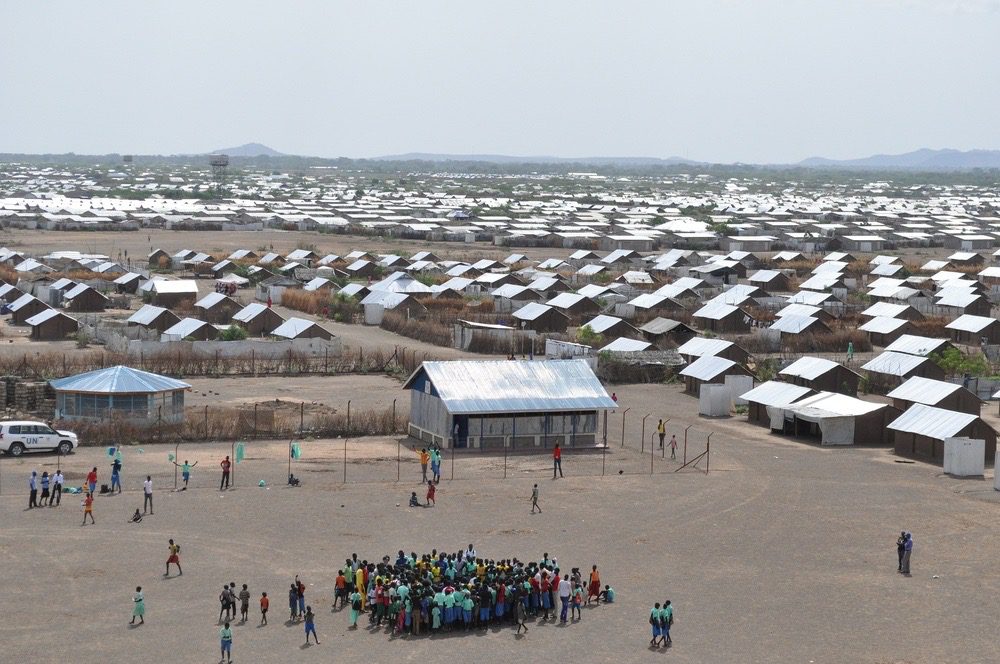
Kakuma : Burundian refugees caught between trade restrictions and security fears
SOS Médias Burundi
Kakuma, September 12, 2026—Anxiety is growing among Burundian refugees in the Kakuma camp in northwestern Kenya. Many of them rely on small businesses and informal work, and they fear that the Kenyan authorities’ new policies toward foreigners will further jeopardize their livelihoods and fuel tensions with host communities.
In the camp and its surroundings, many refugees engage in small-scale activities to support themselves. Some run street vending machines or small shops, while others work as motorcycle taxi riders, construction workers, laborers, or domestic workers.
For many, these activities are a vital source of income and help reduce their dependence on humanitarian aid.
“We fear that the frustrations caused by these speeches will ultimately backfire on us,” some refugees confided, particularly fearing attacks on their businesses and property.
Concerns that go beyond trade
Beyond their income, some refugees also fear for their safety. They worry that economic frustrations and tensions surrounding employment and small businesses could escalate into harassment or clashes with some local populations.
The situation is more sensitive as Kenya, through the Shirika Plan, seeks to gradually transform the Kakuma model and its extension, Kalobeyei, by promoting the socio-economic inclusion of refugees and their coexistence with host communities. The plan notably aims to strengthen access to public services, infrastructure, and economic opportunities.
A joint mission of 14 United Nations agencies visited Kakuma and Kalobeyei from September 2 to 4. It particularly emphasized sustainable livelihoods, inclusive public services, and social cohesion between refugees and host communities.
For some refugees, this desire for integration contrasts sharply with concerns raised by the new rhetoric surrounding foreigners’ business activities.
Refugees caught between precariousness and uncertainty
Several refugees who had left Kakuma to try their luck in Nairobi, the Kenyan capital, are now beginning to consider returning to the camp. Some say they have left their possessions and livelihoods behind, uncertain about their economic future.
In Nairobi, where many Burundians also live and work, the recent announcements have caused considerable anxiety. Hundreds of Burundian nationals have gone to their embassy in recent days to request travel documents. Some say they fear for their safety and are considering returning to Burundi.
Burundians are present in several sectors of the informal economy, including construction, beauty salons, small businesses, food service, street vending, security, domestic work, and motorcycle or tricycle transport, commonly known as Bajaj. Some also run their own small businesses and employ other Burundian nationals.
For the refugees in Kakuma, the risk is that this situation will also affect their opportunities to work and trade in and around the camp.
They are calling on the UNHCR, the UN Refugee Agency, to increase its focus on their safety and take preventative measures to avoid escalating tensions.
They are asking for the right to work legally.
The refugees do not reject the principle of respecting the Kenyan law. Rather, they are asking the authorities to take into account their specific circumstances and limited resources.
“We want to work legally and contribute to the economy.” “But we must also take into account our situation as refugees,” several of them summarized.
They therefore advocate for mechanisms that would allow them to legally participate in the local economy, without being excluded from small businesses because of their status or difficulties in obtaining the required documents.
For them, the issue goes beyond mere commerce. It also concerns their economic independence, their safety, and their ability to coexist with host communities.
Ruto’s speech sparked the concern.
These fears stem from statements made by Kenyan President William Ruto. On September 2, he ordered the closure of small businesses operated by foreigners, arguing that these businesses should not compete with Kenyan merchants. The directive was initially scheduled to take effect on September 7.
The announcement sparked considerable anxiety among foreign communities, particularly Burundians. Some feared the immediate closure of their businesses, while others began considering returning to their country.
Faced with the panic triggered by this announcement, the Kenyan government subsequently clarified its position. Authorities indicated that foreigners legally residing in Kenya and authorized to work or conduct business would not be systematically excluded.
The government granted foreigners engaged in business activities 90 days to regularize their status, particularly regarding immigration, work permits, business registration, and trading licenses. After this period, legal requirements will be more strictly enforced.
The authorities also assured that they would not tolerate threats, harassment, or xenophobic violence against foreign nationals. The government presented this 90-day period as an opportunity for undocumented individuals to regularize their status.
Despite these assurances, concern remains high among Burundians. In Nairobi as well as in Kakuma, many fear that the debate surrounding the protection of Kenyan small traders will translate, on the ground, into increased pressure on foreigners.
Kenya hosts approximately 16,000 Burundian refugees and asylum seekers, according to data cited by the UNHCR. Some of them depend on small businesses for their livelihoods.
In Kakuma and its extension, Kalobeyei, where refugees and host communities are being encouraged to share economic opportunities more closely under new integration policies, the main fear now is that trade restrictions and tensions surrounding the foreign presence will undermine this coexistence.
For Burundian refugees, the challenge is twofold : to continue earning a living legally and to remain safe in a context where political rhetoric regarding the economic activities of foreigners has hardened.
You might also like
Kinama: a new laboratory – hope for refugees and host community
The health center of the Kinama refugee camp in northeastern Burundi recently benefited from a modern laboratory, built with the support of the International Diabetes Federation. This facility replaces an
Burundi : more than 20,000 refugees registered by ONPRA, humanitarian needs intensify
SOS Médias Burundi Bujumbura, December 12, 2025 – Since last Saturday, Burundi has been facing an exceptional influx of refugees from eastern Democratic Republic of Congo (DRC), fleeing the violence

“Arm the FARDC!” : Uvira paralyzed by a day of anger against deteriorating security
SOS Médias Burundi Uvira, August 5, 2026 – The city of Uvira, in South Kivu province, largely observed a “ghost town” day on Wednesday, called for by the Provincial Coordination