
Burundi : eleven parties with no electoral base declare support for Ndayishimiye
SOS Médias Burundi
Bujumbura, November 11, 2026 — Eleven Burundian political parties have officially announced their alignment with Évariste Ndayishimiye, the CNDD-FDD candidate for the 2027 presidential election. Having formed a support group, they have pledged to pool their human, financial, and technical resources to conduct a joint campaign, aiming for a victory in the first round. However, this alliance raises questions regarding the actual electoral weight of its members, none of whom secured a seat in the most recent legislative elections.
The announcement was made on Tuesday during a press briefing held at the Source du Nil Hotel in the commercial capital, Bujumbura. For the occasion, representatives from the eleven political groups mobilized their supporters, who arrived in large numbers, dressed in uniforms reflecting their respective party colors. The venue was packed, creating a festive atmosphere. Leaders of the various parties consulted with one another before taking their places to read their joint statement.
In their communiqué, the signatories justified their decision by citing actions attributed to President Évariste Ndayishimiye—specifically his efforts to combat corruption and economic malfeasance. They framed these initiatives as evidence of an upright administration dedicated to serving the population.
The eleven parties also commended his commitment to preserving territorial integrity and national sovereignty. According to them, the head of state has successfully defended Burundi’s political and economic independence against external pressures, while simultaneously ensuring the safety of citizens and the protection of their property.
Through this declaration, the political groups announced the formation of a coalition dedicated to providing full support for the incumbent president’s candidacy. They have pledged to pool their financial, technical, and human resources to conduct a joint election campaign and contribute to a victory in the first round.
The parties involved are RADEBU, KAZE-DD, INKINZO, PL, MPH, PIEBU, PRP, PMP, SANGWE-PADER, RPB, and FROLINA.
This announcement follows a meeting between the President of the Republic and the leaders of these eleven political groups. Afterward, Évariste Ndayishimiye expressed his gratitude via his X account, describing the initiative as a new milestone for Burundian democracy—one that prioritizes the public interest and the well-being of the population.
Following their statement to the press, representatives from the eleven parties visited the national headquarters of the CNDD-FDD that afternoon. They were welcomed by officials from the ruling party in a festive atmosphere, publicly signaling their political alignment with the ruling party.
Eleven parties whose electoral weight remains to be proven
This alignment raises questions, particularly given that none of these eleven groups secured a seat in the June 2025 legislative elections. Their lack of parliamentary representation stands in contrast to their stated ambitions to participate in a joint campaign and help secure a first-round victory.
Many of these parties have little visibility on the national political stage, and the extent of their support among the electorate remains difficult to gauge. While they have committed to pooling human, financial, and technical resources, there is currently no clarity regarding the actual assets at their disposal or their capacity to mobilize voters.
The motivations behind this alignment also invite further scrutiny. Beyond the arguments put forward in their joint statement, the leaders provided no further details regarding the practical arrangements for their collaboration.
Another notable point : after reading their statement, the representatives of the eleven parties declined to answer questions from journalists, leaving several issues unaddressed.
Presidential achievements that fall short of universal approval
The accomplishments that the eleven political groups attribute to Évariste Ndayishimiye are also far from being universally acknowledged. Since he took office in June 2020, Burundi has continued to face significant economic and social challenges. Recurring fuel shortages—which worsened in 2026—are paralyzing parts of the economy, disrupting transport, and contributing to a rising cost of living.
Despite some improvements in certain macroeconomic indicators, structural challenges persist. Inflation, low foreign currency reserves, supply shortages, and widespread poverty continue to weigh on households. According to World Bank data, Burundi’s GDP per capita in 2025 stood at approximately 234 dollars—the lowest in the world among countries for which comparable data is available.
Burundi’s military involvement in the eastern Democratic Republic of the Congo is another source of controversy. While the authorities in Gitega frame this intervention as a security necessity and an act of solidarity with Kinshasa, it is far from enjoying broad support among the Burundian public. Critics of the government denounce it as a costly war that has resulted in heavy human losses among Burundian soldiers; meanwhile, the authorities provide little information regarding the toll of these operations or the support provided to the families of those killed or wounded.
Some critics go so far as to accuse the government of having transformed the Burundian army into a mercenary force serving the interests of the Congolese government. The authorities reject this accusation, defending the presence of their troops on the grounds of national security and military cooperation between the two nations.
A ruling party that dominates without any real competition
This development takes place within a political landscape profoundly shaped by the dominance of the CNDD-FDD, which has been in power since 2005. Formerly a Hutu-dominated rebel movement, the party rose to power following the political process initiated by the Arusha Peace and Reconciliation Agreement, signed on August 28, 2000. That agreement laid the groundwork for power-sharing after a twelve-year civil war—which began in 1993 and, according to United Nations estimates, resulted in between 250,000 and 300,000 deaths.
However, the political space in Burundi has gradually narrowed, particularly following the 2015 crisis triggered by Pierre Nkurunziza’s bid for a third presidential term. Since then, according to several human rights organizations, restrictions on opposition figures, pressure on the media, and infringements on political freedoms have significantly undermined political pluralism.
In the legislative elections of June 5, 2025, the CNDD-FDD won all 100 directly elected seats in the National Assembly, securing 96.5% of the vote according to official results. The main opposition party, the CNL, was prevented from participating in the election. UPRONA, another historic political party, garnered only 1.38% of the vote. The CNDD-FDD also won 10 of the 13 seats in the Senate during the July 2025 elections.
This electoral dominance has been accompanied by a significant weakening of opposition forces and an absence of truly balanced political competition—a situation that has been denounced, notably by Human Rights Watch. In this context, the alignment of eleven small political groups with the ruling party’s candidate raises a further question : beyond the number of parties declaring their support, what room remains for genuine political competition in Burundi?
As the 2027 presidential election approaches, Évariste Ndayishimiye is preparing for the vote at the helm of a party that exerts broad control over state institutions, while facing a significantly weakened opposition. The alignment of eleven groups—none of which hold parliamentary representation—expands the list of his declared supporters, yet it does nothing to resolve questions regarding their actual electoral weight or the state of political pluralism.
…..
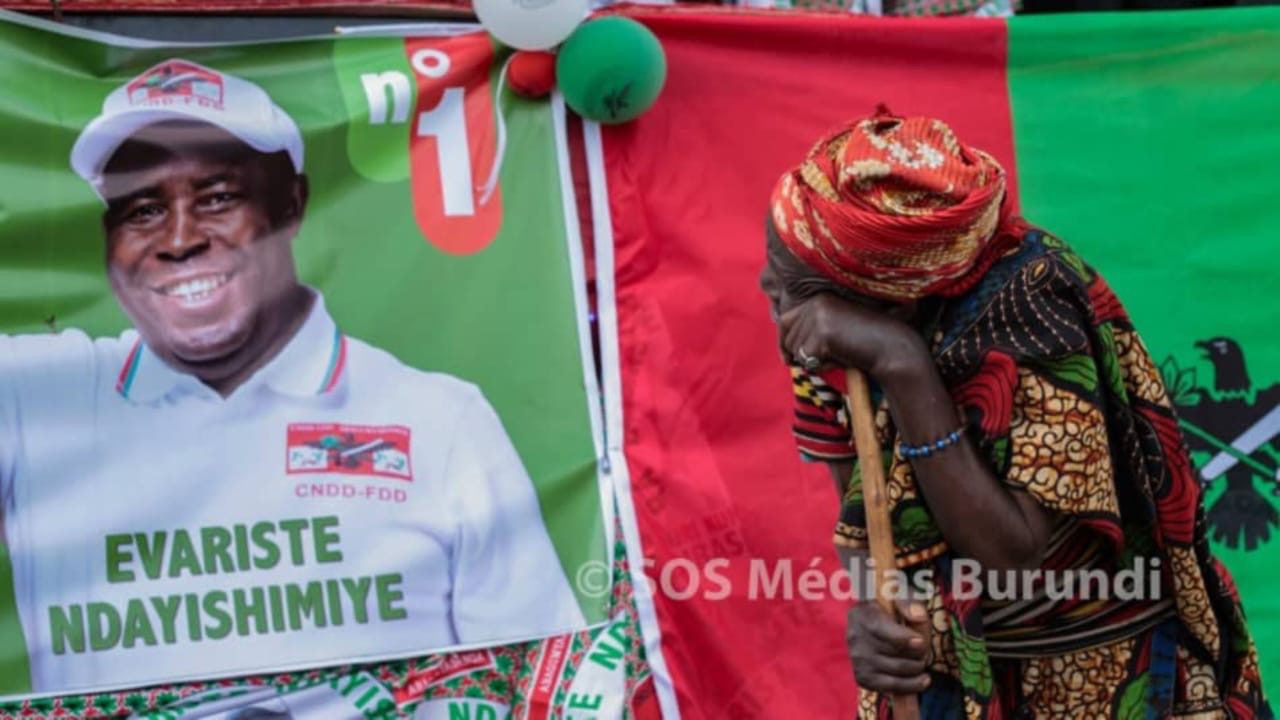
An elderly woman gazes at a campaign poster for President Évariste Ndayishimiye from the 2020 presidential election. Eleven political groups, which failed to secure any seats in the 2025 legislative elections, have officially announced their support for his candidacy in the 2027 presidential race. This development has reignited the debate over their true electoral influence and the state of political pluralism in Burundi (SOS Médias Burundi)
You might also like

DRC: Uhuru Kenyatta tries consultations to find peace
Uhuru Kenyatta, the former president of Kenya is in Kinshasa, the capital of the Democratic Republic of Congo. He is there as part of the facilitation to try to find

Kayanza : a new call to “kill” launched by Révérien Ndikuriyo
The secretary general of the CNDD-FDD party, Révérien Ndikuriyo, urges members of this party to eliminate those he calls “wolves” to leave the “sheep”. Residents of Kabarore district, Kayanza province


Tanzania : more than 100 CNL members seeking asylum
More than a hundred Burundians, members of the opposition CNL party, mainly from the Gitega, Ruyigi and Makamba provinces, fled the country at the end of last week. They fled