
Burundi: refugee fighters accused of terrorizing civilians in Bujumbura border province
SOS Médias Burundi
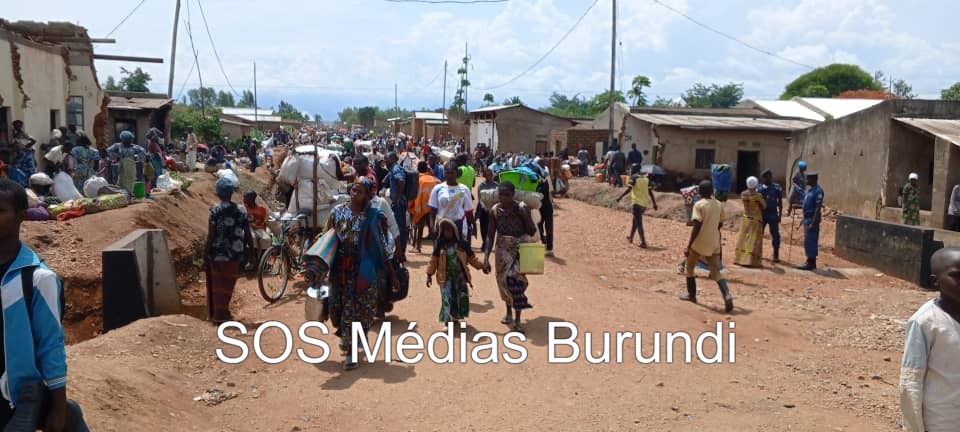
Bujumbura, January 22, 2026 – In December 2025, Burundian soldiers, accompanied by elements of the Armed Forces of the Democratic Republic of Congo (FARDC), Kinshasa-backed Wazalendo militias, the Democratic Forces for the Liberation of Rwanda (FDLR) — a Rwandan Hutu armed group accused of participating in the 1994 genocide against the Tutsis — and Imbonerakure, members of the youth wing of the CNDD-FDD, the ruling party in Burundi, fled fighting against the M23 rebel movement in eastern DRC. Having taken refuge in Burundi, these armed men are accused of serious abuses against civilians, particularly in the border province of Bujumbura.
Those involved fled the hostilities in several towns and villages in South Kivu province, which borders Burundi.
According to several consistent testimonies gathered on site, they crossed the Rusizi River, the natural border between the DRC and Burundi, and entered the Burundian territory in Kaburantwa village, in the Buganda zone of Bukinanyana district, in Bujumbura province, in the west of the country.
This crossing reportedly took place via a bridge under construction by a Chinese company on the 6th avenue, as part of a hydroelectric project.
Gantry in populated areas
Once in Burundi, these fighters were gathered in two main locations. The first is located behind the Muremera primary school, a school recently built by an Indian company as part of a hydroelectric project, and scheduled to welcome its first pupils for the 2026-2027 school year. The second site is located in Rugano village, in the Buhayira zone, also within the Bukinanyana district.
For over a month, the presence of these armed men in inhabited areas has severely disrupted the daily lives of local residents.
Reports of looting and sexual violence
Residents accuse these armed groups of engaging in repeated looting. They reportedly go into the crop fields to forcibly harvest farmers’ crops and frequent local markets to rob civilians of their belongings.
Even more serious, several testimonies report sexual violence. Women and girls are said to be victims of rape, under threat of intimidation and reprisals if they report it. Faced with this situation, some families have fled their villages, while others have sent their daughters to seek refuge elsewhere, for fear of further abuses.
Material and environmental damage
At the Muremera primary school, the damage is significant. School desks and benches were reportedly used as firewood for the fighters’ cooking. The surrounding trees were cut down, leaving the site completely deforested.
“We fled to other areas after witnessing their bad behavior,” testified a displaced person encountered in the Buganda zone’s main town.
Fighters awaiting instructions
According to some interviewees, several fighters have reportedly removed their military uniforms and are wearing T-shirts bearing the CNDD-FDD colors. They claim to be confined to these sites awaiting a decision from the Burundian authorities, who may be redeployed to the DRC or to other missions.
They also describe precarious living conditions, stating that they receive only one meal a day and are forced to fend for themselves.
Local authorities alerted
The head of the Buhayira zone confirms having received numerous complaints from the population. “I have already forwarded several reports to my superiors and I am awaiting instructions,” he states.
For their part, the district administrator of Bukinanyana and some leaders of former Burundian and Congolese armed groups assert that a solution is being prepared. They announce the imminent withdrawal of all combatants from inhabited areas and their reassignment to other activities, without specifying their nature.
A still explosive regional context
These allegations come amid a highly tense regional context. Reactivated at the end of 2021, the M23, composed mainly of Congolese Tutsis, is part of the Congo River Alliance (AFC), led by Corneille Nangaa, former president of the Congolese Independent National Electoral Commission (CENI). The movement controls several strategic areas in North and South Kivu, including Goma and Bukavu, the provincial capitals, as well as the Rubaya mining site, one of the world’s largest coltan deposits.
According to an internal report from the Congolese Ministry of the Interior and Security, consulted by SOS Médias Burundi, Burundi has deployed more than 29,000 soldiers in eastern DRC, of whom approximately 10,000 are currently on the ground, fighting alongside the FARDC and the Wazalendo militias against the M23.
Kinshasa accuses Kigali of supporting the M23, while Rwanda rejects these accusations and asserts that the DRC and Burundi are providing support to the FDLR. On the ground, clashes continue despite the Washington Agreement signed on December 4, 2025, under the US mediation, in which Burundi participated as an observer. The ongoing hostilities are forcing thousands of families to flee to neighboring countries. The small east African nation has already taken in over 100,000 Congolese refugees since the beginning of December 2025.
You might also like
Tragedy in Muyinga : a policewoman shoots dead her neighbor after an argument
Kinyota village, in the district and province of Muyinga (northeastern Burundi), is in shock after the tragedy that claimed the life of Eugénie Mukawera, a mother of four children. On
South Kivu : Kinshasa accuses the M23 of preparing an offensive on Uvira, local authorities have already retreated to Bujumbura
SOS Médias Burundi Bukavu, July 12, 2025 – The Congolese government is warning of a possible imminent offensive by the M23 and its ally, the AFC, in Uvira territory, in

Gitega : a 14-year-old found dead in bush in Kanyonga, an investigation launched
SOS Médias Burundi Gitega, March 15, 2026 — The lifeless body of a 14-year-old teenager was discovered Saturday morning in Kanyonga village in Gitega district and province, in the heart