
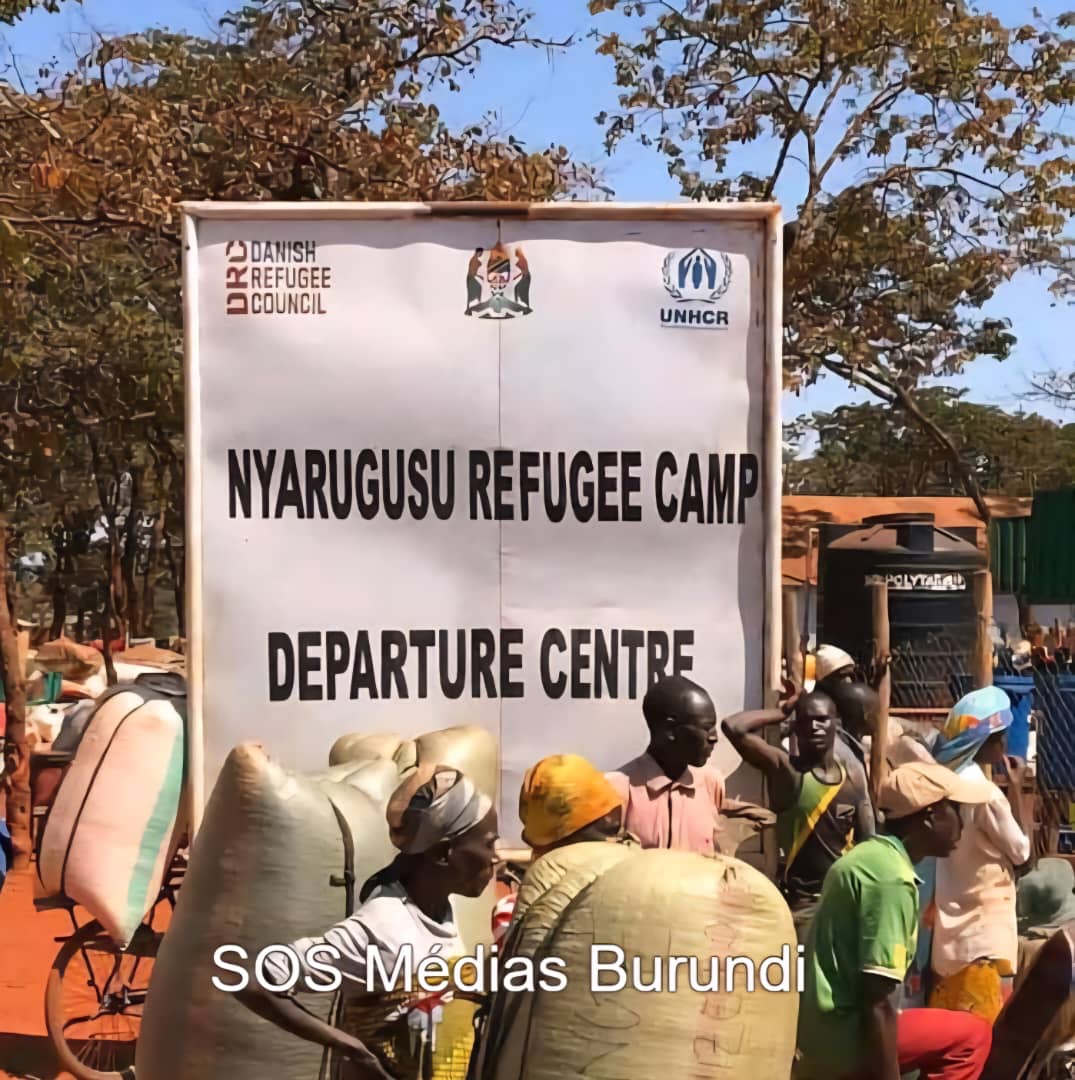
“Starve to death or return home” : the last Burundian refugees in Nyarugusu sound the alarm
SOS Médias Burundi
Nyarugusu, Tanzania, July 8, 2026 — The Nyarugusu camp, which housed more than 50,000 Burundian refugees less than a year ago, is now almost empty. Fewer than 200 Burundians remain, while repatriation operations have accelerated over the past two months. The last remaining residents denounce increasing pressure, the suspension of humanitarian aid, and fear a return that is not entirely voluntary.
A nearly empty camp
The Nyarugusu camp was initially scheduled to close on June 30, 2026, but an additional month was granted to finalize the repatriation of the last Burundian refugees.
Even though this new deadline has not been fully met, Tanzanian authorities believe the process is well underway.
The camp president, representing the Tanzanian Ministry of the Interior, announced last weekend that the voluntary repatriation exercise was more than 90% complete. He specified that the camp facilities would soon be handed over to the government for public use.
According to him, the remaining few hundred Burundians should be repatriated within a week.
Among those who remain are individuals who say their safety would be threatened if they returned to Burundi. According to investigations and testimonies gathered last year, some of them continue to require international protection.
Tanzanian authorities indicated that these refugees are not numerous and that they could be transferred to the section of the camp occupied by Congolese refugees.
“Starve to death or go home”
For about two months, humanitarian assistance previously provided by the World Food Program (WFP) has been suspended for Burundian refugees remaining in Nyarugusu.
The United Nations High Commissioner for Refugees (UNHCR) explains that it has focused its efforts on repatriation, return packages, and the reintegration of refugees in Burundi, stating that aid is now directed towards those who choose to return.
This situation has been denounced by the last remaining refugees in the camp.
“It’s clear that the UNHCR is colluding with Tanzania to mistreat us. We have no choice but to starve to death or go home,” testifies one of the Burundian refugees still in Nyarugusu.
For these refugees, the suspension of assistance constitutes additional pressure to accept returning. They are calling for urgent intervention to ensure that any repatriation respects the principles of voluntary participation, safety, and dignity enshrined in international protection standards.
They are invoking, in particular, the principle of non-refoulement, which prohibits returning a person to a country where they risk being exposed to persecution or serious threats.
“We are demanding the restoration of basic humanitarian services and an end to intimidation before everyone is repatriated,” they plead.
But some say they have lost hope. “We see that it’s too late to act,” they lament.
The end of an era for Nyarugusu
With the closure of the Nduta camp at the end of April 2026, Nyarugusu became the last site in Tanzania still hosting Burundian refugees.
Created to accommodate people fleeing crises in the Great Lakes region, Nyarugusu was for several years one of the largest refugee camps in Tanzania. It also hosts Congolese refugees who fled violence in eastern Democratic Republic of Congo.
The mass exodus of Burundian refugees marks a turning point in the history of Burundian exile in Tanzania, a country that has hosted hundreds of thousands of Burundians during the various political and security crises that have plagued the small East African nation.
Former refugees from Nduta return to exile
According to testimonies gathered from former refugees at the Nduta camp, a significant number of them have returned to exile, notably to camps in Uganda, Kenya, and Rwanda, after leaving Tanzania under difficult circumstances.
Several claim to have been forced to abandon their possessions and livelihoods, paying the price of this new departure with uncertainty, precariousness, and the search for new protection.
These testimonies rekindle the concerns of the remaining refugees in Nyarugusu, who demand that any decision to return be based on a truly free and informed choice, in accordance with international standards.
Nearly 200,000 Burundian refugees still in exile
According to data from the United Nations High Commissioner for Refugees (UNHCR), nearly 200,000 Burundian refugees are still living in exile in several countries in the region.
They are notably present in Uganda, Tanzania, Rwanda, the Democratic Republic of Congo, and Kenya, as well as in some member countries of the Southern African Development Community (SADC), including Zambia and Malawi.
As Nyarugusu gradually empties, the last remaining Burundian refugees are demanding that their return be a freely chosen decision and not the result of unbearable living conditions.
You might also like
Ruyigi : on alert, Congolese refugees trapped, a climate of growing concern
In Ruyigi, more than 60 Congolese refugees from the Nyankanda, Bwagiriza and Kavumu camps, located in the provinces of Ruyigi and Cankuzo in eastern Burundi, were arrested and sent to

Nakivale (Uganda) : school dropouts among Burundian refugees reach new heights
School dropouts are reaching a peak at the Nakivale camp among Burundian refugees : 60%, according to teachers for the first term alone. The main cause given is the lack

Mahama (Rwanda) : the assistance to refugees is becoming more and more problematic
The UNHCR has made changes to the fuel gas distribution system for refugees in the Mahama camp in Rwanda. This assistance has been cut in half. The refugees cry out