
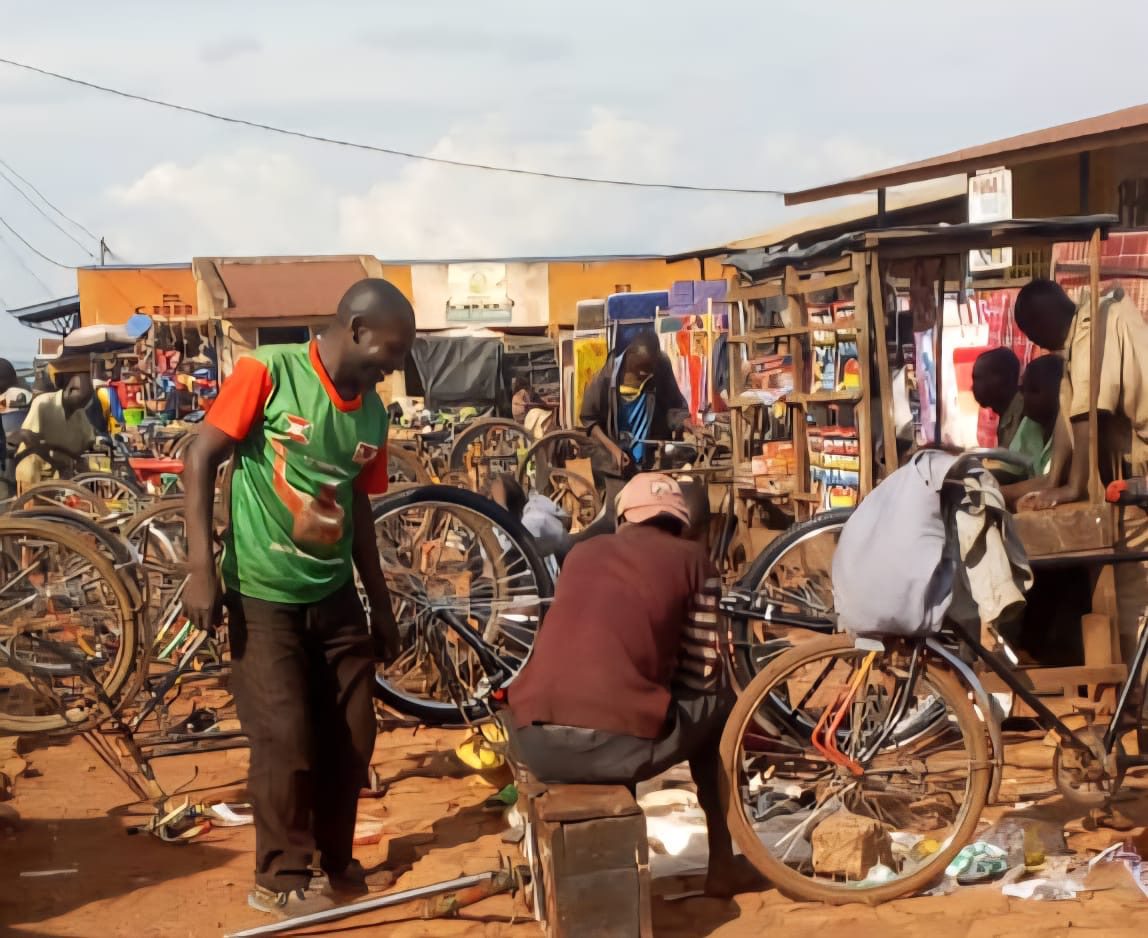
Facing decreasing aid, 907 refugees from Musasa and Kinama strive for self-reliance
SOS Médias Burundi
Muyinga, September 2, 2026 — As humanitarian aid dwindles and needs remain significant, 907 refugee households in the Musasa camp, in Butanyerera province, northern Burundi, and the Kinama camp, in Buhumuza province, eastern Burundi, are beginning to receive capital to launch income-generating activities. The goal is to enable these families to gradually develop a source of income and become less dependent on humanitarian assistance.
Each beneficiary household receives 585,500 Burundian francs, or approximately $200 according to the exchange rate of the Burundi Central Bank (BRB). The funding is provided by the World Bank, through the World Food Program (WFP).
Support to transition from assistance to self-reliance
The beneficiaries are already part of the Merankabandi program, a social assistance program that provides regular financial support to vulnerable households. In both camps, the families involved receive 72,000 Burundian francs every two months, aid intended primarily to help them cover their basic needs.
The new funding will allow these households to use some of this support in a different way, by investing in income-generating activities.
Before receiving the funds, the beneficiaries were assisted in developing business plans. These plans were then evaluated and validated.
Agriculture and livestock as priorities
For this first phase, the funding is primarily intended for activities related to agriculture and livestock farming.
In Musasa, 505 beneficiaries are involved, compared to 402 in Kinama, for a total of 907 households.
Other sectors of activity should be considered in future funding rounds.
The initiative aims to transform aid into productive capital, enabling families to develop small businesses and ultimately have more regular incomes.
“A hope of less dependence on aid”
For Mutumaini, a beneficiary, the transfers from Merankabandi already allow her family to get through difficult times.
“The 72,000 francs help us a lot when the situation becomes difficult, especially when the food ration hasn’t arrived yet,” she explains.
According to her, the new funding represents an opportunity to start a small business and gradually reduce her dependence on humanitarian aid.
Kwizera, another beneficiary, believes, however, that the current context makes this initiative particularly important.
With the reduction of certain forms of assistance, he explains, some families might be tempted to use part of the capital to meet immediate food needs when rations or other aid are slow to arrive.
He therefore believes it is essential that beneficiaries receive adequate support so that the funds can actually be used to develop income-generating activities.
More than 17,000 refugees in the two camps
The Musasa and Kinama camps together host more than 17,000 refugees. Some have lived there for over twenty years.
Nearly 2,000 households in the two camps currently benefit from cash transfers from the Merankabandi program, paid every two months.
For those involved in the program, this new funding should allow them to take a further step : gradually shifting from assistance aimed at meeting immediate needs to support that enables refugees to develop their own livelihoods.
You might also like

Nyarugusu (Tanzania) : a representative of Burundian refugees dismissed for his alleged opposition to forced repatriation
This is the representative of Burundian refugees in zone 10 of the site. The Nyarugusu camp administration accuses him of not supporting the Tanzanian government’s program for the voluntary repatriation
Nakivale (Uganda) : the UNHCR investigates reasons for the non-voluntary repatriation of Burundian refugees
For almost two weeks, the UNHCR has been conducting interviews with Burundian refugees to find out why they do not want to return voluntarily and en masse. Those concerned do

Kakuma : faced with the predicted severe weather, refugees denounce their vulnerability
SOS Médias Burundi Kakuma, October 7, 2026 — Concern is rising in the Kakuma refugee camp in northwestern Kenya as severe weather approaches in the coming days. Heavy rains accompanied