
Burundi : in Busuma, over 33,000 Congolese refugees face threats from rainfall while living in dilapidated shelters
SOS Médias Burundi
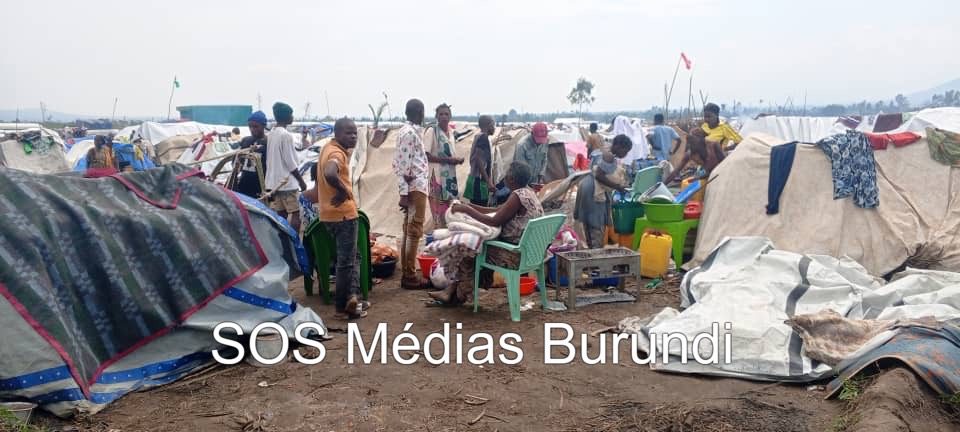
Busuma, October 15, 2026 — With the rainy season now underway—causing human casualties and material damage in various parts of Burundi—Congolese refugees in Busuma, located in the Ruyigi district (Buhumuza province) in the east of the country, fear that their living conditions will deteriorate further. More than 33,000 people are still residing in precarious shelters, many under worn-out tarpaulins that may not withstand heavy downpours. Nine months after their mass arrival, families worry that their meager belongings could be damaged by water seepage, and that their shelters might be blown away or destroyed by the wind.
The Busuma site was established in December 2025 to accommodate Congolese people fleeing violence in the eastern Democratic Republic of the Congo (DRC). Within a few months, it received approximately 65,000 individuals—a massive influx that quickly overwhelmed existing capacity. Some families were placed in community hangars, while others were provided with tarpaulins for protection against the elements.
Months later, housing conditions remain a major concern. Exposed to the sun, wind, and dust, some of the tarpaulins have begun to degrade. They offer only limited protection against the cold and may well fail under heavy rain.
For the families living in these makeshift shelters, the rains represent a new source of distress—particularly for children, the elderly, and other vulnerable individuals. “At night, we are very cold”.
Shukuru, a Congolese refugee living in Busuma with his family, describes a daily life marked by cold, gusts of wind, and uncertainty. With the arrival of the rains, he fears that their shelter may no longer be able to protect them.
“We have been living under a tarp for several months. Conditions are very difficult, especially at night. When it’s cold, we struggle to sleep. The wind gets in easily, and sometimes we have to wake up just to check if our shelter is still standing,” he says.
The condition of the tarps has become an additional source of concern. After months of exposure to the elements, some no longer seem to provide adequate protection.
“Some of the tarps are starting to get old. They’ve already endured months of sun, wind, and dust. Now that the rainy season is here, we’re afraid of what might happen when there’s heavy rainfall. We don’t know if our shelters will hold up,” Shukuru explains.
He is particularly worried about the impact that water leaking into the shelters could have on families, who have very few belongings to cope with such a situation. He urges the United Nations High Commissioner for Refugees (UNHCR) to maintain its support, despite financial constraints it faces.
“When it rains heavily, we fear that water will get into our shelters. We have our clothes, blankets, and a few other possessions inside. If everything gets wet, we don’t know what we’ll do. We ask the UNHCR to keep us in mind and see how they can help us prepare, even given the financial difficulties they are facing,” he pleads.
Rains exacerbate concerns
The concerns of refugees arise against a backdrop of weather forecasts predicting a potentially heavy rainy season in Burundi.
According to seasonal forecasts from the Geographic Institute of Burundi (IGEBU), the farming season from September to December 2026 could see rainfall levels above the climatic norm, with totals projected between 400 and 450 millimeters. The first significant rains were expected to arrive gradually, starting in late September and early October, across several regions of the country.
In a location situated in a mountainous area, heavy rains can further complicate living conditions for those housed in temporary facilities. The risks of water seepage, runoff, and the deterioration of shelters compound existing challenges related to cold weather and access to essential services.
With rains already causing human casualties and material damage in some parts of Burundi, the refugees in Busuma fear that their shelters may not provide adequate protection. Any further degradation of the tarpaulins could expose families to even harsher conditions.
For these displaced individuals, the urgent priority is to secure shelter capable of withstanding adverse weather, thereby protecting their families and the few possessions they still own.
Humanitarian aid facing financial challenges
The precarious living conditions in Busuma are compounded by a context of reduced humanitarian funding. The UNHCR in Burundi is facing financial constraints that are impacting its operational capacity and limiting the resources available to meet the needs of refugees.
The decline in some international funding, particularly from the United States, has occurred within the context of a reorientation of US foreign aid policy following Donald Trump’s return to the presidency in January 2025.
These financial difficulties can lead to staff reductions and limitations on certain humanitarian activities. This is happening while the number of people in need of assistance remains high and the needs for shelter, healthcare, food, and protection remain substantial.
For the refugees in Busuma, however, these constraints do not diminish the urgency of their needs or their vulnerability to the elements. As the rains continue, the capacity of humanitarian organizations to meet the most pressing needs remains a major challenge.
A crisis linked to violence in eastern DRC
The massive influx of Congolese refugees into Burundi is due to the deteriorating security situation in eastern DRC, where fighting between Congolese government forces and their allies, on the one hand, and the AFC/M23 coalition, on the other, has caused massive population displacements.
The AFC/M23 coalition seized control of Goma in January 2025, then Bukavu in February of the same year, disrupting the political and security balance in the region.
On Monday, October 12, 2026, in Goma, main leaders of this coalition announced the creation of the Front for the Refoundation of the Nation (FRN), headed by former Congolese President Joseph Kabila. Corneille Nangaa and Bertrand Bisimwa became its vice-presidents. This reorganization marks the replacement of the AFC with a new political structure, according to announcements made in Goma.
This change comes as the humanitarian consequences of the conflict continue to be felt in neighboring countries, particularly Burundi, which has taken in tens of thousands of Congolese who fled the violence.
Returns, but still significant needs
Starting in April 2026, return movements to the DRC began at the Busuma site. The UNHCR, in collaboration with Burundian and Congolese authorities, assisted refugees who wished to voluntarily return to their country.
These departures have gradually reduced the site’s population from approximately 65,000 people to just over 33,000 today. Despite this decrease, significant needs remain in terms of shelter, water, food, healthcare, and protection.
For families remaining in Busuma, the arrival of the rainy season adds another layer of urgency to an already dire humanitarian situation. In this mountainous area, wind and heavy rainfall threaten to further damage their temporary shelters.
Faced with this situation, the refugees hope their shelters can be reinforced or replaced to allow them to get through the coming months in safer conditions. For thousands of families who have already fled the violence in eastern DRC, the challenge now is to avoid further hardship in shelters unable to protect them from the elements.
You might also like
Nduta (Tanzania) : Resumption of the ransacking of refugees’ fields
The Nduta camp administration has ordered the destruction of the refugees’ vegetable and cereal fields. For the administration, this type of agricultural and commercial activity discourages the voluntary repatriation movement.
Kakuma : faced with the predicted severe weather, refugees denounce their vulnerability
SOS Médias Burundi Kakuma, October 7, 2026 — Concern is rising in the Kakuma refugee camp in northwestern Kenya as severe weather approaches in the coming days. Heavy rains accompanied

Giharo: arrest of several Congolese refugees including minors
At least 18 Congolese refugees are detained by the Rutana police in southeastern Burundi. According to administrative and police sources, these Congolese were arrested in the Musenyi refugee site in