
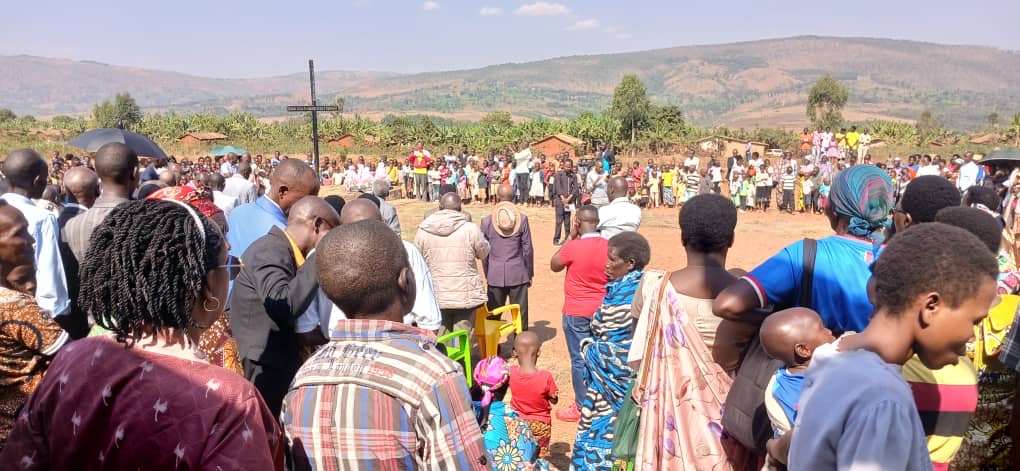
Bugendana : 648 Tutsis massacred, 30 years later survivors denounce impunity and demand justice
SOS Médias Burundi
Bugendana, July 27, 2026—The commemoration of the 30th anniversary of the massacre of 648 Tutsis at the Bugendana camp for displaced persons took place on Sunday, July 26, 2026, at the Bugendana parish in Gitega province, central Burundi. Thirty years after this tragedy, survivors and the victims’ families continue to demand truth and justice, denouncing impunity and calling for those allegedly responsible to be brought to justice.
In his homily, Father Deogratias Mvuyishanga, parish priest of Bugendana, framed his message around love, unity, forgiveness, reconciliation, and peaceful coexistence.
He urged the faithful to reject all forms of violence and not to seek wealth through force. Addressing those who had planned or participated in the massacres, the priest called on them to change their behavior and work for peace.
Speaking on behalf of the displaced people at the Bugendana site, Raphaël Nkurunziza, the site manager, described the difficult living conditions they have faced for several years. He specifically mentioned the lack of decent housing, the hardships encountered during the rainy season, limited access to healthcare, and problems related to children’s education.
He also denounced what he considers discrimination in access to support programs granted to other citizens, particularly the distribution of small livestock.
Survivors demand truth and justice
Speaking on behalf of the survivors of the Bugendana massacres, lawyer Pascal Ntahonkuriye expressed his concerns regarding the Bugendana International Airport construction project.
He denounced the pressure he claims is being exerted on displaced persons to leave the site and questioned the fate of the victims’ remains as well as the future of the families still living there.
For his part, lawyer Prosper Ciza, representing the Girimoso Genocide Association, stated that it was not yet appropriate for displaced persons to return to their ancestral villages.
According to him, people accused of participating in the massacres continue to live freely while the victims still await justice. He regretted that, in his view, the Truth and Reconciliation Commission (CVR) had not sufficiently taken into account the Bugendana massacres and requested the intervention of the International Criminal Court (ICC).
Representatives of the survivors reaffirmed their main demand : that the full truth be established about the Bugendana massacres and that those responsible be brought to justice.
A look back at a 30-year-old tragedy
The victims at the Bugendana site were mostly displaced people who had fled the massacres of Tutsis that followed the assassination, in October 1993, of Melchior Ndadaye, Burundi’s first democratically elected Hutu president.
This assassination triggered a deadly civil war that plunged the country into mourning for more than a decade and caused the deaths of over 300,000 people, according to the United Nations.
On the morning of July 21, 1996, the Bugendana displaced persons camp was attacked by more than a thousand men armed with rifles, machetes, spears, and clubs, according to witnesses. Coming from several directions, the assailants attacked the camp, setting fire to buildings with grenades and chasing women and children who were trying to flee.
During this attack, 648 Tutsis were massacred with bullets, grenades, and machetes.
At that time, the districts of Bugendana, Mutaho, and Gihogazi were under the control of rebels from the Front for the Defense of Democracy (FDD), an armed movement that would later become the CNDD-FDD party, which is now in power in the small East African nation.
The administration calls for dialogue
Representing the local administration, Saouris Ntakarutimana, legal advisor to the administrator of Bugendana district, invited the displaced people to participate more actively in development projects, particularly by planting avocado and coffee trees on their ancestral villages.
Regarding the Bugendana International Airport construction project, he assured that survivor organizations and those responsible for the displaced persons camp would be involved in the discussions so that their concerns would be addressed.
With the 2027 presidential election approaching, Saouris Ntakarutimana also called on the displaced people of Bugendana to continue to preserve peace, security, and social cohesion.
You might also like
Rumonge : 15 years in prison for a man found guilty of raping his domestic servant
A resident of Rumonge was sentenced to a heavy prison sentence for sexually abusing his minor domestic servant, on January 6, 2025. The case, marked by attempts at cover-up, sparked
Burunga : a man’s body discovered in the Muyogo River
SOS Médias Burundi Makamba, February 14, 2026 — Residents of the town center of Burunga province, in southern Burundi, awoke in shock this Thursday morning. Around 6:00 a.m., the lifeless

War in Eastern Congo : Kinshasa suspends relations with Kigali which doesn’t care
Kinshasa announced Saturday evening the recall of all its diplomats to Kigali and asked Rwanda to cease all diplomatic and consular activities. Rwandan Diplomacy Minister Olivier Nduhungirehe responded in a