
Drinking water shortage in Bujumbura : residents at their wits’ end
SOS Médias Burundi
Bujumbura, August 18, 2026—The lack of drinking water continues to weigh heavily on the daily lives of residents in several neighborhoods of Bujumbura, Burundi’s commercial capital. From the north to the south of the city, the same complaints are repeated : some households go several weeks without regular deliveries, while other neighborhoods seem less affected by the disruptions.
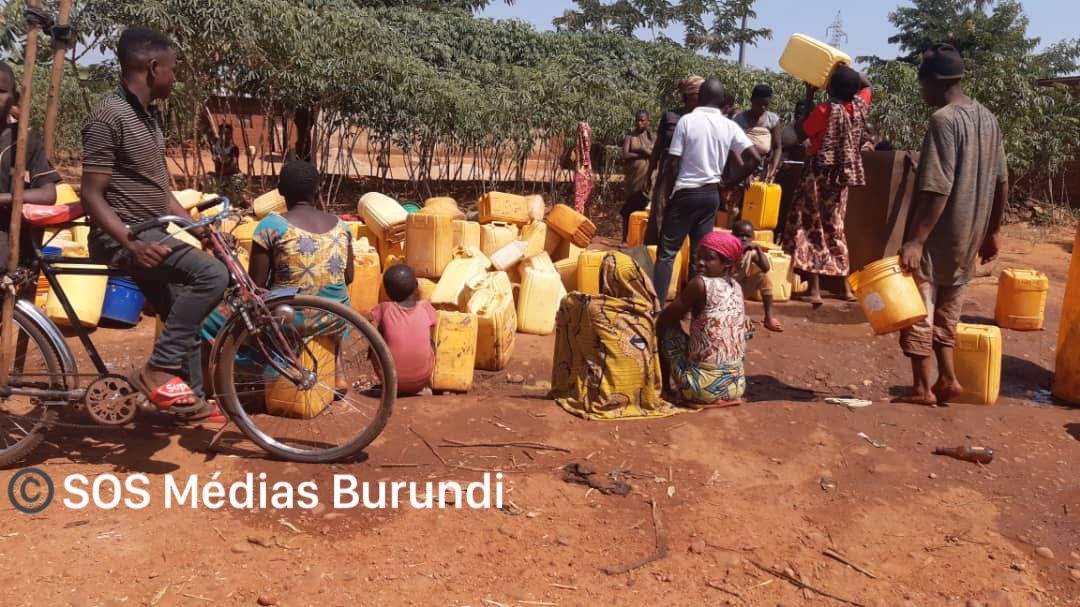
In the southern neighborhoods of the city, particularly Musaga, Kanyosha, and Gasekebuye, the search for water has become a daily ordeal. Women and children, in particular, travel long distances in search of a few liters of water. At Regideso (the national water utility) distribution points or in households that still have a reserve, long lines form.
With jerrycans and buckets balanced on their heads, residents sometimes wait for several hours before being able to return home. For those unable to travel to water sources, the situation has also fostered a boom in water transport and sales.
In some cases, a 20-liter jerrycan can cost 1,000 Burundian francs or even more.
“We need water for cooking, cleaning, and other daily uses. We spend at least 10,000 francs a day,” says a resident of Gasekebuye, who, like many others, is facing supply difficulties.
Residents are demanding fair rationing
Faced with this situation, residents of several neighborhoods say they have repeatedly appealed to the authorities and Regideso (the national water utility). They are requesting, in particular, better organization of the distribution system and, where necessary, clearly established rationing so that different neighborhoods can benefit equitably from the resource.
Regideso, the sole state-owned company responsible for distributing drinking water and electricity in Burundi, is facing particular criticism from residents experiencing supply disruptions.
For residents, the problem lies not only in the lack of water, but also in the way the available resource is distributed.
In some neighborhoods, residents say they go several days, even several weeks, without a regular supply, while other areas seem less affected by the disruptions.
They are demanding greater transparency regarding distribution schedules and zones. They argue that during periods of shortage, no neighborhood should be left without water for extended periods while other, better-served areas receive it.
The dry season and urban growth are blamed
Regideso sometimes attributes the supply disruptions to several factors, including the decrease in water resources during the dry season.
The rapid growth of the urban population is also cited, with water demand increasing as Bujumbura expands.
But these explanations are not enough to quell the frustration of the residents. For them, the current difficulties primarily reveal the limitations of the infrastructure for water collection, treatment, storage, and distribution.
They are therefore calling for investments that will sustainably increase supply capacity and improve distribution in the most affected neighborhoods.
A paradox in a country rich in water resources
The situation in Bujumbura is not an isolated case. But the residents of the commercial capital remain particularly affected. The search for water further complicates daily life in a context of fuel shortages that have lasted for almost six years.
For many observers, the situation is difficult to understand in a country with abundant water resources. Burundi is crisscrossed by numerous waterways and has many springs, while several catchment areas are relatively easily accessible.
Some describe the situation as “absurd” : the small East African nation has significant water resources, yet a portion of its population struggles to access safe drinking water regularly.
For these observers, the problem is therefore not solely one of water availability. It also concerns the capacity for water collection, treatment, storage, and distribution, as well as how existing infrastructure is operated.
The existence of abundant natural resources does not, in itself, guarantee access to drinking water if the infrastructure needed to extract and deliver it to households remains insufficient.
An additional burden for households
In the affected neighborhoods, the wait is long and expenses are mounting. For the poorest households, buying several jerrycans of water daily represents an additional burden in an already difficult economic context.
The shortage is also disrupting families’ daily routines. Some residents have to change their schedules, interrupt their activities, or travel several kilometers to fill their containers.
In Bujumbura, drinking water, an essential resource, has thus become for many families a commodity that must be sought, waited for, and sometimes paid for at a high price.
As disruptions continue in several neighborhoods, residents are demanding lasting solutions : increased production and storage capacity, improved distribution networks, and a fairer distribution of available water.
For them, in a city where access to water directly impacts hygiene, health, and daily activities, the shortage can no longer be considered a mere temporary disruption.
You might also like
Burundi : authorities arrest the fifth activist, jail the team suspected of funding terrorism
The minister in charge of internal affairs and security announced Thursday the arrest of another member of associations. This is Prosper Runyange, in charge of the land program within the
Buganda : a fuel seller commits suicide after the seizure of his quantities by the police
André Ndayambaje, 35 years old, died on Thursday. This man from the locality of Nyamitanga in the district of Buganda in the province of Cibitoke (northwest Burundi) committed suicide after


Ecocash- Affairs: the situation going from bad to worse
Since the disruption of money transfer operations via the Ecocash service, the population is grumbling. Agents and super agents are in an untenable situation and ask the central bank to