
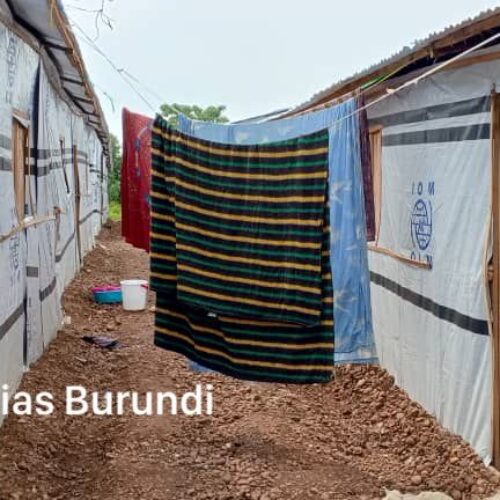
Nyarugusu (Tanzania): three health centers closed
Neither the UNHCR nor the camp administration has provided any explanations to the refugees for the closure of the three health facilities. Refugees speak of coercion for forced repatriation. INFO SOS Médias Burundi
It was early this week when refugees learned that there were health facilities closed.
“Several Burundian refugees had gone for treatment, especially at the zone 9 hospital. They waited for the staff to no avail. Towards the afternoon, a watchman came to tell them the facility was already closed. They then headed towards the health post in zone 11. There, the gate was hermetically closed,” describe distraught refugees.
Contacted by refugees, refugee leaders joined the camp president’s office to get reliable information.
“Three health centers which could also intern patients are closed: two from zone 9 and one from zone 11. You don’t need to have explanations. It’s a measure that comes from the Ministry of the Interior in charge of refugees,” the president of the camp, a Tanzanian, briefly responded.
The part of the Burundian citizens in the Nyarugusu camp was equipped with five health structures, managed by the UNHCR. This UN agency has not indicated anything about the reasons for this closure, a move that triggered strong criticism among Burundian refugees.
“How are two hospitals in zones 8 and 10 going to be able to receive patients who were already overwhelming five health facilities? It is an unfair and inhumane measure,” they lament.
The services offered by these two health posts which remain functional are essentially linked to pediatrics and maternity.
Influence of the Burundian authorities?
Last August, a Burundian delegation to the Nyarugusu and Nduta camps predicted this.
Calinie Mbarushimana, permanent secretary at the Ministry of the Interior and head of this delegation did not mince her words in emphasizing that “your asylum is almost coming to an end”.
“You have heard that Tanzania has told you that it intends to close schools and hospitals in the camps, so what will be your fate and that of your children? Assistance will also be temporarily suspended. Would you like to be repatriated by force? I don’t imagine we’ll get to this stage! “, she asked them, “pretending to sympathize,” according to refugees.
For his part, Nestor Bimenyimana, general director of repatriation in Burundi, seduced the refugees with the return package.
“The amount that a returnee must receive has been increased to 560,000 FBU (more than $190 on the official rate), plus food in kind and the construction of houses. You will also receive regular monitoring from several NGOs in the areas of health and children’s education. Take advantage of this opportunity to make a good decision, otherwise around November 2023, we will be able to eliminate all these advantages,” he tried to coax the Burundian refugees.
Forced repatriation?
For the moment, refugees consider this measure of closing hospitals as dictated by the government of Burundi “to force us into necessarily forced return”.
They ask humanitarian agencies like the UNHCR not to enter into “the game of the Burundi-Tanzania duo” and to instead fully fulfill their mission of protecting refugees.
Nyarugusu has more than 50 thousand Burundian refugees alongside more than 60 thousand Congolese who are not affected by the repression of the Tanzanian authorities, a discriminatory situation supported by the UNHCR, charge the Burundian refugees.
You might also like

Dzaleka (Malawi) : four Burundian refugees detained on suspicion of organizing a demonstration
Men, Burundian refugees, were arrested by the police last Thursday. They are suspected of organizing demonstrations within the Dzaleka camp. They deny these accusations. INFO SOS Médias Burundi They were
Ntahangwa: eight cases of cholera recorded in one week
This Thursday, four cases of cholera were detected in Bukirasazi 1 in the Kinama zone. It is in the urban commune of Ntahangwa, in the north of the commercial city
: three health centers closed)
Buganda : 288 displaced people find refuge at the Gateri site
Since the end of November 2024, 288 displaced people from the Gatumba zone, located in the district of Mutimbuzi not far from the border with Congo, have been welcomed at