
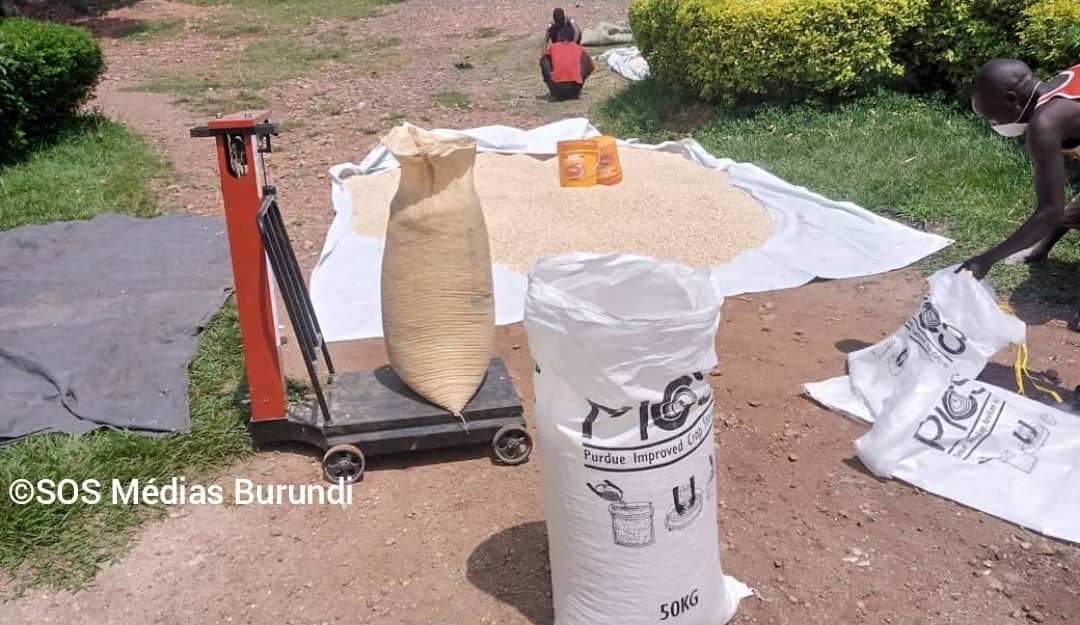
Burunga : maize rots in sheds, farmers accuse the state of abandonment
SOS Médias Burundi
Burunga, September 26, 2025 – In Burunga province in southern Burundi, tons of corn produced by farmers are unsold and beginning to rot, angering producers who accuse the state of abandonment.
According to witnesses who spoke to SOS Médias Burundi, farmers expressed their frustration on Wednesday during a meeting with Prime Minister Nestor Ntahontuye, dedicated to promoting major agricultural and livestock projects.
Frustration and agricultural impasse
In the provincial town center, the atmosphere was tense. The Prime Minister opened the meeting by calling on investors to strengthen their commitment to this sector, presented as the key to the national economy.
But behind the official rhetoric, frustrations erupted. The participants, mostly agricultural producers, made a bitter observation : the imposed mobilization for corn cultivation had led to a dramatic impasse.
Abandoned harvests and broken promises
In the Giharo zone, farmers had been encouraged by the local administration to engage in maize cultivation on a massive scale. The National Agency for the Management of Strategic Food Stocks (ANAGESSA) had promised to buy back the produce. But the reality is quite different.
“Of the seven warehouses built to accommodate the harvest, only one has been filled,” laments Désiré Hakizimana, head of the Giharo zone. With no buyers, the corn is piling up and starting to deteriorate.
A farmer expresses his dismay : “I have more than 10 tons of corn from the mobilization. Today, my entire harvest has rotted. How can I get back into production while the government isn’t honoring its commitments?”
Export ban and angry producers
Producers have not accepted the government’s decision to suspend corn exports to Tanzania. There, a kilo of maize sells for 700 shillings, or 2,100 Burundi francs, well above the 1,700 francs offered locally by ANAGESSA.
“Why prohibit us from selling our products abroad if no one here buys them?” asked a participant. Many believe the government should at least authorize exports subject to the payment of taxes, rather than imposing a “double embargo” : a ban on foreign sales and no buyers at home.
Challenging banks and lack of insurance
The crisis is exacerbated by the behavior of financial institutions. Several speakers denounced the banks’ slowness in granting credit, as well as what they consider exorbitant interest rates. Without adequate financing, it is impossible to invest in modern technologies or purchase quality inputs.
Other voices advocated for the creation of specialized insurance companies capable of protecting farmers and livestock producers against repeated losses linked to market or climate hazards.
A cautious but unrealistic Prime Minister
Faced with this avalanche of grievances, the Prime Minister expressed caution. He emphasized the need to strengthen agricultural research through the Burundi Institute of Agricultural Sciences (ISABU) and to develop local producers’ capacities. He also promised that the State would make land available to investors and urged banks to further support this strategic sector.
But regarding the immediate problems—the rotting maize harvest, the suspension of exports, and the dismay of producers—Nestor Ntahontuye offered no concrete solutions. The export suspension, he explained, resulted from “observed irregularities” in the process, without providing further details.
National ambitions versus local reality
The government nevertheless maintains a clear ambition : providing every district in the country with a 200-cow farm. But for the producers in Burunga, this national dream contrasts painfully with their daily lives filled with debt, unsold crops, and broken promises.
“If the state does not change its ways of acting, we will go from crisis to crisis,” summed up a participant, to the applause of his peers.
You might also like

DRC : more than two hundred thousand new displaced persons registered in Ituri in 2023
The office for the coordination of humanitarian affairs in the DRC reports that 202,000 Congolese have fled their homes since the beginning of this year, 2023, in the province of
South Kivu : Tutsi Burundian refugees in Mulongwe camp demand evacuation amid threats from Wazalendo militias
SOS Médias Burundi Gitega, December 30, 2025 – Tutsi Burundian refugees living in the Mulongwe camp in Fizi territory, South Kivu province, are making an urgent appeal to the United

Ebola in DRC : new outbreak in the East, Goma affected, and partial border closure with Rwanda
SOS Médias Burundi Gila, May 18, 2026 — A new Ebola virus disease outbreak has struck eastern Democratic Republic of Congo (DRC), affecting the provinces of Ituri and North Kivu