DRC : thousands of protesters in Goma and Bukavu against proposed constitutional revision
SOS Médias Burundi
Goma/Bukavu, July 28, 2026 – Thousands of people demonstrated Tuesday in Goma, North Kivu, and Bukavu, South Kivu, to denounce a proposed constitutional revision attributed to the Congolese authorities. The protesters, mobilized by civil society organizations and citizen movements, also called for a return to peace, inclusive dialogue, and rejected any idea of the “Balkanization” of the Democratic Republic of Congo.
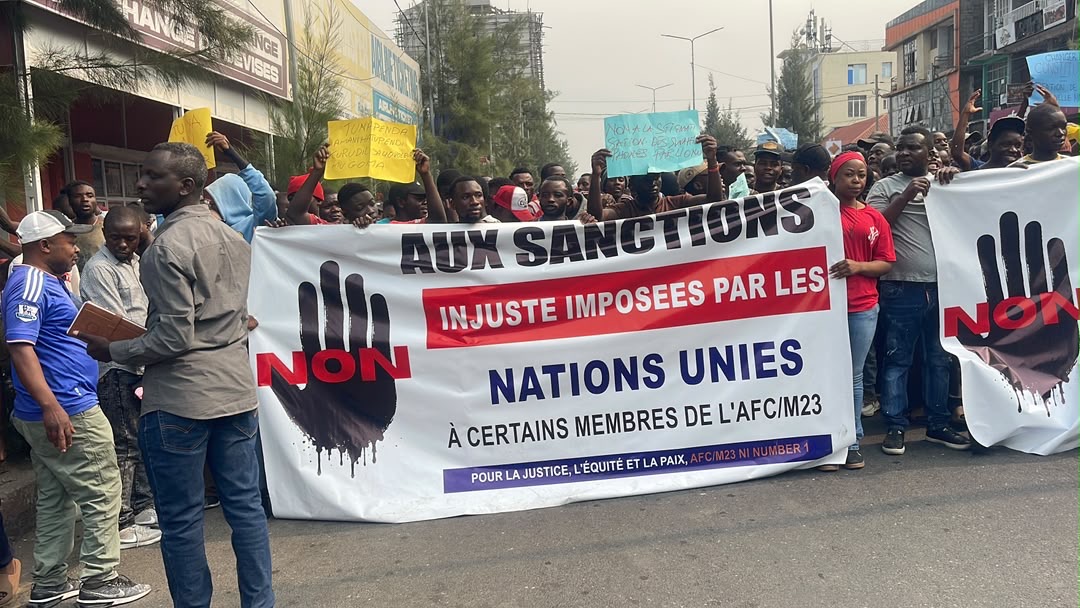
In Goma, the capital of North Kivu, which has been controlled by the AFC/M23 rebel coalition since the end of January 2025, the demonstration brought together tens of thousands of people in the city’s main thoroughfares. The demonstrators were responding to a call from civil society organizations, citizen movements, and pressure groups active in areas under the de facto administration of the AFC/M23.
Organizers claimed more than 100,000 participants, an estimate that could not be independently verified. The demonstrators held up signs and banners bearing several messages, including : “No to changing the Constitution in the DRC,” “We want peace and lasting security,” and “No to the return of insecurity in Goma and the areas under AFC/M23 control.”
The participants argued that Congolese authorities should focus their efforts on security, social, and economic issues rather than on reforming the fundamental law.
“We don’t understand how a government can promote a change to the Constitution when the population is waiting for answers to the problems of security, development, and living conditions,” they said. “Above all, we want peace to return to the entire country,” stated Gentil Sonny Mulume, a member of a civil society organization in North Kivu.
Within the procession, some demonstrators also voiced political demands, calling for President Félix Tshisekedi to step down rather than for an amendment to the Constitution.
“The president must leave power and leave the Constitution in peace. We see no need to amend the fundamental law in the current context,” declared a participant encountered along the route.
The organizers submitted a memorandum to the head of the United Nations Organization Stabilization Mission in the Democratic Republic of the Congo (MONUSCO) office in Goma before continuing their march through several neighborhoods of the city. According to them, the document expresses their opposition to any initiative for constitutional revision and outlines several demands related to the security situation in the east of the country.
Throughout the demonstration, several slogans also targeted the United Nations and MONUSCO. Some protesters accused the UN mission of failing to effectively protect civilians from the ongoing violence in the Beni territory and several territories of Ituri, where the ADF terrorist group is particularly active. Others implicated the Armed Forces of the Democratic Republic of Congo (FARDC), accusations made by the protesters that were not supported by verifiable evidence.
In Bukavu, the capital of South Kivu, which has also been controlled by the AFC/M23 rebel coalition since mid-February 2025, the civil society organized a peaceful march to express its opposition to a potential constitutional amendment.
The protesters, who came from various neighborhoods of the city, marched to the South Kivu governor’s office where they delivered a memorandum outlining their demands. Several messages were visible on the banners and placards : “We want peace,” “No to changing the Constitution,” and “No to the balkanization of the DRC.”
Speaking on behalf of the civil society, Masirika Zilimobagabo indicated that this mobilization aimed to alert the authorities to the risks that a constitutional change could pose to the country’s stability. According to him, such an initiative could exacerbate divisions and contribute to the balkanization of the Democratic Republic of Congo. He called on leaders to prioritize inclusive dialogue in order to preserve the national unity and consolidate peace.
At the end of the march, the governor of South Kivu, Patrick Busu Bwa Ngwi, praised the peaceful nature of the demonstration. He congratulated the organizers and promised to convey their concerns and demands to the relevant authorities.
These mobilizations are taking place amidst intense debate on the institutional future of the DRC. No official reaction from the Congolese government was immediately available. The authorities have repeatedly stated that any institutional reflection falls within the framework of democratic debate, while the opposition, several civil society organizations and the National Episcopal Conference of Congo (CENCO) believe that a possible constitutional revision is not a priority in the face of the country’s security and humanitarian challenges.
The debate over a possible constitutional reform has resurfaced in recent months following several statements by President Félix Tshisekedi and the adoption of a law governing the organization of referendums. While the presidential majority maintains that the aim is to strengthen the institutional framework and allow the people to express their views on major national issues, his opponents see it as a potential political maneuver.
The Constitution of the Democratic Republic of Congo limits the presidential term to five years, renewable only once consecutively. First elected in December 2018 and then re-elected in December 2023, Félix Tshisekedi is currently serving his second term. His critics accuse him of wanting to amend the Constitution in order to run for a third term in 2028, an accusation rejected by the head of state and his majority, who assert that the debate concerns institutional reform and not an extension of the presidential power.
Barring institutional changes or force majeure, the next presidential, national legislative, and provincial elections are scheduled for December 2028, in accordance with the current electoral calendar.
Goma, the largest city in eastern Democratic Republic of Congo, and Bukavu, the capital of South Kivu province, have been under the control of the AFC/M23 rebel coalition since 2025. The movement established its administrative and military structures there after capturing these two major cities in the east of the country.
Led by Corneille Nangaa, former president of the Independent National Electoral Commission (CENI), the AFC/M23 advocates, among other things, the establishment of a federal state in the DRC. Congolese authorities accuse Rwanda of supporting this rebellion, which Kigali denies. However, reports by United Nations experts indicated last year the presence of 5,000 to 7,000 Rwandan soldiers alongside the AFC/M23.
These demonstrations illustrate the rising tensions surrounding the constitutional issue in the Democratic Republic of Congo. In a country still grappling with armed violence in its eastern region, particularly with attacks attributed to the Allied Democratic Forces (ADF), an armed group affiliated with the Islamic State according to the United Nations, in the Beni territory and several territories of Ituri, a segment of the population believes that restoring
security and peace should remain the top national priority before any reform of the constitution.
You might also like
Makamba : the body of a young man found hanging from a tree
Cédric Nkeshimana’s corpse was discovered on Tuesday. He was hanging from a tree in the town center of Makamba province (southern Burundi). Circumstances of his death remain unknown. The police
Bukinanyana : a woman killed with a machete, her husband arrested after disturbing statements
SOS Médias Burundi Bukinanyana, August 30, 2026—A man identified as Toto was arrested by police after being accused of killing his wife, Butoyi, with a machete on the evening of

Rumonge : an angry crowd besieges the prosecutor’s office to demand the release of its village chief
SOS Médias Burundi Rumonge, September 12, 2025 — Tensions erupted on Thursday in the town center of Rumonge district. Dozens of residents of Mwange village, in Burunga Province, southern Burundi,