
2027 presidential election : is the UPRONA playing a role in the power struggle?
SOS Médias Burundi
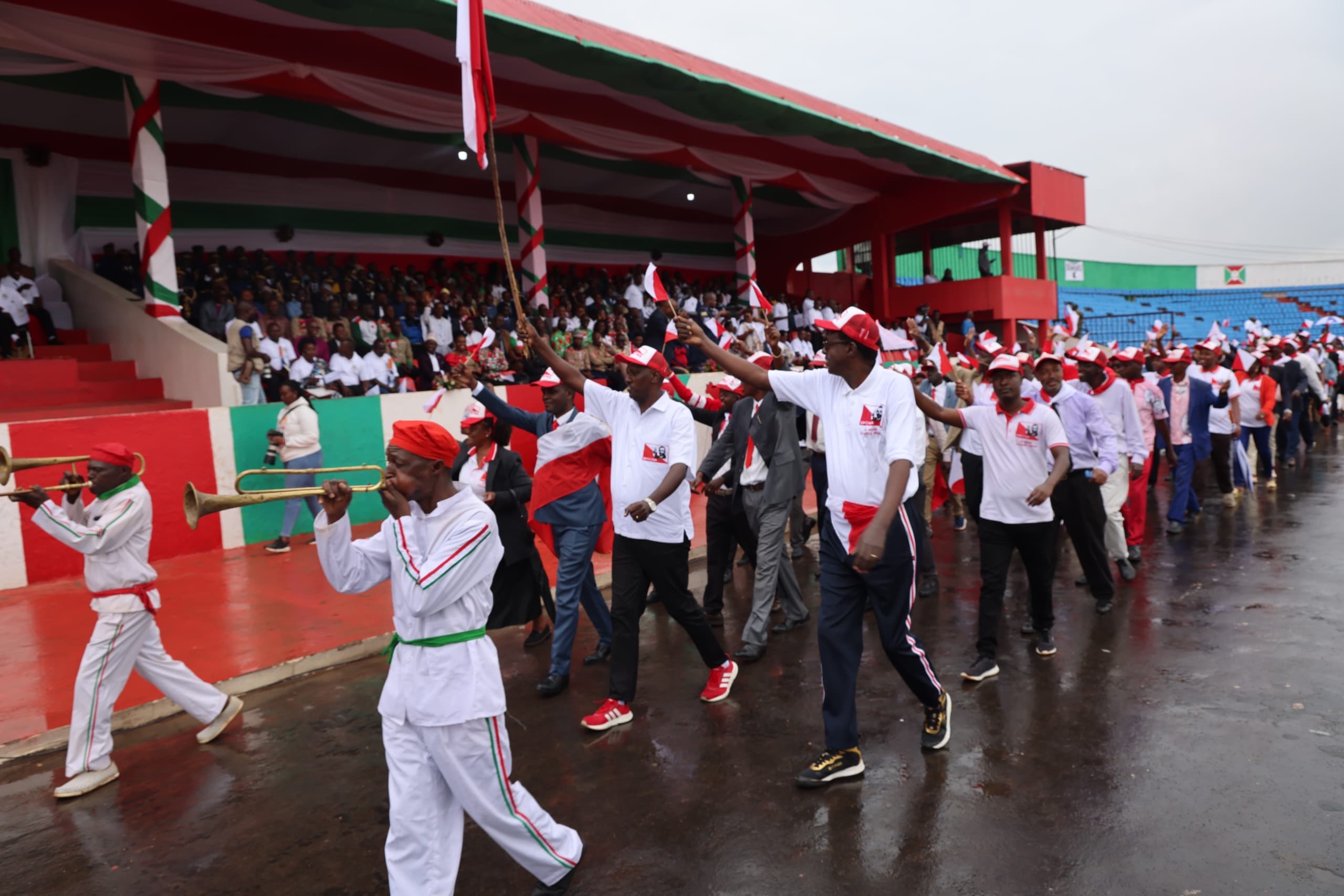
Bujumbura, August 10, 2026—Re-elected for five years as head of UPRONA, Olivier Nkurunziza will have to lead the historic independence party into the 2027 presidential election. The national congress on August 8 nominated Abel Gashatsi as the party’s candidate for the highest office. But internal disputes and close ties between the party’s recognized wing and the government are fueling an increasingly sensitive question : Does the UPRONA truly want to regain power, or is it likely to be merely a “facilitator” for the CNDD-FDD in the next presidential election?
The Union for National Progress (UPRONA) aims to position itself in the 2027 presidential race. Meeting on Saturday, August 8, at the party’s national headquarters in Bujumbura (the commercial capital), delegates re-elected Olivier Nkurunziza as president for another five-year term and nominated Abel Gashatsi as the party’s candidate for the highest office.
The congress, held under the theme “Unity is the shield of the UPRONA party and our country,” was intended to allow the historic party, the cornerstone of independence, to showcase its unity and launch its campaign for 2027.
However, behind this demonstration of unity, internal dissent has emerged, highlighting the divisions that continue to plague the party.
A dissent that erupts during the congress
Even before the proceedings began, messages circulating on social media and in WhatsApp groups had announced a change in the leadership of UPRONA.
Serges Njebarikanuye, former party official in Buhumuza province, was presented as Olivier Nkurunziza’s successor. A voicemail attributed to him also circulated, in which he presented himself as the party’s new leader.
Olivier Nkurunziza, however, opened the congress and presented his record and the party’s strategic direction for the next five years.
The protest then erupted during the speech by Prosper Bazombanza, Vice President of the Republic and a leading figure in UPRONA.
Four party members interrupted the session to denounce what they considered irregularities in the organization of the congress and the internal elections.
The protesters were removed from the meeting hall in Ku Mugumya. According to information shared during the congress, they were subsequently sanctioned and suspended from party activities for five years.
The incident, however, did not prevent the continuation of the proceedings or the re-election of Olivier Nkurunziza.
Nkurunziza promises unity
Re-elected as head of UPRONA, Olivier Nkurunziza promised to work towards bringing together the party’s various factions.
He also emphasized UPRONA’s historical responsibilities in Burundi’s political life and governance.
The re-elected president pledged to strengthen party cohesion and indicated that, in accordance with UPRONA’s statutes, he would take measures against anyone seeking to obstruct its operations.
But the suspension of members who contested the conduct of the congress could raise further questions about the party’s internal democracy, at the very moment when it is trying to present itself as a credible political alternative.
Gashatsi : “UPRONA will win”
Another major decision of the congress : Abel Gashatsi was nominated as UPRONA’s candidate for the 2027 presidential election.
A former member of the lower house of Parliament’s bureau, Gashatsi declared himself ready to represent his party and confident in its chances of victory.
“UPRONA will win and return to the leadership of Burundi,” he stated, according to reports from the congress.
The candidate affirmed, however, that UPRONA would accept a potential defeat if the elections were conducted fairly.
He called on the Independent National Electoral Commission (CENI) to guarantee a regular and transparent electoral process.
Gashatsi also invited party members who disagreed with the leadership to rejoin UPRONA in order to contribute to the party’s unity and strengthening.
But can UPRONA truly worry the government?
That’s the crucial question.
Abel Gashatsi’s candidacy comes at a time when President Évariste Ndayishimiye remains at the center of political projections for 2027.
In some circles of Burundian public opinion, Gashatsi’s candidacy, like that of other contenders, is already being met with skepticism.
Some critics portray them as mere “facilitators” of the government, believing that their political and electoral weight is insufficient to challenge the CNDD-FDD’s dominance.
This interpretation, however, is based on political analysis and not on established fact.
The UPRONA, on the contrary, claims it wants to win and return to power.
But to convince the public, the party will have to answer a key question : how can it present itself as a genuine alternative to the government while the faction recognized by the authorities has been considered close to the CNDD-FDD for several years?
A close relationship with the government fuels accusations
The UPRONA is currently divided into several factions and wings.
The wing recognized by the government continues to participate in institutions and maintains close ties with the government.
Its detractors go so far as to consider this branch as “nothing more than a branch of the CNDD-FDD.”
The UPRONA rejects this political accusation, but it constitutes one of the main obstacles to its positioning for 2027.
Because a party that wants to win power must convince voters that it has sufficient political autonomy to govern differently.
The challenge is therefore as much electoral as it is about identity : the UPRONA must demonstrate that it is not simply a component of the current political system, but a party capable of offering a genuine alternative.
Has Rwagasore’s party become a marginal force?
The contrast with UPRONA’s history is striking.
Founded by Prince Louis Rwagasore, an independence hero assassinated in October 1961, the party played a major role in the struggle that led Burundi to independence, proclaimed on July 1, 1962.
For several decades, the UPRONA held a central position in the Burundian political life.
However, crises, internal divisions, and the civil war have profoundly diminished its influence.
The Arusha Agreement of August 2000 initiated a transitional period intended to end the civil war and reorganize Burundian institutions.
The victory of the CNDD-FDD in the 2005 elections then marked the rise to power of this former Hutu rebellion, which had become a political party after several years of civil war.
Since then, the UPRONA has never regained its former influence.
A sharp decline in parliamentary representation
Recent election results illustrate this loss of influence.
In the 2020 general elections, the UPRONA won two seats in the National Assembly. The party thus maintained a parliamentary presence despite its limited electoral weight.
One of the two UPRONA deputies was also challenged by his own party.
This situation reveals the party’s current paradox : it retains historical influence and a certain institutional visibility, but its national electoral base appears significantly reduced.
The UPRONA also retains representatives in the Legislative Assembly of the East African Community, while it currently holds no seats in the National Assembly elected in the previous legislative elections.
An institutional ally that wants to become an electoral opponent
The UPRONA’s political situation is therefore particularly delicate.
On the one hand, the party claims it wants to return to the leadership of Burundi.
On the other hand, its wing recognized by the government has retained institutional positions and close ties with the regime.
This situation allows its opponents to portray it as merely a “facilitator” in the upcoming elections.
The accusation is politically significant : it suggests that UPRONA’s presence in the presidential race could contribute to creating an appearance of pluralism without truly threatening the government.
But if the UPRONA wants to silence this criticism, it will have to demonstrate its political independence on the ground and present a sufficiently different platform to convince voters.
2027 : the real challenge begins now
The 2027 presidential election will take place in a Burundi facing significant economic and social challenges : poverty, unemployment, limited access to essential services, shortages, and the consequences of regional crises.
Voters will therefore not simply be choosing between individuals or parties.
They will also have to assess proposals concerning the economy, employment, agriculture, infrastructure, governance, and living conditions.
For UPRONA, the challenge will be to transform its historical legacy into a contemporary electoral force.
The name of Rwagasore alone will not suffice.
Nor will institutional proximity to the government.
And the nomination of Abel Gashatsi does not, in itself, guarantee electoral success.
A presidential election that could reveal UPRONA’s true strength
With Abel Gashatsi, UPRONA now officially has a candidate for 2027.
Olivier Nkurunziza, reappointed for five years, has the necessary mandate to organize the campaign and attempt to rebuild the party.
But the challenges to the congress show that unity remains fragile.
Above all, the party’s recent low electoral performance and its close ties to the government raise a difficult question.
Is UPRONA still capable of returning to power, or will its presence in the presidential election primarily serve to support the regime in a contest where the winner is already known?
The answer will come neither from the UPRONA congress nor from the pronouncements of its leaders.
It will be measured on the ground, during the campaign, and then at the ballot box in 2027.
You might also like
Burundi : CENI extends voter registration card collection by one day
SOS Médias Burundi Bujumbura, May 14, 2025 — The Independent National Electoral Commission (CENI) of Burundi announced on Wednesday an exceptional extension of the collection of voter registration cards throughout

Kabarore : teachers forced to give contributions
Teachers in the Kabarore district, in the province of Kayanza (North Burundi) are forced to contribute money to finance projects of the ruling CNDD-FDD party. The concerned denounce what they

Burundi : the CNDD-FDD restructures itself without splitting
The CNDD-FDD held a congress this Sunday in the political capital Gitega. The majority of observers expected it to split. But the ruling party announced some restructurings without cracking as