
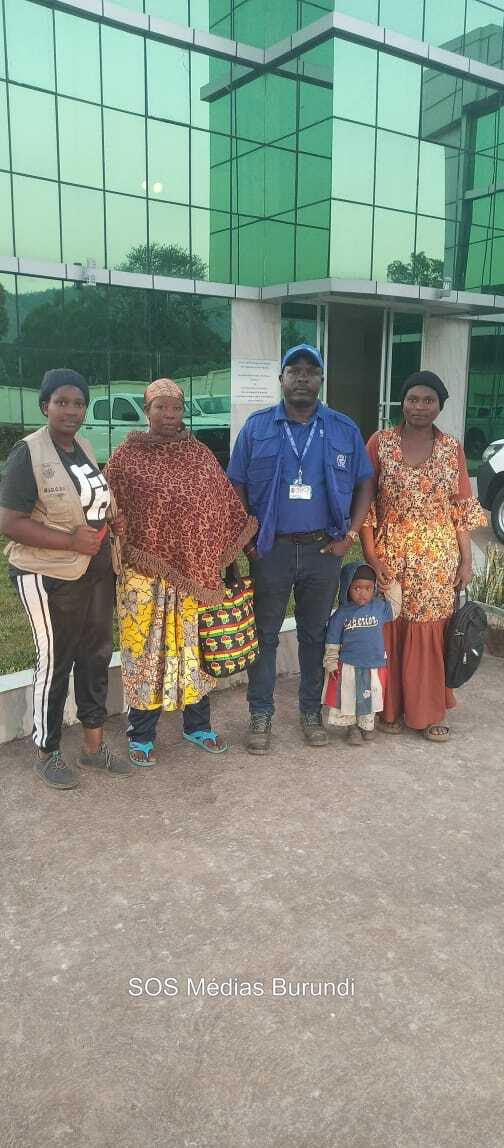
Buhumuza : the forced return of refugees from Tanzania increases pressure on an already overburdened province
SOS Médias Burundi
Buhumuza, August 26, 2026—Forced to leave the Nduta and Nyarugusu camps in Tanzania, tens of thousands of Burundian households are attempting to resettle in Burundi. The province of Buhumuza, bordering Tanzania, is receiving a large number of these returnees, while already hosting nearly 95,000 Congolese refugees. Difficulties accessing land, housing, and livelihoods are raising fears of a worsening of the already precarious situation.
Cyprien Nduwimana, regional head of the Directorate General for Repatriation and Reintegration within the Ministry of the Interior for the provinces of Gitega in central Burundi and Buhumuza in eastern Burundi, estimates that nearly 100,000 people have returned to the region after residing in Tanzania.
Most of these returnees were forced to leave the Nduta and Nyarugusu camps following decisions made by Tanzanian authorities in collaboration with the Burundian government.
Both governments cite the improved security situation in Burundi and the return to peace as justification for the repatriation process. However, several reports continue to express concerns about the security and political situation in the country.
The return has not been permanent for everyone. SOS Médias Burundi has documented the cases of former refugees who, after returning to Burundi, have gone back into exile. Some have gone to refugee camps in Uganda and neighboring Rwanda.
Buhumuza under severe pressure
Buhumuza is receiving a large number of returnees from Tanzania, according to information gathered by SOS Médias Burundi. Its proximity to the border facilitates their settlement in the region.
But their arrival is putting additional pressure on a province that already hosts a significant number of Congolese refugees who fled the violence in eastern Democratic Republic of Congo.
Buhumuza is home to nearly 95,000 Congolese refugees, primarily hosted in the camps of Bwagiriza, Kavumu, Nyankanda, and at the Busuma site.
The massive influx of Burundian returnees is thus increasing the pressure on available land, infrastructure, and basic social services in several communities.
Nearly 100,000 people have returned to the region.
Cyprien Nduwimana indicates that the majority of returnees crossed the border at Cijongwo, in Gisuru district, before reaching the provinces of Gitega and Buhumuza.
This massive influx, he says, necessitates better coordination between authorities and various partners to avoid duplication of assistance and interventions.
From the start of the repatriation process until June 30, 2026, the closing date of the Nduta and Nyarugusu camps, more than 32,000 households are estimated to have returned via the Cijongwo border. In May and June alone, 9,148 households reportedly used this route.
Land, a major concern
Cyprien Nduwimana also points out that a significant number of returnees have headed to the Kabuyenge area, located near the Tanzanian border. Some have reportedly purchased plots of land there to develop small cross-border trading businesses.
But access to land remains a major concern.
After several years in Tanzania, some returnees find their former properties in a different condition than when they left. Others do not have enough land to resume their farming activities.
Demographic pressure, particularly high in certain areas of Gitega, further complicates access to arable land.
During a meeting held on Tuesday with government partners involved in the repatriation and reintegration process, the authorities reiterated that the assistance provided to returnees to facilitate their resettlement is time-limited.
After a three-year period, support is expected to end, and beneficiaries will be expected to live independently, like other citizens.
“Repatriation should not be considered an end in itself.”
Pascal Kanani, advisor on political affairs to the administrator of Ruyigi, believes that simply returning to Burundi does not guarantee reintegration.
“Repatriation should not be considered an end in itself. Those returning must be able to regain their livelihoods and fully participate in the life of their community,” he stated.
Access to livelihoods is therefore one of the main priorities.
Agriculture, livestock farming, small-scale trade, and income-generating activities are considered essential means to enable repatriated families to gradually regain their economic independence.
Partners involved in the process are urged to prioritize projects that empower beneficiaries to become self-reliant rather than remaining dependent on assistance.
The challenge of social reintegration
Local authorities and community leaders are called upon to foster cohesion between returnees and those who remained in the country, particularly through dialogue and awareness-raising.
However, reintegration is not limited to economic issues. The return of former refugees also requires their social reintegration within their communities.
For families who have lived for many years in Tanzania, returning represents a significant change. Children born or raised in the camps must adapt to their new environment and integrate into the Burundian education system.
“Hunger and a lack of clothing are commonplace.”
Audace Ciza, originally from Ruyigi and now living in Gashurushuru, says that returning to Burundi represents a new beginning, but that living conditions remain difficult.
“Hunger and a lack of clothing and other basic necessities are commonplace,” he testifies.
Fébronie Hakiza, another returnee, states that access to land, housing, and income-generating activities are among her main concerns.
Residents of the host communities also emphasize the importance of solidarity and peaceful coexistence with the returnees.
Reintegration undermined by further departures
Burundian and Tanzanian authorities present the repatriation as a consequence of the return to peace and improved security in Burundi. However, the departure of some former refugees to other countries in the region raises questions.
SOS Médias Burundi has documented cases of former refugees who, after their return, have once again gone into exile, notably to Uganda and Rwanda.
For those involved in reintegration, the challenge now is to prevent the return from becoming a new period of vulnerability.
Partners called upon to strengthen their support
Those involved in the repatriation and reintegration process are calling for better coordination between authorities, humanitarian organizations, United Nations agencies, and beneficiary communities.
Appropriate support should enable returnees to access basic social services and develop economic activities capable of ensuring their long-term self-sufficiency.
Authorities also emphasize the need to integrate the needs of returnees into local development plans.
In a province already heavily burdened by the presence of tens of thousands of Congolese refugees, the massive influx of Burundians returning from Tanzania presents a new challenge.
The success of the process will therefore depend not only on the number of people who have crossed the border to return to the country, but above all on their ability to rebuild a dignified life, to access land and essential services, to engage in economic activity and to live in harmony with the host communities.
You might also like
DRC : a truce announced between Kinshasa and the M23 under Qatari mediation, but fighting continues in the east
SOS Médias Burundi Despite a joint declaration announcing a truce between the Congolese government and the M23 under the auspices of Qatar, armed clashes continue in the eastern Democratic Republic
Mahama (Rwanda) : a WFP data update raises concerns
SOS Médias Burundi Mahama, October 13, 2025 — The World Food Program (WFP) has launched an exercise to update the data of its beneficiaries in the Mahama refugee camp in


Mahama (Rwanda) : poor quality of health services
In the Mahama camp in Rwanda, refugees denounce poor quality of services provided in dispensaries. Only urgent cases are handled. This happens at a time when the new manager of