Burundi : Ndayishimiye accuses Kagame of planning the extermination of Hutu students in 1995
SOS Médias Burundi
Gitega, November 23, 2026 — Burundian President Évariste Ndayishimiye accuses his Rwandan counterpart, Paul Kagame, of planning the massacre of Hutu students at the University of Burundi in June 1995. According to Ndayishimiye, the current Rwandan president, who at the time held the positions of vice-president and Minister of Defense, gathered Tutsi students at the Kiriri campus in the commercial capital, Bujumbura, to incite them to kill their Hutu classmates. The Burundian head of state spoke on Saturday, November 21, at the Ingoma Stadium in Gitega, Burundi’s political capital, at the closing ceremony of the Veterans’ Week, dedicated to former combatants of the CNDD-FDD, the former Hutu rebellion that had been in power since 2005. The movement had participated in the negotiations that led to the signing of the Arusha Peace and Reconciliation Agreement in Tanzania on August 28, 2000. The Burundian civil war, which began in 1993, resulted in approximately 300,000 deaths, according to some international estimates.
Reflecting on the circumstances that led him to join the Forces for the Defense of Democracy (FDD) rebellion, which later became the CNDD-FDD, Évariste Ndayishimiye asserted that only this movement had truly fought for democracy. He notably downplayed the role of other Hutu armed organizations that existed before it.
“Before President Ndadaye’s assassination, there was a movement called Palipehutu. However, it never waged war as it had promised,” he stated.
The president situated his involvement in the context of the violence that followed the assassination, in October 1993, of Melchior Ndadaye, Burundi’s first democratically elected Hutu president. According to him, the massacres of Hutus committed by soldiers of the Burundian army, which he described as a Tutsi-dominated army, drove Hutu students and teachers to join the rebellion.
“When they assassinated Head of State Melchior Ndadaye, that’s when we understood that with a Tutsi-dominated army, democracy was impossible. Furthermore, the soldiers roamed every corner of the country, mercilessly killing anyone who wasn’t of their Tutsi ethnicity,” he asserted.
He added that this violence had led Hutus to seek refuge in the Kibira forest, near Teza, where rebel fighters were located.
However, in his account, the president did not mention the massacres of Tutsis committed in several regions of Burundi after the assassination of Melchior Ndadaye. This violence, perpetrated by Hutu groups, resulted in thousands of victims. An international commission of inquiry mandated by the United Nations concluded that acts of genocide against the Tutsis had occurred during the events of October 21, 1993, and the days that followed. It notably established that Hutu leaders had participated in these massacres. The reprisals carried out by the army, which was predominantly Tutsi at the time, also resulted in thousands of Hutu victims.
Hutu intellectuals accused of cowardice
Évariste Ndayishimiye also attacked Hutu intellectuals who had refused to join the rebellion. He criticized them for believing that their level of education would allow them to assume political responsibilities without participating in the armed struggle.
The president recounted that an intellectual he had asked to join the rebellion replied, “Not all generals go to the front.”
The head of state thus defended the role of veterans in the conquest of power, recalling the sacrifices made during the war years.
Kagame directly implicated in the 1995 massacres
The most serious accusation leveled against him concerned Paul Kagame. Évariste Ndayishimiye claimed that the current Rwandan president held a meeting with Tutsi students at the Kiriri campus of the University of Burundi in the commercial capital, Bujumbura, to incite them to massacre their Hutu classmates.
“Even President Paul Kagame, when he was Vice-President of Rwanda and Minister of Defense, met with Tutsi students at the Kiriri campus to carry out massacres of Hutu students,” he stated.
He then recounted the remarks he attributes to Kagame during this meeting. According to his account, the Rwandan official said he didn’t understand how Tutsi students could sit with Hutu students, given that Hutus had committed genocide against the Tutsis in Rwanda.
“We will never forget it. Some people think we have forgotten,” Ndayishimiye insisted.
He added that some people had asked him if this meeting had actually taken place. His answer, he explained, is to invite the skeptics to ask those who were attending the university at that time.
The Burundian president’s accusations against Paul Kagame were not accompanied, in his statement, by any documents or evidence that would allow for independent verification of the meeting and the remarks he attributes to him. The Rwandan presidency and the Rwandan government had not immediately responded to these statements.
The massacres of Hutu students at the University of Burundi took place on the night of June 11, 1995. They affected the Mutanga, Kamenge, and Kiriri campuses in the commercial capital, Bujumbura, as well as the Zege campus in the political capital, Gitega.
Évariste Ndayishimiye was among the Hutu students who joined the rebellion after these events. His involvement in the armed movement led him to hold several positions of responsibility within the CNDD-FDD, before his rise to the presidency in 2020.
The Truth and Reconciliation Commission (CVR) has undertaken investigations to establish the identities of the victims and recover their remains. In 2020, its chairman, Pierre Claver Ndayicariye, announced that 109 of the slain students had been identified.
“Of the 14 mass graves already excavated, we have not yet found a mass grave where these students were thrown.” “Some testimonies say they were thrown into the Rusizi River or the Rukoko natural reserve, but our search continues,” he said.
Conflicting memories continue to divide
Ndayishimiye’s statements come in a context where the inter-ethnic violence that has marked Burundi’s history continues to be subject to divergent interpretations.
In December 2021, the Truth and Reconciliation Commission (CVR) classified the 1972-1973 massacres, which primarily claimed the lives of Hutus, as genocide. However, in May 2022, Évariste Ndayishimiye refused to endorse this classification, believing that the time was not yet right.
For their part, Tutsi rights organizations continue to demand recognition of the 1993 massacres as genocide against this community. They criticize the Truth and Reconciliation Commission (CVR) for prioritizing research on Hutu victims of 1972 and not paying sufficient attention to Tutsi victims of 1993, particularly regarding the search for their remains and the identification of mass graves. Some also denounce the obstacles encountered during commemorations.
Relations between Burundi and Rwanda also remain deeply strained. In January 2024, Burundi closed its land borders with Rwanda after accusing Kigali of supporting the RED-Tabara armed group, which is fighting the Burundian government. Rwanda rejected these accusations and criticized Gitega’s decision.
The rivalry between the two countries is also evident in the conflict ravaging eastern Democratic Republic of Congo. Burundi has deployed troops from the Burundi National Defense Force (FDNB) alongside Congolese forces and the Wazalendo militias, supported by Kinshasa, who are fighting the M23 and its allies in the Front for the Refoundation of the Nation (FRN). Kinshasa and Gitega accuse Kigali of supporting the rebel movement. Rwanda continues to deny these allegations and, for its part, accuses Burundi and the DRC of collaborating with the FDLR, a Rwandan Hutu armed group whose members are accused of participating in the 1994 genocide against the Tutsis.
Évariste Ndayishimiye has repeatedly made threatening remarks toward Rwanda. He notably stated that Burundian troops were ready to march to Kigali if war broke out between the two countries. His recent accusations against Paul Kagame have thus reignited tensions between Gitega and Kigali, fueled by security, political, and historical rivalries.
More than 670 Burundians suspected of participating in the Rwandan genocide
Tensions between the two countries are also fueled by legal cases related to the 1994 genocide against the Tutsis in Rwanda. Rwandan judicial authorities had compiled a list of more than 670 Burundian nationals suspected of participating in the genocide. Some of those wanted were reportedly Burundian refugees who had been living in Rwanda since 1989, while others allegedly crossed the border in 1994 to take part in the massacres alongside the Interahamwe.
These suspicions were based in particular on testimonies gathered before the Gacaca courts, community-based tribunals established in Rwanda after the genocide to try many of those accused of participating. Organized at the local community level, these courts relied heavily on the testimonies of residents and the participation of the population in the hearings.
Kigali regularly criticizes Gitega for not cooperating sufficiently in prosecuting individuals suspected of involvement in the genocide who may be present on the Burundian territory, particularly regarding extradition and trial.
Burundian authorities and several CNDD-FDD officials have repeatedly denied or downplayed the genocide committed against the Tutsis in Rwanda in 1994. Among them is Révérien Ndikuriyo, secretary-general of the ruling party, who notably declared in January 2025 : “We don’t care about the genocide against the Tutsis.”
———-
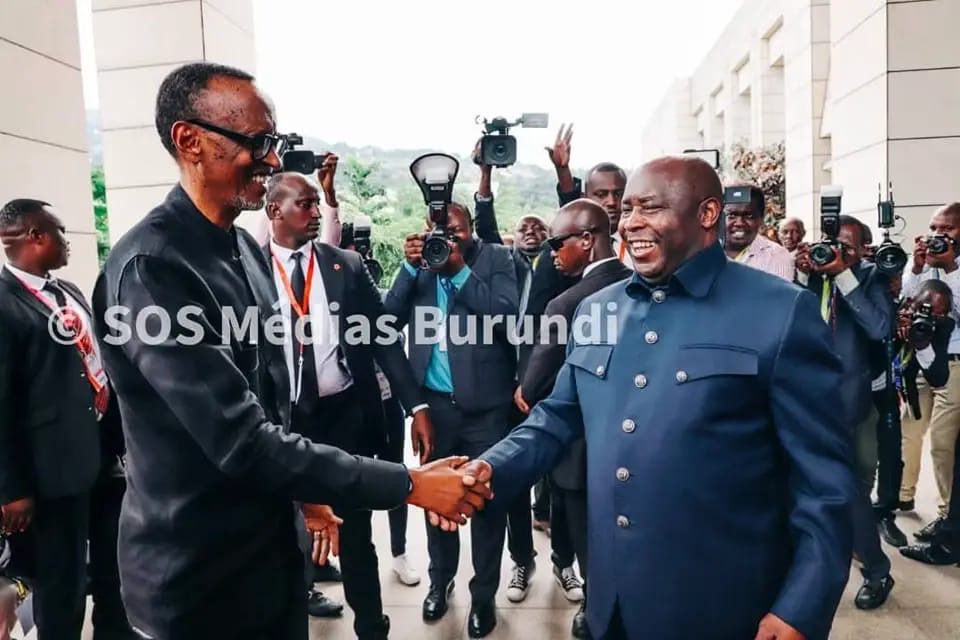
Burundian President Évariste Ndayishimiye and Rwandan President Paul Kagame shake hands during the extraordinary summit of heads of state of the East African Community (EAC), held in Bujumbura, Burundi’s commercial capital, on February 4, 2023. On November 21, 2026, in Gitega, Évariste Ndayishimiye accused his Rwandan counterpart of having planned the massacres of Hutu students at the University of Burundi in June 1995, an accusation he did not substantiate with evidence during his speech (SOS Médias Burundi)
You might also like
Ituri : 27 civilians killed and 11 missing in new attacks attributed to the ADF
SOS Médias Burundi Mambasa, July 26, 2026 — At least 27 civilians have been killed and 11 others are missing following a new series of attacks attributed to the Allied
Itaba : a couple arrested for infanticide
A tragedy has rocked Nkima village, in Itaba district, Gitega province. A couple was arrested on Monday, March 17, 2025, on suspicion of infanticide. INFO SOS Médias Burundi According to

Mutambara : when a murder hides behind a presumed suicide
SOS Médias Burundi Rumonge, August 4, 2025 – A gruesome discovery has shocked the population of Kagoti, in Mutambara village, Rumonge district, in Burunga province, southern Burundi. On the morning