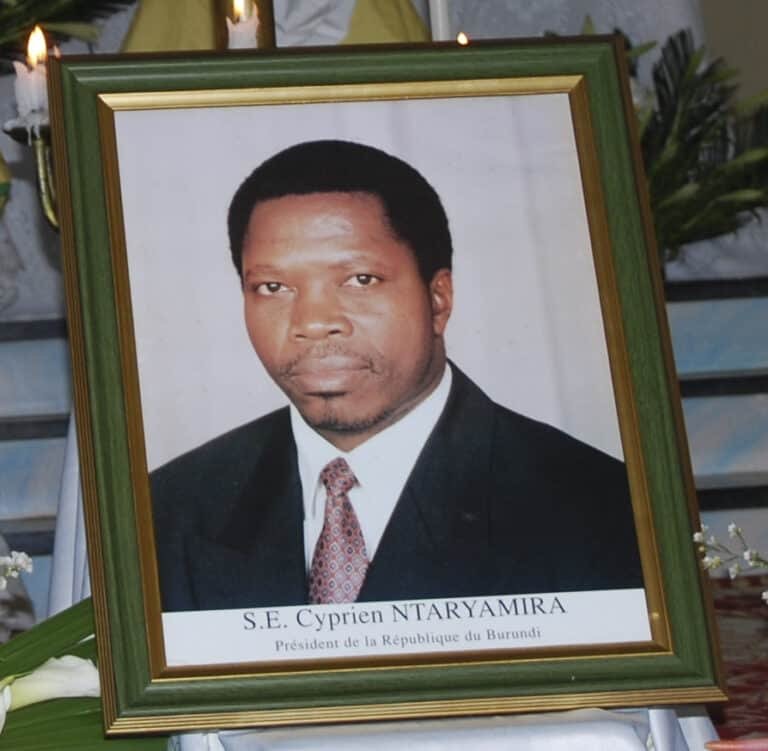
Ntaryamira : 32 years later, a memory fades in silence
SOS Médias Burundi
Bujumbura, April 7, 2026 — Burundi commemorated the 32nd anniversary of the tragic death of President Cyprien Ntaryamira on Monday, April 6. He died in a plane crash in Kigali in 1994. The tragedy, which also claimed the lives of two of his ministers, occurred as he was returning from a summit of heads of state in Tanzania.
April 6 is a public holiday in Burundi, dedicated to his memory. Yet, this year again, the commemorations took place with relative discretion, far removed from the fervor of the national ceremonies of the past.
On April 6, 1994, the presidential plane, which also carried Rwandan President Juvénal Habyarimana, was shot down as it was about to land in Kigali. This attack, which remains unsolved, immediately triggered the genocide against the Tutsis in Rwanda, which, according to the Rwandan government, claimed nearly one million lives in just one hundred days.
A somber commemoration
At Regina Mundi Cathedral in the commercial capital, Bujumbura, a simple mass was celebrated to commemorate President Cyprien Ntaryamira. In his homily, Father Félix Fupi recalled the significance of Ntaryamira’s messages, highlighting his leadership as a source of hope during a period of profound instability. He stated that Ntaryamira’s speeches resonated deeply with Burundians, embodying a desire for reconciliation and national recovery that was brutally cut short.
An unfinished quest for truth
Gabriel Banzawitonde, president of the Alliance for Peace, Democracy, and Reconciliation political party, called for this historic date not to be trivialized and for the search for truth surrounding the assassination of Cyprien Ntaryamira to continue. He urged the authorities to bring justice to the victims’ families, emphasizing that Ntaryamira’s memory should not be reduced to a mere formality.
A fragile political legacy
For Banzawitonde, Ntaryamira’s legacy—particularly his emphasis on discipline and integrity—remains essential for the future of the small East African nation. The Sahwanya Frodebu party, to which Ntaryamira belonged, as well as his family, continue to demand truth and justice, more than three decades after the events.
A difficult historical context
Ntaryamira’s rise to power on February 5, 1994, occurred during a period of major crisis. He succeeded Melchior Ndadaye, Burundi’s first democratically elected Hutu president, who was assassinated on October 21, 1993, after only 102 days in office. His death plunged the country into widespread violence, marked by massacres of Tutsis across the territory, which several human rights organizations have described as genocide.
Founder of the Sahwanya Frodebu party, Ndadaye embodied a historic break with the past and carried the hopes for a democratic transition in a deeply divided country. His brutal death plunged Burundi into a major political and security crisis, the aftereffects of which are still visible today. Ntaryamira thus inherited a country on the brink of chaos, where every decision was fraught with consequences.
The widow’s rare but significant statement
In 2024, Ntaryamira’s widow broke her silence to clarify the issue of compensation. She stated, in particular, that contrary to some misconceptions, the Rwandan authorities had provided the families with supporting documentation. “Contrary to what people are saying, Rwanda hasn’t blocked everything for us,” she declared.
A fading memory and ignored international responsibilities
In the streets of Bujumbura, where the monument to the martyrs of democracy stands—a place where authorities, political party representatives, diplomats, families, and citizens once gathered to pay their respects—the commemoration took place with restraint and discretion. Thirty-two years later, a question remains : is the memory of Cyprien Ntaryamira gradually fading or is it being transformed by indifference?
For some, the memory remains vivid, a poignant reminder of the ideals of justice and reconciliation championed by the assassinated president. For others, it seems to be fading, in a country grappling with other priorities, while the truth about this historical tragedy remains elusive.
The official silence and lack of concrete answers reveal a complex geopolitical reality : responsibilities remain unclear, international investigations have failed to determine the role of Rwanda or other regional actors in the tragedy, and regional justice struggles to impose credible responses. For many Burundians, this prolonged impunity illustrates not only the fragility of institutions but also the influence of political considerations on national memory.
Without transparency or genuine commitment from international bodies, the memory of Cyprien Ntaryamira risks becoming a half-forgotten symbol, while the quest for truth and justice remains unfinished, painfully suspended between memory and oblivion.
You might also like
Bujumbura : the Constitutional Court has deemed opponents’ complaints admissible but has given them a very limited deadline to correct irregularities
The Constitutional Court of Burundi has accepted the complaints of the only political coalition of the opposition “Burundi Bwa Bose” and the CNL party. But they will have to rearrange
Burunga : a UPRONA official and his family victims of a punitive expedition
SOS Médias Burundi Burunga, September 16, 2025 – In Burunga province, southern Burundi, a local UPRONA official and his family were violently attacked. This incident once again illustrates the political

Burundi : the lower house renewed the CVR team without the presence of the CNL
This Friday evening, the National Assembly adopted and renewed the team of the Truth and Reconciliation Commission (CVR). The activity took place in the absence of deputies of the main