DRC: Ndayishimiye, Tshisekedi’s ally, called upon to play mediator role in the face of a wary opposition
SOS Médias Burundi
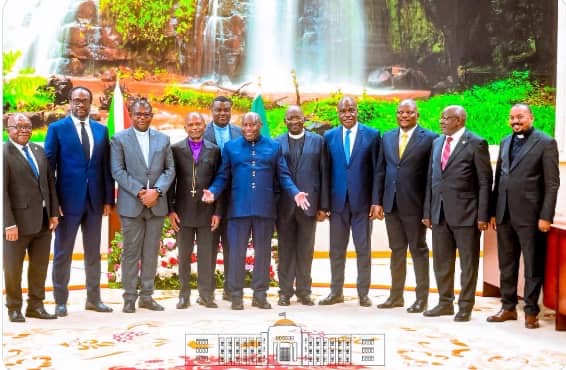
Bujumbura, July 8, 2026 – Burundian President and current Chairperson of the African Union, Évariste Ndayishimiye, received a Congolese delegation on Monday in Bujumbura, Burundi’s commercial capital. The delegation comprised leaders of opposition political parties and representatives of the main religious denominations in the Democratic Republic of Congo (DRC). Presented as an initiative to foster dialogue among Congolese actors, this meeting comes amid heightened political and security tensions in the DRC. However, some circles accuse the Burundian head of state of having been approached by Kinshasa to influence a segment of the Congolese opposition.
These accusations, circulating in certain political circles and on social media, are not accompanied by any public evidence at this stage and have not been confirmed by either the Burundian authorities or the members of the delegation received.
The Congolese delegation included representatives of the C64 Coalition, the National Episcopal Conference of Congo (CENCO), the Church of Christ in Congo (ECC), and the Platform of Religious Denominations and Revival Churches in the DRC.
According to the Burundian Presidency, the initiative was organized by Évariste Ndayishimiye in his capacity as Chairperson of the African Union to encourage dialogue between the various Congolese political and religious actors.
Mediation in an explosive political climate
This meeting comes at a time when the DRC is experiencing a period of political tension fueled in particular by debates surrounding a possible constitutional revision.
Part of the Congolese opposition accuses President Félix Tshisekedi of wanting to amend the Constitution to allow him to run for a third presidential term, even though the current constitution limits the number of terms to two. Congolese authorities reject these accusations and maintain that institutional discussions fall within the scope of national political debate.
Sources close to the Congolese presidency indicate that Félix Tshisekedi has requested the involvement of his Burundian counterpart to facilitate talks with certain opposition figures.
A mediator whose neutrality is being questioned
The role assigned to Évariste Ndayishimiye is raising questions due to his close relationship with Félix Tshisekedi.
The two leaders share a common view on the security crisis in eastern DRC and accuse Rwanda of supporting the M23 rebel movement, an accusation Kigali denies.
This close political and security relationship has led some observers to question Gitega’s perceived neutrality in a process intended to bring the Congolese government and its opponents closer together.
In some political circles, accusations are circulating that the Burundian president was tasked with convincing certain Congolese opposition figures to align themselves with the Kinshasa government. No public evidence supports these claims.
The C64 Coalition was present, the AFC/M23 was absent
Among the participants was the C64 Coalition, a Congolese opposition political platform whose name refers to Article 64 of the DRC Constitution.
This article stipulates that every Congolese citizen has a duty to resist any person or group of individuals who seize or exercise power by force or in violation of constitutional provisions.
However, the Congo River Alliance (AFC), the political-military coalition to which the M23 is affiliated, was not represented in Bujumbura.
The AFC/M23 has controlled several areas in the provinces of North Kivu and South Kivu, in eastern DRC, for over a year and a half, where it has established parallel administrative structures in the territories under its influence.
His absence is noteworthy, especially given that the security crisis in eastern Congo is a major source of tension between Kinshasa and its adversaries.
Some observers believe that a dialogue process concerning the political and security future of the DRC could hardly ignore an armed actor playing a central role in the current conflict.
Gitega and Kinshasa : strengthened relations
This meeting comes a few days after the visit of President Évariste Ndayishimiye and First Lady Angeline Ndayishimiye to Kinshasa, reinforcing ties between Gitega and Kinshasa in a context marked by the political and security crisis in the DRC.
This diplomatic development comes at a time when Burundi and the Democratic Republic of Congo maintain close cooperation on several issues, particularly in the security sector.
The two heads of state consider Rwanda a destabilizing actor in the Great Lakes region and accuse Kigali of supporting the M23, an accusation rejected by Rwandan authorities.
For several years, Burundian soldiers have been deployed in eastern DRC alongside the Armed Forces of the Democratic Republic of Congo (FARDC) and armed groups allied with Kinshasa, known as Wazalendo, in the fight against the M23.
This cooperation has strengthened ties between the two countries, but also fuels criticism from those who believe Burundi cannot be seen as a completely impartial mediator.
The Banyamulenge issue, another controversial episode
This involvement also recalls another meeting organized by the Burundian president with Congolese stakeholders.
About four months ago, Évariste Ndayishimiye received representatives of the Banyamulenge community living in the DRC and in the diaspora in Gitega.
They claimed to oppose what they called “Rwandan manipulation,” while intense fighting continued in the Minembwe highlands of South Kivu, a region where a significant portion of this community lives.
Banyamulenge representatives in the diaspora and in the DRC denounced the meeting, arguing that some participants did not represent their community’s concerns and calling them “sellouts.”
A risky diplomatic gamble for Ndayishimiye
By getting involved in the Congolese crisis, Évariste Ndayishimiye is seeking to strengthen his role as a regional diplomatic player during his presidency of the African Union.
But this mission remains delicate : between his close relationship with Félix Tshisekedi, the mistrust of part of the opposition, and the absence of certain key players in the armed conflict, the Burundian president will have to demonstrate his ability to play a mediating role accepted by the various parties.
You might also like
DRC: tensions and refugees’ repatriation under the watchful eye of the M23 in the east of the country
SOS Médias Burundi Goma, August 27, 2025 – The Rutshuru territory in North Kivu and the city of Goma, the provincial capital, are experiencing new tensions linked to the operations
Ngozi : a Musasa refugee representative behind bars after allegations of abuse, relatives denounce harassment
SOS Médias Burundi Ngozi, July 29, 2026 – Matabaro Ntawigira, a representative of the Barundi community from the Rusizi Plain among Congolese refugees in Burundi, has been detained since July

South Kivu : Twirwaneho armed group and M23/AFC-M23 claim to have fallen Point Zero, the main stronghold of the FARDC and FDNB in the highlands
SOS Médias Burundi Minembwe, July 6, 2026 — The Twirwaneho armed group and the M23/AFC-M23, affiliated with the Congo River Alliance (AFC-M23) political-military coalition, claim to have taken control of