
Photo of the week-Buhumuza : fines, prison threats, and mandatory construction : new measures sowing fear
In Buhumuza province, eastern Burundi, the mandatory paving of private land providing access to national roads, the campaign to eliminate thatched houses, and new conditions imposed on couples getting married are sparking heated debate. Presented by the authorities as measures to accelerate the province’s modernization in line with the Burundi Vision 2040-2060, these decisions are also generating concern and criticism among a segment of the population facing numerous economic hardships.
The Burundi Vision 2040-2060 is a long-term national development strategy developed by the Burundian government. It aims to make Burundi an emerging country by 2040 and a developed country by 2060. This vision places particular emphasis on infrastructure modernization, housing improvement, urbanization, agricultural transformation, industrialization, human capital development, governance, and attracting investment. The authorities thus present housing and urban planning measures as actions contributing to achieving these objectives.
In various districts of Buhumuza, provincial authorities are progressively implementing the requirement to pave private spaces bordering national roads. According to them, this initiative aims to beautify urban centers, reduce dust, combat erosion, improve sanitation, and make the province more attractive to investors.
At the same time, the campaign against thatched houses continues. The authorities consider this type of housing incompatible with the country’s modernization goals.
At a meeting held on Monday, June 30, with technical and financial partners as well as local and international non-governmental organizations involved in the province’s development, the governor of Buhumuza, Denise Ndaruhekere, indicated that more than 52,000 homes in the province still had thatched roofs.
She called on development partners to integrate housing improvement into their programs to accelerate the replacement of thatched roofs with sustainable materials.
On this occasion, the governor also announced that, in the future, any couple wishing to marry will have to build a house made of fired bricks with a corrugated iron roof before the wedding ceremony. According to her, couples who do not meet this requirement will have to wait before celebrating their union.
Sanctions that worry residents
Regarding the paving of private areas providing access to national roads, provincial authorities have launched a campaign to enforce administrative sanctions against households that have not complied with this obligation.
According to several residents interviewed in various districts of Buhumuza, administrative fines ranging from 100,000 to 500,000 Burundian francs have already been imposed on some households.
Several of them also stated that they had been warned that persistent refusal to comply with this measure could lead to imprisonment.
These announcements have provoked numerous reactions among young people, parents, and other residents of the province.
Some acknowledge that these measures could help improve Buhumuza’s image, strengthen housing security, and accelerate the province’s development.
Others, however, believe that the imposed requirements exceed the financial means of many households. They cite the high cost of building materials, the economic difficulties faced by many families, and the potential impact of administrative sanctions on the most vulnerable households.
For many residents, the announcement of possible prison sentences has heightened anxieties among the population.
The governor defends the measures
Faced with criticism, Denise Ndaruhekere maintains her position. She asserts that these decisions are mandatory measures taken by the government as part of the country’s modernization, in accordance with the Burundi Vision 2040-2060.
According to her, sufficient time has been given to the population to allow everyone to prepare for their implementation.
The governor believes that the criticism stems primarily from what she calls “negativists,” whom she accuses of systematically opposing the government’s actions, programs, and projects aimed at promoting Burundi’s development.
She warned that any opposition to these measures would be “null and void” and called on the population to respect the authorities’ decisions.
Surged prices complicate housing modernization
These new measures come amid a context marked by a continuous rise in the prices of construction materials and labor.
The price of a bag of cement now ranges from 55,000 Burundian francs (Bif) for cement produced locally by the Burundi Cement Company (BUCECO) to 75,000 Bif for cement imported from Zambia, the Democratic Republic of Congo (DRC), or Tanzania.
The price of BG 32 single-layer corrugated metal roofing sheets, widely used for roofing, has risen from 33,000 Bif to 55,000 Bif, an increase of approximately 66.7%.
Finishing materials have also seen a sharp increase. A 20-liter bucket of water-based paint currently costs 135,000 Bif, while a 4-liter can of concentrated paint sells for 45,000 Bif.
In addition to this increase in material costs, there has also been a rise in labor costs. Depending on the district, a mason’s daily wage ranges from 25,000 to 35,000 Bif. A mason’s assistant earns between 15,000 and 20,000 Bif per day.
According to surveys conducted on the local market, several imported materials have also experienced significant price increases in recent months. The price of 60 x 40 mm metal tubing has increased by approximately 20%, followed by 8 mm rebar at 13.33%, board nails at 12.5%, tile cardboard at 8.7%, and plywood at 6.25%.
This price surge makes access to decent housing even more difficult for low-income households.
Between development ambitions and social realities
For the authorities, these reformsk represent a necessary step towards a more modern and better-planned Burundi.
But for a segment of the population, the priority remains meeting basic daily needs : food, access to healthcare, and children’s education.
Several observers believe that the success of this policy will depend not only on the implementation of the announced measures, but also on the ability of the authorities and their partners to support the most vulnerable households.
For families still living under thatched roofs, the challenge isn’t simply choosing between straw and corrugated iron. It’s primarily about having necessary resources to improve their living conditions.
It is within this economic and social reality that the future of the housing modernization policy in Buhumuza will be determined.
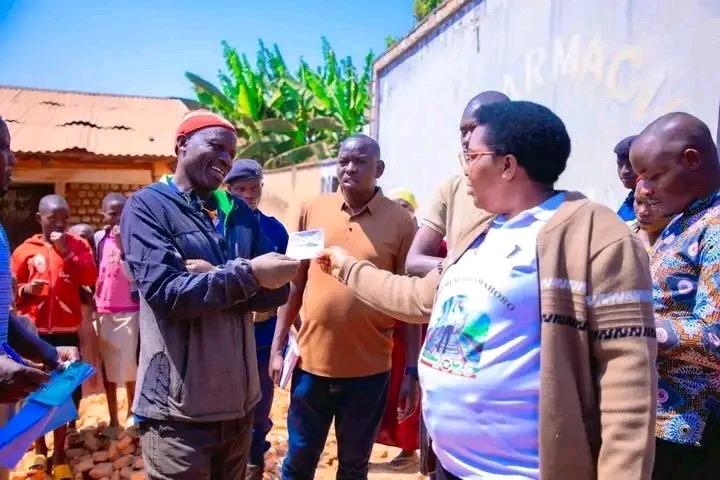
Our photo : the governor of Buhumuza province hands over a report imposing a fine of 300,000 Burundian francs on a resident for failing to comply with the requirement to pave the private space providing access to the national highway
You might also like
Photo of the week : Victoire Ingabire’s hearing postponed, opposition leader calls for Kenyan legal team
Rwandan opposition leader Victoire Ingabire appeared before a court on Tuesday July 8 in Kigali (capital of Rwanda) for a bail hearing. This was her first public appearance since her

Photo of the week : Évariste Ndayishimiye nominated as CNDD-FDD candidate for a second term amid a show of force
In Gitega, the political capital of Burundi, the ruling CNDD-FDD party nominated President Évariste Ndayishimiye as its candidate for re-election in the 2027 presidential election on Sunday, April 26, 2026,

Photo of the week : the President of the National Assembly prohibits deputies from denouncing the current crisis, intends to reintroduce the death penalty for those disrupting the economy
The lower house of the Burundian parliament on Thursday passed the general State’s budget for 2024-2025 financial year. Some deputies have denounced since Wednesday when the Vice- President of the