
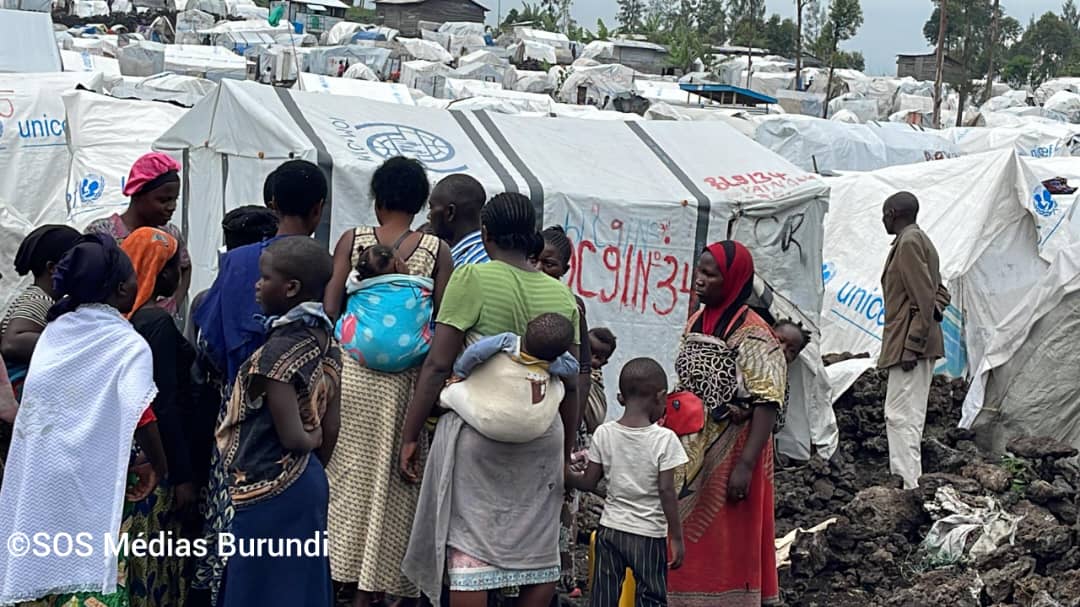
DRC : over 3 million displaced people have returned, but without any assistance, OCHA warns
SOS Médias Burundi
Goma, August 11, 2025 – According to the latest report from the United Nations Office for the Coordination of Humanitarian Affairs (OCHA), more than three million internally displaced people have returned to their villages since January 2025 in the Democratic Republic of the Congo (DRC). This return movement, observed mainly in the eastern provinces of the country, contrasts, however, with the persistence of a critical humanitarian situation.
OCHA explains that these returns are largely explained by a relative lull in violence in certain areas. In North Kivu, nearly two million displaced people have been able to return, although a million others remain in camps inside the country. In South Kivu, more than 600,000 people have returned to their villages, compared to 1.5 million who still live in internal exile.
The report also highlights that in some areas, such as Goma (provincial capital) and Nyiragongo in North Kivu, returns have been forced following the dismantling of displacement sites. In South Kivu, they mainly concern populations from Idjwi, Minova, and Kalehe. The areas where these returns are occurring are now under the control of the M23, a rebel movement affiliated with the Congo River Alliance (AFC), a politico-military group hostile to Kinshasa.
Despite these returns, OCHA notes that 8.3 million internally displaced people still need humanitarian assistance in the DRC. Many of them have fled to the neighboring provinces of Ituri, Tanganyika, and Maniema due to the ongoing violence, particularly in the Masisi and Uvira territories, located in North Kivu and South Kivu respectively.
Furthermore, the resumption of fighting between the Congolese army and the AFC-M23 in the east of the country risks exacerbating an already critical crisis. Humanitarian agencies are sounding the alarm over funding deemed largely insufficient to meet the scale of the needs.
During a visit to the DRC in June, UN Under-Secretary-General for Humanitarian Affairs Tom Fletcher denounced the deteriorating situation on the ground. He stated that he had witnessed the plight of populations facing both epidemics and violence, particularly sexual violence, suffered by women in conflict zones.
You might also like
Nyarugusu (Tanzania): mpango wa chakula PAM (WFP) uligawa maharagwe yasioweka kutumiwa na wakimbizi
Mwishoni mwa mwezi oktoba, PAM (mpango wa chakula duniani) ulitoa maharagwe ya viwango vibaya kwa wakimbizi katika kambi ya Nyarugusu nchini Tanzania. Wakimbizi walitoa malalamiko kwa HCR na uongozi wa
Buhumuza : the return of repatriates exposes the unpreparedness of authorities in schools
SOS Médias Burundi Cankuzo, August 26, 2026 — The massive influx of Burundian pupils repatriated from Tanzania risks exacerbating the shortage of classrooms and desks in Buhumuza province, eastern Burundi,

Crisis in Nakivale : refugees forced to drink water from dry lakes and wells for three months
SOS Médias Burundi Nakivale, Uganda, March 9, 2026 – All the taps in the Nakivale camp have been dry for nearly three months, leaving more than 150,000 refugees, including over