Gatumba : 166 refugees massacred, 22 years of impunity, the Banyamulenge speak out
SOS Médias Burundi
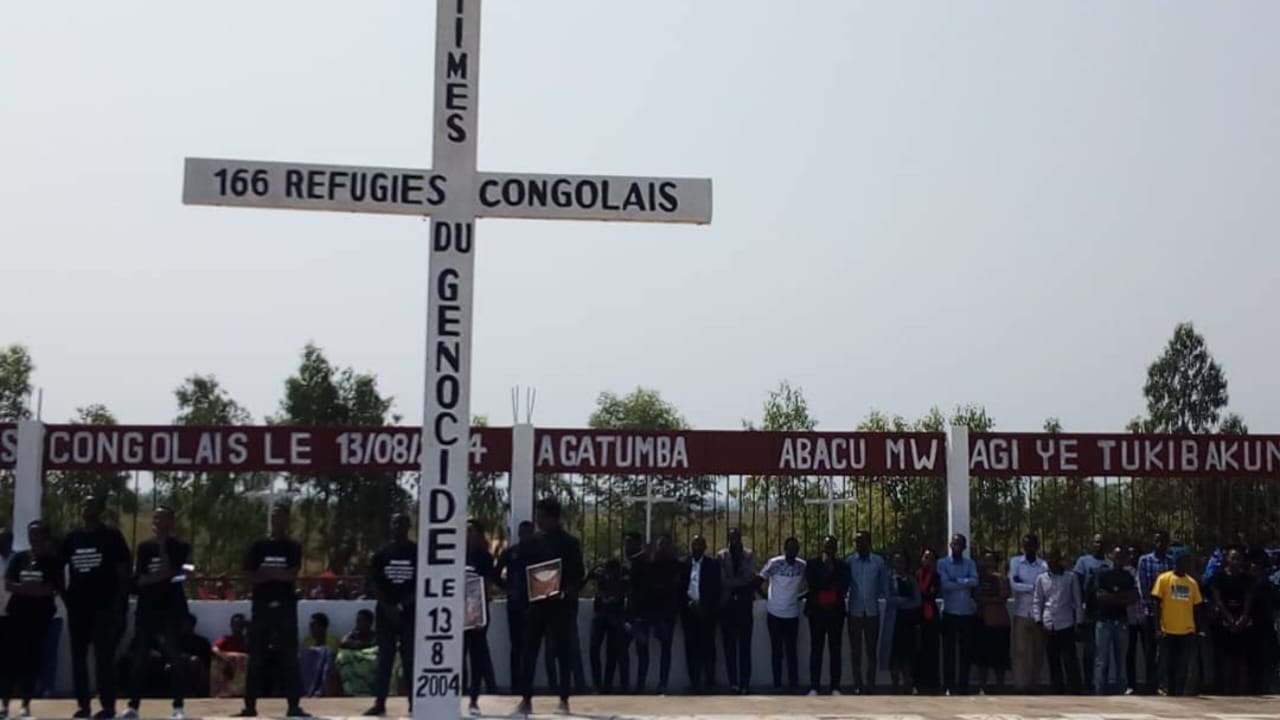
Bukavu, August 13, 2026 — Twenty-two years after the Gatumba massacre, which claimed the lives of 166 Congolese refugees in western Burundi, the Banyamulenge community of Bukavu denounces the lack of justice and demands that those responsible finally be brought to justice. Survivors, families of the victims, young people, and students commemorated this tragedy on Thursday, marked by poignant testimonies and the reading of the names of the deceased.
The Banyamulenge community of Bukavu, in South Kivu province, gathered on Thursday at the Résidence Hotel to commemorate the 22nd anniversary of the Gatumba massacre.
Relatives of the victims, survivors, young people, students, and numerous supporters took part in this ceremony dedicated to the memory of those killed in this tragedy.
On August 13, 2004, 166 Congolese refugees were massacred in a UN-run transit camp in Gatumba, near the border between the Democratic Republic of Congo (DRC) and Burundi. Among the victims were 154 members of the Banyamulenge community and 12 members of the Babembe community.
A ceremony to remember
The commemoration was marked by several moments of reflection.
Young women sang songs of consolation in memory of the victims, while students read aloud, one by one, the names of the refugees killed in the attack.
For the participants, this ceremony represents a duty to remember those who lost their lives and a way to pass on their story to future generations.
The victims had fled the fighting in the DRC before being sheltered in a UN-run transit camp in Gatumba, Bujumbura province, western Burundi.
“I saw my friends, children, fathers, and mothers killed.”
Among those present was Mugabe Commando, one of the survivors of the massacre.
With emotion, he recounted the night of August 13-14, 2004.
“It was around 10 p.m. in Gatumba. We heard people singing, then gunfire. People started being killed. Others were burned alive in buildings with gasoline. I saw my friend Askof killed. My uncle was wounded. My little brother and I ran outside.”
His testimony illustrates the violence of the attack and the trauma that continues to haunt the survivors and the families of the victims, more than two decades later.
“Those who killed our brothers walk free”
For Vincent Runezerwa, vice-president of the Banyamulenge Mutual Aid Society of Bukavu, the lack of justice remains a profound source of pain for the families and the community.
He calls on Congolese and Burundian authorities, as well as the international community, to work to ensure that those presumed responsible for the massacre are prosecuted.
“For 22 years, we have demanded justice. We ask the international community, our country, and neighboring countries to deliver justice. Those who killed our brothers walk free, without fear. But we remain hopeful that one day, those who killed our brothers in Gatumba will be brought to justice.”
The participants reiterated their demand for a full investigation into the circumstances of the massacre and for those presumed responsible to be held accountable for their actions before the courts.
The FNL claimed responsibility for the attack before retracting it
The massacre, perpetrated on the night of August 13-14, 2004, was initially claimed by the National Liberation Front (FNL), then a Burundian Hutu rebel movement.
Pasteur Habimana, who was the FNL spokesperson at the time, assumed responsibility for the attack before retracting his statement.
Several legal proceedings were subsequently initiated in the DRC, Burundi, and Rwanda, as well as with the International Criminal Court (ICC).
The massacre was also documented by Human Rights Watch and several United Nations agencies, including the UN missions in the DRC and Burundi, and the Office of the United Nations High Commissioner for Human Rights.
Bukavu under AFC-M23 control
The city of Bukavu, capital of South Kivu province in eastern DRC, is now among the main areas controlled by the AFC-M23 political-military coalition, led by Corneille Nangaa, former president of the Independent National Electoral Commission (CENI).
AFC-M23 rebels seized control of Bukavu in mid-February 2025, after several days of advancing in South Kivu.
The coalition claims to be advocating for political reform in the DRC and the establishment of a federal state. Kinshasa, for its part, accuses the AFC-M23 of being supported by Rwanda, an accusation regularly rejected by Kigali.
The civil society denounces the rhetoric of hate
The ceremony in Bukavu also provided an opportunity for civil society actors in South Kivu to denounce hate speech and acts of discrimination targeting the Banyamulenge community.
Speakers advocated for strengthening peace, social cohesion, and respect for the rights of all communities living in the DRC.
This year, several commemorative activities were also organized in various African countries, in camps hosting members of the Banyamulenge community in the Great Lakes region, as well as in Europe and North America.
Twenty-two years after the Gatumba tragedy, survivors and the families of the victims continue to keep the memory of the deceased alive. Through these commemorations, they reaffirm their commitment to preserving this memory, to having the victims recognized, and to continuing their fight for justice.
You might also like
DRC : Kinshasa accuses Rwanda of three decades of atrocities before the International Court of Justice
SOS Médias Burundi Kinshasa, June 29, 2026 – The Democratic Republic of Congo (DRC) has taken its dispute with Rwanda to the International Court of Justice (ICJ), accusing its neighbor
Gitega : inmates alarmed by food shortages
SOS Médias Burundi Gitega, May 11, 2026 – The food shortage at Gitega Central Prison, in Burundi’s political capital, is causing serious concern among inmates. According to internal sources, more

DRC-Masisi : new violent fighting between the M23 and local armed groups in the Bashali chiefdom
Violent clashes between local armed groups and M23 rebels in the territory of Masisi in North Kivu have caused massive displacements of civilian populations since Sunday evening. According to the