
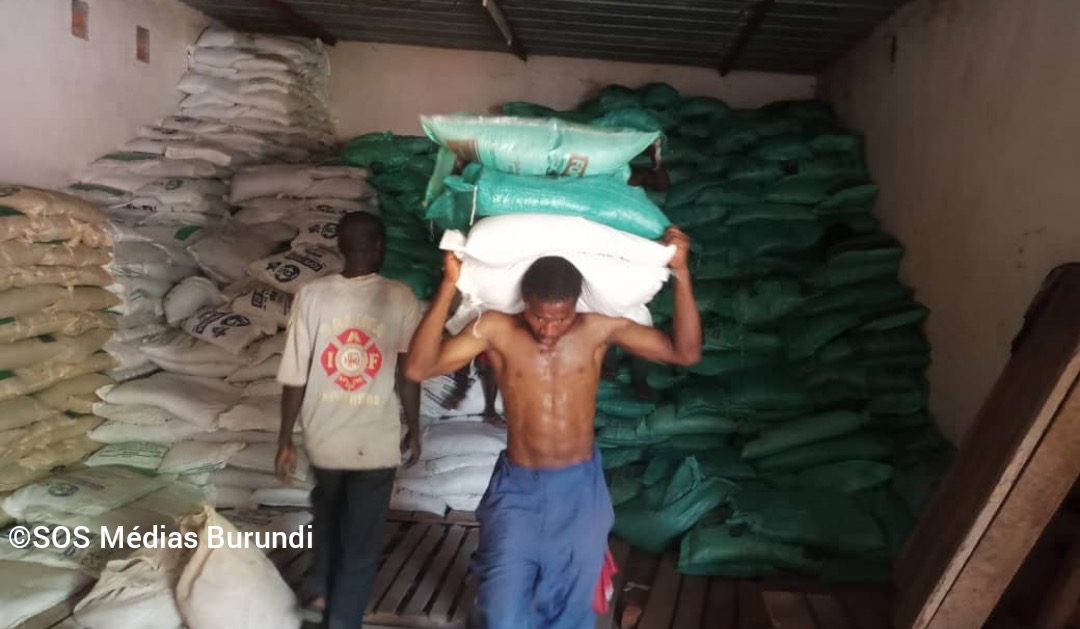
Fertilizer scandal in Burundi : billions claimed, unclear responsibilities, and farmers held hostage
SOS Médias Burundi
Bujumbura, January 2, 2026 – Since the end of December 2025, a scandal with serious financial and political implications has rocked the Burundian agricultural sector. A power struggle pits the Burundian Ministry of Finance against the company FOMI (Organo-Mineral Fertilizers) over tens of billions of Burundi francs claimed from the State, persistent suspicions of mismanagement and embezzlement, while the fertilizers remain unavailable in the crop fields. This institutional crisis has direct consequences for thousands of farmers, now held hostage by a conflict at the highest levels of government.
The Ministry of Finance sounds the alarm
On December 27, before the Senate, the Minister of Finance, Alain Ndikumana, made statements deemed alarming. He claims that the FOMI company is demanding over 50 billion Burundi francs from the State for fertilizers distributed in excess of the quantities stipulated in the signed contracts. In addition, the population is expected to bear over 24 billion Burundi francs for the year 2024.
The minister denounces this as “excessive budgetary indiscipline” and questions the origin of the funds needed to cover such sums, which are not provided for in the budget law. He also criticizes the management of fertilizer stocks in the field, asserting that the provincial stock managers are under the authority of FOMI and not the Ministry of Agriculture, as is often claimed.
To restore transparency, Alain Ndikumana proposes that fertilizers be placed under the direct responsibility of the provincial governors, who would be tasked with ensuring traceability and accountability. He maintains that he is not opposed to the national fertilizer program, but argues for a more rigorous organization, claiming to be under pressure and facing threats on this issue.
FOMI counterattacks and rejects accusations
Four days later, on December 31, FOMI held a press conference to refute the minister’s accusations point by point. Its deputy director general, Hermenegilde Manyange, asserts that the signed amendments are based on a clear memorandum of understanding between the Ministries of Finance and Agriculture, particularly regarding production quantities.
He acknowledges, however, that the shortage of foreign currency is a major obstacle to production, while assuring that the company is doing “everything possible” to maintain its operations. In an aggressive tone, he criticizes the minister for not having sought to clarify the situation directly with FOMI, preferring, according to him, to present “erroneous reports” to elected officials.
Hermenegilde Manyange believes the Minister of Finance has “overstepped the mark,” suggesting this situation is linked to his new position at the head of the ministry, as his predecessors, he claims, fully understood the workings of the fertilizer distribution system. FOMI fears this climate of suspicion will discourage the only local company in the sector, even as it seeks to establish itself in international markets.
Farmers held hostage by an institutional dispute
While institutions clash, Burundian farmers are denouncing a much more concrete reality : fertilizers paid for but nowhere to be found. Many farmers claim to have paid for the A farming season several months ago, without ever receiving the promised fertilizers, severely jeopardizing their harvests and exacerbating food insecurity.
FOMI promises a resolution soon, but on the ground, uncertainty remains.
The civil society demands independent investigations
Faced with the gravity of the situation, the Association of Burundians for the Reconstruction of Africa (ABA) has taken a stand. During a press conference held on December 29, its legal representative, Jean Bosco Ndereyimana, called for a thorough investigation into the management of public funds allocated to FOMI.
He considers the Finance Minister’s remarks particularly worrying, believing they raise suspicions of mismanagement, or even embezzlement, in a sector vital to the national economy. The ABA denounces a lack of patriotism among certain public officials, accused of plundering State resources.
Similarly, the NGO PARCEM (Words and Action for Awakening Consciences and Changing Mentalities), through its legal representative Faustin Ndikumana, is calling for the establishment of an independent commission to investigate what it describes as “serious and shameful fraud” at the FOMI factory. It questions the continued disbursement of billions of Burundi francs while fertilizers remain insufficient and are rarely available on time.
Faustin Ndikumana also raises suspicions of collusion between certain high-ranking State officials and influential business operators, who are allegedly imposing their personal interests at the highest levels of power, to the detriment of the common good.
A contract amendment at the heart of the dispute
During an extraordinary session of the Senate, the Minister of Finance revealed that FOMI had submitted a contract amendment concerning the 2025 B and C farming seasons, as well as the 2024 C season, with quantities exceeding those stipulated in the initial contract.
According to legal experts consulted, an amendment presented after the partial or total execution of a contract is not automatically binding on the State. The Minister’s refusal to sign would therefore be legally justified, in order to avoid payments not authorized by the budget law and liable to prosecution for irregular payment or embezzlement.
A crisis revealing a deeper problem
This affair comes amid an already tense climate. On December 26, during a public address, President Évariste Ndayishimiye acknowledged the misappropriation of agricultural inputs by certain authorities, who were allegedly reselling them outside the country—a statement that reinforces suspicions and the demand for truth.
Amidst conflicting accusations, suspicions of poor governance, and a persistent fertilizer shortage, a question remains : who is telling the truth in the FOMI case? While awaiting credible investigations and clear decisions, Burundian farmers continue to pay the heavy price of a State scandal with major agricultural and social consequences.
You might also like

Burundi : inhabitants of Bujumbura city can no longer bear the high cost of living
The population of the commercial city Bujumbura is indignant at the excessively high prices of foodstuffs on the market. Families are no longer able to provide three meals a day
Kayanza: the price of the transport ticket is skyrocketing
Residents of the province of Kayanza (northern Burundi) denounce a vertiginous increase in the price of the transport ticket. It went up to the double for local trips on motorcycles.

Cibitoke: general increase in the prices of basic necessities
A generalized spike in stuff price is observed across the communes of Cibitoke province (north-west Burundi) with people asking the government to fix the matter. The governor warns speculators saying