
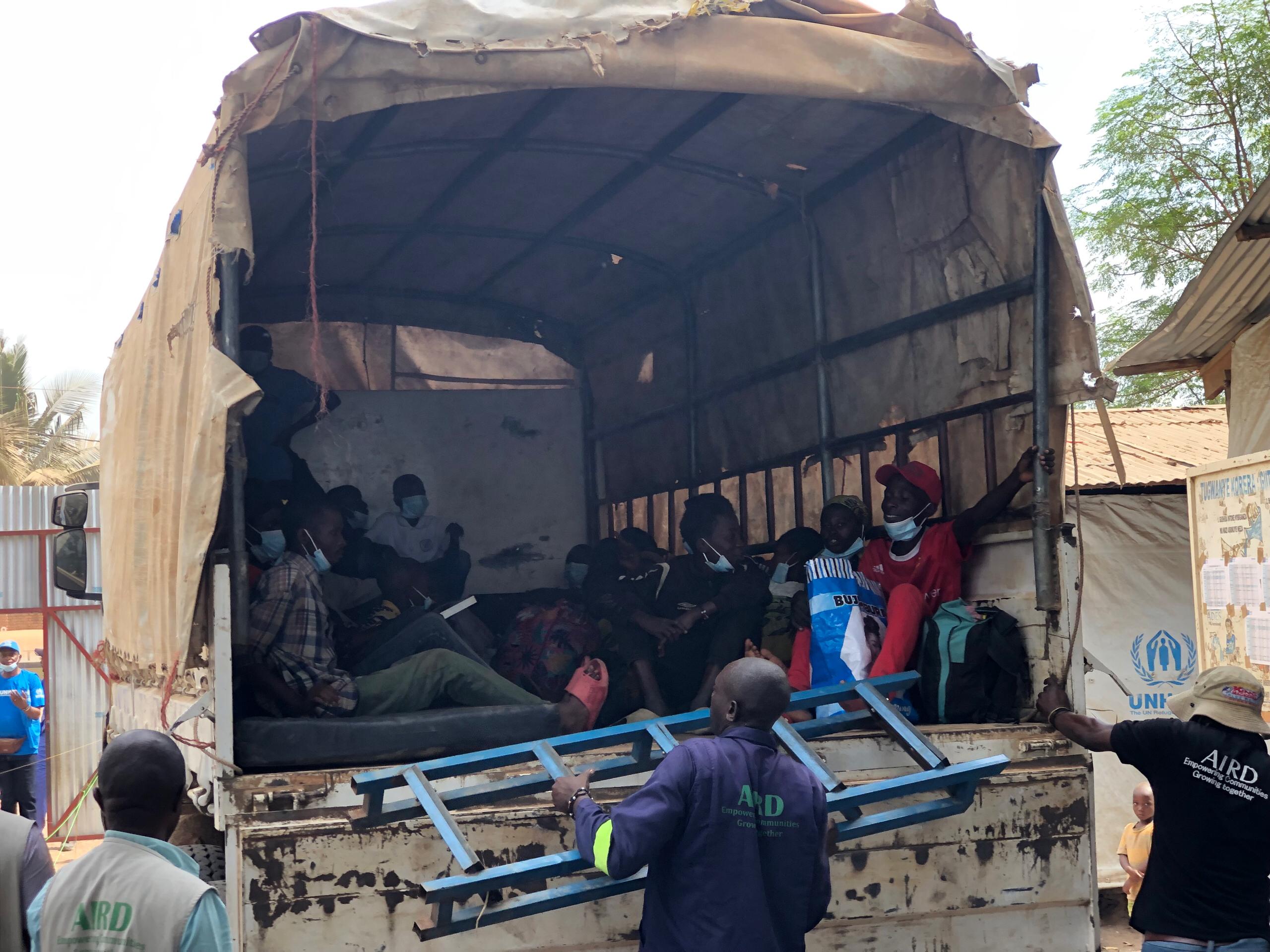
Musenyi : thousands of Congolese refugees demonstrate to demand the repatriation to the DRC
SOS Médias Burundi
Musenyi, June 15, 2026 — Thousands of Congolese refugees living at the Musenyi camp in Burunga province, southern Burundi, held a peaceful demonstration on Monday, June 15, 2026, to demand their voluntary repatriation to the Democratic Republic of Congo (DRC). This large-scale mobilization reflects deep discontent with the living conditions at the camp, which has become overcrowded since the intensification of the conflict in eastern DRC.
The march, which began around 10:00 a.m., led the demonstrators to the camp administration offices and those of humanitarian organizations operating in the camp, including the United Nations High Commissioner for Refugees (UNHCR). Throughout the rally, refugees chanted slogans in Swahili, including : “Tunataka Kongo yetu, Tunataka Kongo yetu” (“We want our Congo, we want our Congo”).
According to several participants, this mobilization aimed to draw the attention of Burundian authorities, the UNHCR, and humanitarian partners to living conditions they consider increasingly difficult in the camp. They denounced, in particular, insufficient food rations, difficulties accessing medical care, a lack of adequate shelter, and widespread poverty affecting many families.
The Musenyi site was established in 2024 with an estimated capacity of 10,000 people. However, the intensification of the conflict in eastern DRC, particularly in the provinces of North Kivu and South Kivu, has triggered a massive influx of refugees into Burundi.
After the capture of Goma and then Bukavu by M23 rebels, following clashes with the Armed Forces of the Democratic Republic of Congo (FARDC), supported by Burundian forces and the Wazalendo militia, backed by Kinshasa, tens of thousands of civilians fled the fighting.
In this context, the Musenyi site has taken in nearly 22,000 Congolese refugees, more than double its initial capacity, further straining existing infrastructure and humanitarian services.
“We have made several appeals, but we see no concrete responses.”
Among the protesters, Mugisha, who arrived in Burundi in January 2025 after fleeing the fighting in South Kivu, gave a heartfelt testimony.
“We are facing hunger. Many families go entire days without enough food. The children are suffering terribly.” Since our arrival here in January 2025, our children have barely been able to attend school. Some have lost more than a year of schooling and don’t know what the future holds for them.”
He went on to call for the expansion of the repatriation program already underway :
“We are asking our government to repatriate us, as is already being done in Busuma. We are facing the exact same difficulties as the refugees at this site. We have repeatedly appealed to the authorities and humanitarian organizations, but sometimes we feel there is little will to expedite our situation.”
“If we have decided to demonstrate today, it is not to cause trouble. We simply want our concerns to be heard and taken into consideration. We want to return home, to our land, our families, and rebuild our lives in our country.”
The Busuma site, located in Buhumuza province in eastern Burundi, hosts Congolese refugees and is currently one of the main centers involved in voluntary return operations. In this context, the Burundian and Congolese governments, in collaboration with the United Nations High Commissioner for Refugees (UNHCR), had to organize targeted repatriations following several demonstrations and clashes between some site occupants and security forces.
In response to the demonstrators’ demands, the site administrator, Oscar Niyibizi, and the local UNHCR representative, Ms. Valérie, indicated that the voluntary repatriation program is already underway and will be gradually extended to Musenyi.
This demonstration comes a few days after the tripartite DRC-Burundi-UNHCR meeting held in Kinshasa, the Congolese capital, from June 2 to 4, 2026. This meeting brought together Congolese and Burundian authorities and UNHCR representatives to assess the conditions for the voluntary repatriation of Congolese refugees living in Burundi and Burundian refugees residing in the DRC.
At the conclusion of the meeting, participants adopted a final report containing several recommendations aimed at strengthening repatriation operations and refugee protection.
A three-year roadmap was also approved to guide future cooperation between the various parties. The delegations reaffirmed their commitment to ensuring voluntary returns in safe, dignified conditions and sustainable reintegration into their areas of origin.
On the sidelines of this meeting, Congolese Prime Minister Judith Suminwa Tuluka met in Kinshasa, the Congolese capital, with Brigitte Mukanga Eno, UNHCR Representative in Burundi, to discuss the practical arrangements for repatriation and the coordination mechanisms between the DRC, Burundi, and the UN agency.
The voluntary repatriation program for Congolese refugees officially began on April 23, 2026, at the Busuma site. According to humanitarian authorities, approximately 1,000 refugees are repatriated to the DRC each week.
While operations continue in Busuma, the refugees in Musenyi now hope to be quickly integrated into this program so they can return home after several months in exile.
In the Great Lakes region, population movements remain closely linked to the evolving security situation in eastern DRC. For the thousands of refugees living in Musenyi, the prospect of returning home remains their primary hope.
You might also like
Burundi : Congolese Rrefugees in distress faced with dwindling aid
SOS Médias Burundi Musenyi, August 9, 2025 – Amid rising humanitarian needs and dwindling international resources, the regional representative of the United Nations High Commissioner for Refugees (UNHCR) in Africa,
DRC : General Masunzu arrested, a symptom of an army in crisis
SOS Médias Burundi Bukavu, November 4, 2025 – Lieutenant General Pacifique Masunzu, commander of the 3rd Defense Zone of the Armed Forces of the Democratic Republic of Congo (FARDC), was

Musenyi : protests over incomplete UN Women distribution
SOS Médias Burundi Musongati, October 11, 2025 — Congolese refugee women from the Musenyi refugee site, in Musongati district (Burunga province, southern Burundi), demonstrated on Thursday, October 9, after a