Dawn bombings on Rubaya : North Kivu entering a new deadly phase?
SOS Médias Burundi
Goma, February 24, 2026 – Bombings reported at dawn on Tuesday, February 24, 2026, in the mining town of Rubaya mark a worrying turning point in the clashes shaking the Masisi territory in North Kivu province, eastern DRC. Following fierce fighting on Monday between rebels of the Congo River Alliance/March 23 Movement (AFC/M23) and the Armed Forces of the Democratic Republic of Congo (FARDC), supported by the Wazalendo militia backed by Kinshasa, the war appears to be entering a new phase. At the heart of the fighting : Rubaya, one of the world’s largest coltan deposits, supplying a significant portion of the tantalum used in the electronics industry and new technologies. Control of this deposit is at the heart of military rivalries, economic stakes, and regional tensions.
A night of strikes and panic
In a message posted on X, formerly Twitter, Lawrence Kanyuka, spokesperson for the AFC/M23, claims that drones attributed to pro-government forces targeted Rubaya starting at 2:43 a.m.
The rebel movement maintains that the strikes hit populated areas, causing panic and civilian casualties. It refers to a “massacre of innocent civilians” and speaks of “war crimes” as well as “crimes against humanity.” At this stage, no independent casualty figures have been confirmed, and the Congolese authorities have not yet issued a public statement.
If the use of armed drones were to be confirmed, it would mark a significant escalation of combat tactics in a densely populated and highly strategic area.
Monday : A battle for control of Rubaya
These bombings come the day after fierce clashes in the towns of Kasenyi, Chugi, and Kinigi, located in the immediate vicinity of Rubaya, in the Bahunde area.
According to local sources, the Wazalendo militia, supported by Kinshasa, briefly recaptured these positions, considered to be M23 forward operating bases around the mining site. Sources close to the AFC/M23 dispute this version, claiming to have repelled the offensives launched by government forces and their local allies as early as Sunday afternoon.
Residents describe intense exchanges of heavy and light weapons that lasted several hours. The explosions were reportedly heard as far away as some outlying areas of the town, causing panic among civilians.
The hill known as “Sita,” a commanding position allowing control of roads and neighboring towns, is reportedly the target of a rebel offensive. In this war, control of the high ground is equivalent to control of mineral flows.
Rubaya : A global strategic issue
Rubaya is one of the world’s largest coltan deposits, supplying a significant portion of the tantalum used in the electronics industry and new technologies. This strategic mineral is used in the manufacture of essential components for phones, computers, military equipment, and digital infrastructure.
In eastern Congo, the mining economy has fueled the dynamics of war for decades. Controlling Rubaya means not only dominating territory but also securing a major source of funding and military influence. The ongoing battle thus transcends the local context : it involves economic interests that resonate far beyond the borders of the Congo.
A war with regional ramifications
The M23, composed mainly of Congolese Tutsis, is currently affiliated with the Congo River Alliance (AFC), led by Corneille Nangaa, former president of the Congolese Independent National Electoral Commission (CENI). The movement, which advocates for a federal state in the DRC, controls several strategic areas, including Goma and Bukavu, the capitals of North Kivu and South Kivu provinces, as well as the Rubaya mining site.
According to a report by the Congolese Ministry of the Interior and Security, consulted by SOS Médias Burundi in December 2025, more than 29,000 soldiers from the Burundi National Defense Force (FDNB) were deployed between August 2022 and December 2025 to support the FARDC and the Wazalendo militia, which is backed by Kinshasa. Last December, Burundian authorities carried out a partial withdrawal of their troops following the M23’s dramatic advances and heavy losses within the FDNB ranks, before conducting a limited redeployment a few weeks later. Currently, Burundian soldiers are stationed only in South Kivu.
The Armed Forces of the Democratic Republic of Congo, FARDC, constitute the Congolese loyalist army. Their role is to defend the territorial integrity of the DRC, to secure civilian populations, and to conduct operations against rebel groups, often in coordination with local militias such as the Wazalendo.
In some situations, the coalition against the M23 also includes the Democratic Forces for the Liberation of Rwanda (FDLR), a Rwandan Hutu armed group, some of whose members are accused of participating in the 1994 genocide against the Tutsis.
Congolese authorities continue to accuse Rwanda of supporting the M23, while Kigali denies this and points to alleged support from the DRC and Burundi for the FDLR. Despite these repeated denials, a report by the UN Group of Experts confirmed in December 2025 the presence of 5,000 to 7,000 Rwandan soldiers alongside the M23 rebels.
Despite the Washington Agreement, signed on December 4, 2025, between the DRC and Rwanda, hostilities continue. Burundi participated in this agreement as an observer, represented by President Évariste Ndayishimiye.
Civilians caught in the crossfire and humanitarian crisis
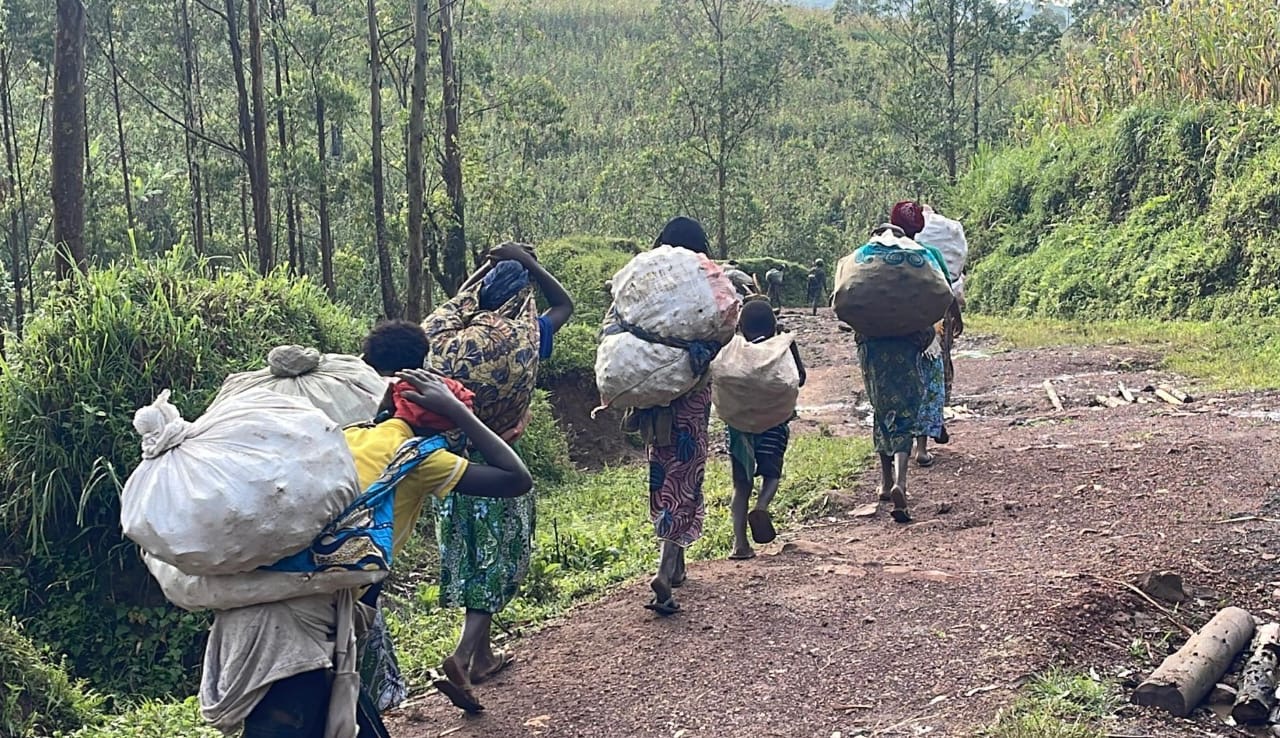
Each flare-up of violence triggers further population displacements. Thousands of families flee the fighting zones to safer territories or neighboring countries.
By the end of February 2026, the humanitarian crisis in the Democratic Republic of Congo (DRC) had reached unprecedented levels, with millions of people displaced by the conflict in the east of the country :
Internally displaced persons (IDPs)
Estimated total : Approximately 7.8 million people are currently internally displaced within the DRC.
Most affected areas : the provinces of North Kivu, South Kivu, and Ituri account for the vast majority of displaced persons.
Recent developments : in the last months of 2025 and early 2026 alone, hundreds of thousands more people were forced to flee, despite some isolated return movements.
Congolese refugees in neighboring countries
Estimated total : more than 1.2 million Congolese refugees or asylum seekers live in countries in the region.
In Masisi and around Rubaya, the coltan war continues to rage on strategic hills and in populated areas, leaving civilians on the front lines and exacerbating the already dire humanitarian crisis.
You might also like
15,000 francs for a single trip : Bwagiriza refugees strangled by rising transport costs
SOS Médias Burundi Ruyigi, July 21, 2026—For Congolese refugees in the Bwagiriza camp, located in the district of Ruyigi, Buhumuza province, in eastern Burundi, as well as for the surrounding

DRC (Beni): more than ten people killed in a latest attack blamed to the ADF in Rwenzori
Thirteen people died in a new attack allegedly led by the ADF (Allied Democratic Forces) rebels in the night from Thursday to Friday. The incident took place in the village

DRC – Uvira : Gatumba border closed, thousands of Congolese and Burundians affected
SOS Médias Burundi Uvira, January 5, 2026 – Since December 10, 2025, the Gatumba border between the DRC and Burundi has remained closed, disrupting trade, education, and access to healthcare