
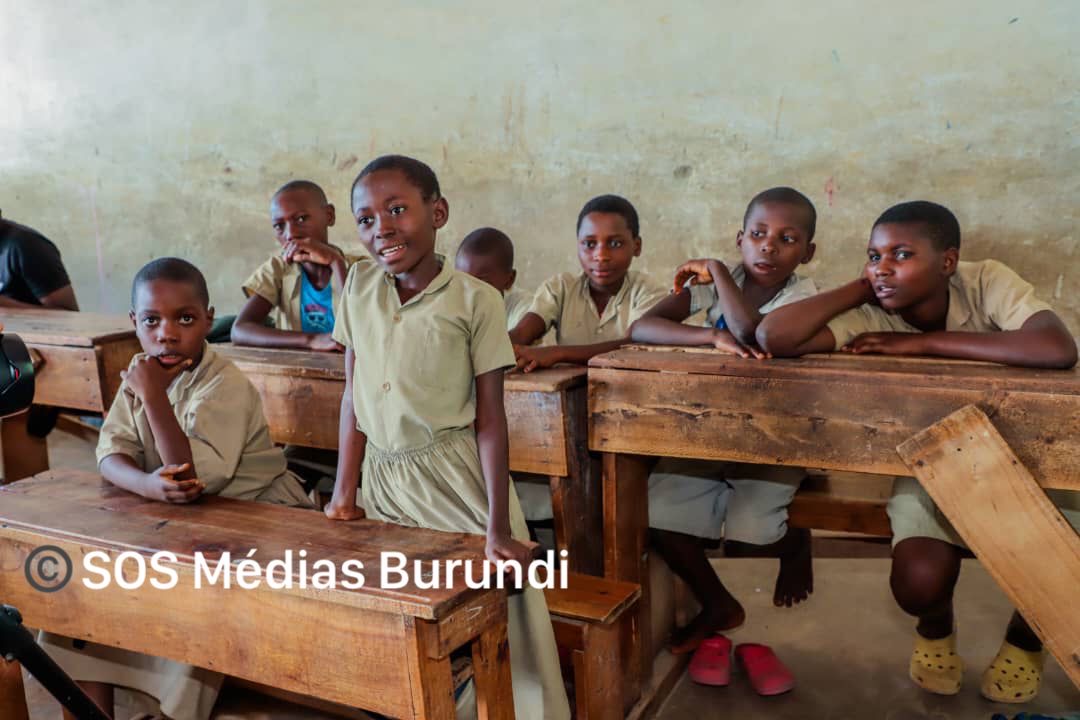
Burundi : after the failure of the basic school, the government forced to tethink its plan
SOS Médias Burundi
Bujumbura, June 15, 2026— More than a decade after its launch, the basic school, presented as the cornerstone of the modernization of Burundian education, is now at the heart of a profound reassessment. Faced with declining student performance, particularly in French, curricula deemed inadequate, and criticism voiced for several years by specialists in the field, the government has announced a new educational reform that will be gradually implemented starting with the 2026-2027 school year. This decision reignites the debate on past mistakes and the persistent challenges of the education system in this small East African nation.
The Burundian government is preparing to launch a new reform of the education system starting with the 2026-2027 school year. The announcement was made last week by André Nduwimana, Director General in charge of preschool, primary, post-primary, general, and teacher training programs, during an interview with Radio Nderagakura. This direction was confirmed on Thursday by Prime Minister Nestor Ntahontuye during a public broadcast with journalists.
This reform comes after several years of implementing the primary school system, the evaluation of which revealed significant shortcomings. According to André Nduwimana, the Ministry of National Education and Scientific Research has observed a worrying decline in students’ French proficiency, despite French being the primary language of instruction in the country.
“We cannot implement a new curriculum without teachers mastering it and expect to succeed,” he stated, announcing the organization of training sessions for teachers during the school holidays to prepare them for the new curriculum.
The reform will be introduced gradually in grades 7, 8, 9, and 10. According to the results of a thorough evaluation conducted with various stakeholders in the education sector, some subjects involve unnecessary repetition, while others suffer from significant gaps. Ministry officials believe these shortcomings are primarily linked to the rushed implementation of the basic education system.
The Director General explained that the low level of French has repercussions on learning in other subjects. To address this situation, the Ministry has developed a new core curriculum based on national, regional, and international guidelines. A pedagogical reform plan covering grades 7 through 10 has also been developed based on recommendations from various evaluations.
Among the announced innovations is the introduction of a new grade 10 class starting in the 2027-2028 school year. The Prime Minister also announced the reopening of boarding schools for 7th-grade pupils admitted to elite schools following the national competitive entrance exam.
Similarly, the student dining system at the University of Burundi is expected to be reinstated, a measure demanded for several years by students and their representatives.
Warnings issued more than a decade
For several observers of the education sector, the conclusions of this evaluation echo concerns long voiced by certain education specialists.
Among them is Libérat Ntibashirakandi, a lecturer, expert in information and communication technologies applied to education, and author of several reflections on the future of Burundian schools. During the National Education Conference held in 2014, he had already delivered a scathing assessment of the national education system.
In an article entitled “What About a 21st-Century Burundian School, or the Pervasiveness of Excellence?”, he denounced, among other things, the lack of qualified teachers, insufficient teaching materials, overcrowded classrooms, inadequate planning, teacher demotivation, and the “improvisation of educational reforms.”
For him, the Burundian school system needed to be redesigned around a clear vision based on excellence, language proficiency, pedagogical innovation, the integration of information and communication technologies, and ongoing teacher training.
The expert also advocated for greater coherence in school curricula, the development of libraries, laboratories, and digital infrastructure, arguing that no reform could succeed without properly trained teachers and adequate resources.
More than a decade after these recommendations, several of the identified difficulties remain evident in the country’s schools. The criticisms voiced at the time resonate particularly strongly today, as the government itself acknowledges the limitations of the system implemented in recent years.
Unions supportive but cautious
Teachers’ unions welcomed the government’s announcement. While praising the authorities’ commitment to reforming the education system, they emphasized the need for sufficient support measures to ensure the success of this new reform.
According to them, the sustainable improvement of teaching quality depends, in particular, on adequate teacher training, the availability of teaching materials, improved working conditions, and rigorous planning for the implementation of the announced changes.
For many stakeholders in the sector, this new reform represents an opportunity to correct past mistakes. However, they also point out that several reforms undertaken in recent years have suffered from a lack of financial, human, and material resources.
While education is regularly presented as one of the main drivers of national development, the challenge for the authorities will now be to translate promises into concrete results so that the shortcomings denounced today do not become tomorrow’s failures.
You might also like
Rumonge: economic activities paralyzed, the population forced to welcome the torch of peace
This Thursday morning, no economic activity was undertaken in the town center of the province of Rumonge (southwest Burundi). The central market of Rumonge was closed by administration authorities as
Five Years at the Helm: President Ndayishimiye Celebrates His “Victory Over the Opposition” During a Crusade in Gitega
SOS Médias Burundi Gitega, June 23, 2025 — Five years after coming to power, President Évariste Ndayishimiye marked his term anniversary in Gitega with a religious crusade laced with political


Karusi-Rumonge: the two provinces have new governors
Léonard Niyonsaba and Dévote Nizigiyimana are respectively new governors of the province of Rumonge (South-West of Burundi) and Karusi (Center-East). They were approved by the upper house of the Burundian