Burundi : on the 64th anniversary of independence, President Ndayishimiye attacks “colonists,” the church, and the civil society
SOS Médias Burundi
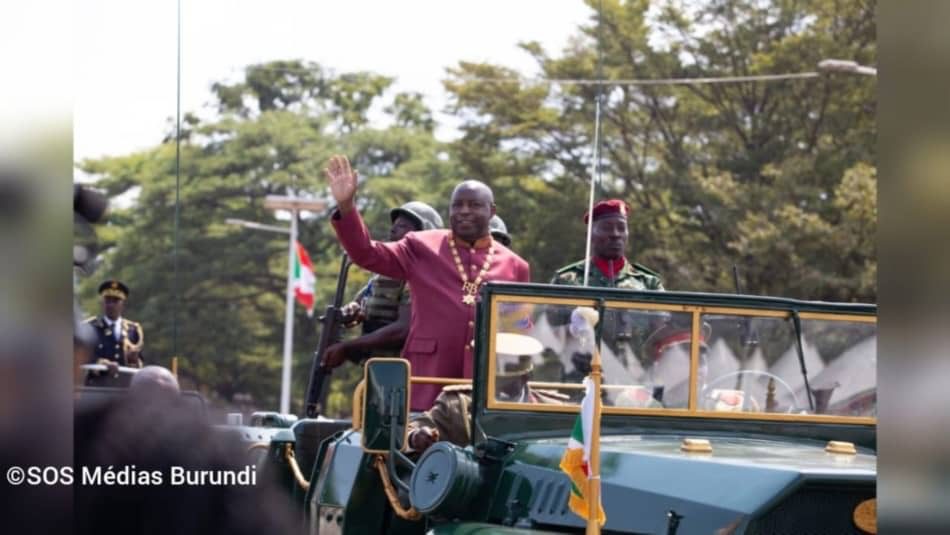
Bujumbura, July 1, 2026 – Burundi celebrated the 64th anniversary of its independence on Wednesday, which was achieved on July 1, 1962. On this occasion, President Évariste Ndayishimiye addressed the nation in a message of about thirty minutes broadcast by the National Radio and Television of Burundi (RTNB) and relayed by several media outlets. The head of state devoted a large part of his speech to denouncing the colonial legacy, as well as launching sharp criticisms against the Catholic Church, intellectuals, and civil society organizations, which he accuses of serving foreign interests.
In his speech, the president invoked a biblical reference, comparing the divisions within the Burundian society to the story of the Tower of Babel from the Book of Genesis. In this narrative, people speaking the same language attempt to build a tower reaching the heavens, before God confuses their language, causing them to scatter and become unable to understand one another. Évariste Ndayishimiye used this image to illustrate, in his view, the divisions inherited from the colonial period.
“It was the colonizers who created the divisions among Burundians,” he asserted, arguing that these fractures continue to affect national cohesion more than six decades after independence.
A “rich” country despite its economic ranking
The head of state challenged international rankings that place Burundi among the poorest countries in the world.
According to him, the country possesses significant natural resources that are insufficiently utilized.
“Burundi is rich because we have natural resources. It was these same colonizers who went so far as to hide our geological map and who now come back to call us the poorest country,” he declared.
These remarks come as the country has been experiencing an economic crisis for several years, marked by a persistent fuel shortage, regular stockouts of basic necessities, and inflation that is severely impacting the household purchasing power.
The president asserted that Burundians, by working harder, can transform their economy and eventually attract foreign populations to settle in the country.
New criticism of bishops and the civil society
Évariste Ndayishimiye also addressed the recent criticisms voiced by the Catholic bishops of Burundi, who expressed their concerns regarding the human rights situation, governance, and the living conditions of the population.
Without naming them specifically in this part of his speech, he denounced positions that he considers to be influenced by external interests.
References to the Christian Democratic Party (PDC)
The president also repeatedly referred to the Christian Democratic Party (PDC), a political party active during the Belgian colonial period. He noted that this party opposed the UPRONA party of Louis Rwagasore, which advocated for immediate independence.
According to him, the PDC supported a gradual transition under the Belgian tutelage and maintained close ties with the colonial authorities as well as with the Catholic Church, which was then dominant in the country.
The head of state repeatedly stated that this political movement was “in the pay of the colonizers,” drawing a parallel with certain contemporary criticisms leveled at his government by religious and civil society actors.
Criticism of intellectuals and NGOs
President Ndayishimiye also attacked Burundian intellectuals and civil society organizations, accusing them of disseminating foreign narratives.
“So far, it’s regrettable to see that there are people behaving like overseers working for the colonial powers,” he said.
According to him, the critical reports published by certain national and international organizations constitute attacks against the Burundian state.
“Instead of acknowledging the authorities when there are problems, they blame us,” he lamented.
These statements come amid persistent tensions surrounding issues of governance, human rights, and socio-economic conditions in the small East African nation.
Official celebrations across the country
The 64th anniversary of independence was marked by civilian and military parades, cultural performances, and official gatherings held in several provinces across the country.
July 1st, which commemorates Burundi’s independence from Belgium in 1962, is a paid public holiday throughout the country.
You might also like

Burundi: leaders selling chimeras when talking about agriculture
The ruling party has failed miserably in agricultural policy. The dignitaries are models in agricultural projects, all, or almost as they invest and want to grab everything in all areas.
Gitega seeks to attract its diaspora, but trust remains fragile
SOS Médias Burundi Bujumbura, July 31, 2026 — Burundi’s commercial capital hosted the Pan-African Diaspora Week from July 29 to 30, 2026, under the theme : “Dialogue with the Pan-African

DRC : evacuation of unarmed Congolese soldiers and police officers from Goma to Kinshasa, with support from the ICRC and MONUSCO
SOS Médias Burundi Goma, April 30, 2025 – Several hundred unarmed members of Congolese security forces, protected since January by MONUSCO in Goma, have begun to be transferred to Kinshasa