
Soaring charcoal prices in Gitega : households under pressure from alarming price increase
SOS Médias Burundi
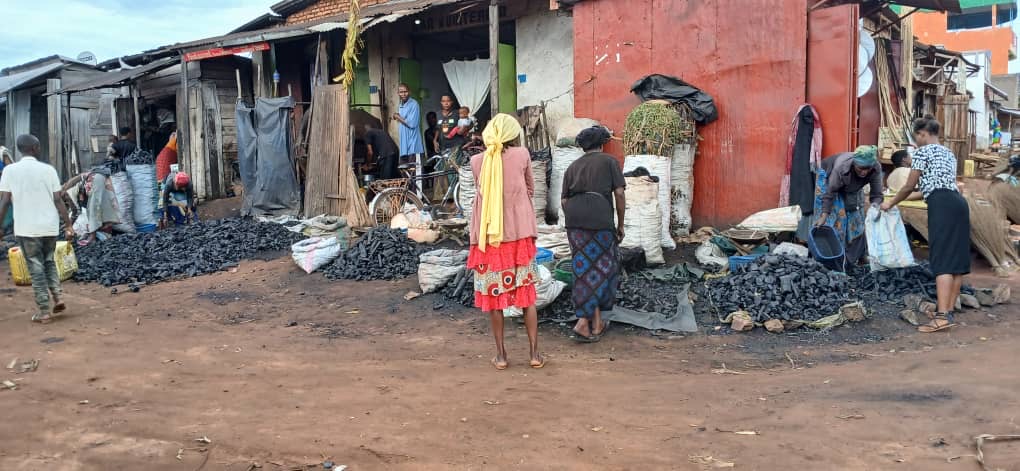
Gitega, March 29, 2026 — In Gitega, the political capital of the small east African nation, the rapid rise in charcoal prices is causing serious concern among residents, who are already facing difficult living conditions. In just six months, prices have increased significantly, jeopardizing the financial stability of many households.
Meeting Julien Ndikumasabo, 64 years old, a father of seven, in Magarama while he was buying charcoal, testifies to this worrying reality. “Six months ago, I bought an average bag of charcoal for 50,000 Burundi francs. Today, I have to pay 70,000 francs for the same bag,” he laments. He specifically mentions the devaluation of the Burundi franc as a likely cause of this price increase. According to him, the quantity purchased is no longer sufficient to cover his household’s monthly needs : “My wife told me that an average bag lasts 20 days. If nothing is done, the situation will become increasingly untenable.”
The same observation was made by Médiatrice Barakamfitiye, 50 yesrs old, a mother of five, whom we met at a charcoal sales site in the Karera I neighborhood. Lacking sufficient funds, she is forced to buy charcoal in small quantities. “If I can find money, I buy a box of charcoal for 2,000 francs a day. With my income, it’s practically impossible for me to buy a whole bag,” she explains. She also points out that the price of a box of charcoal has doubled, going from 1,000 to 2,000 Burundi francs. Faced with this situation, she says she sometimes resorts to firewood gathered from the outskirts of the city. “It has become very difficult for impoverished families to cook for their children,” she laments.
Suppliers are also pointing the finger at the reasons for this price surge. Deogratias Nduwarugira, 43 years old, from Gishora village and a charcoal supplier in Gitega, attributes this increase to the growing lack of forests. According to him, the depletion of forest resources directly impacts charcoal production and supply.
The figures clearly illustrate this upward trend : in six months, the price of a box of charcoal has risen from 1,000 to 2,000 Burundi francs, a bucket from 3,000 to 5,000 francs, a medium bag from 50,000 to 70,000 francs, and a large bag from 80,000 to 110,000 Burundi francs.
Adding to these difficulties are the tax burdens. Suppliers must pay district taxes of 1,000 Burundi francs per bag, as well as 3,000 Burundi francs to the Burundi Revenue Authority (OBR) to obtain a transport permit, in collaboration with the Burundi Office for Environmental Protection (OBPE).
A crisis that extends beyond Gitega
The situation observed in Gitega is not isolated. In the commercial capital, Bujumbura, as well as in several other urban centers across the country, the pressure on charcoal is increasing, fueled by population growth, energy poverty, and the near-total dependence of households on this cooking fuel.
The energy transition underway in the sub-region
Across East Africa, some countries have begun a gradual transition to alternative energy sources, particularly cooking gas, to reduce pressure on forest resources and stabilize household costs.
In Rwanda, the authorities have strongly encouraged the use of domestic gas through tax incentives and awareness campaigns. This strategy aims to reduce reliance on coal, especially in urban areas.
A similar trend is emerging in Kenya, where liquefied petroleum gas (LPG) is becoming increasingly accessible thanks to subsidies and the expansion of distribution networks, particularly in Nairobi. The Kenyan government has also implemented programs to encourage low-income households to adopt clean energy solutions.
In Tanzania, the authorities have launched initiatives in recent years to promote gas and limit charcoal production, although the transition remains uneven between urban and rural areas.
A major challenge for Burundi
In Burundi, this energy transition is still in its early stages. The high cost of gas, the lack of distribution infrastructure, and low household purchasing power are major obstacles to the adoption of alternative solutions.
Faced with the continued surge in charcoal prices, residents and stakeholders in the sector are calling for urgent measures : support for vulnerable households, reforestation policies, market regulation, and the promotion of affordable alternative energy sources.
Without swift intervention, they warn, access to an essential energy source for cooking could become a luxury for a large part of the population.
You might also like
Bubanza : farmers worried about delayed rains and seed shortages
SOS Médias Burundi Bubanza, October 22, 2025 — Although the first agricultural season was supposed to begin several weeks ago, farmers in Bubanza still haven’t seen any rain. Between unpredictable
Burundi: Government releases 66 billion for the general population census while waiting for its partners’ financing to come
Development partners who promised to support the country for the general census of the population, housing, agriculture and livestock have not yet honored their commitments, the president of the Central

Bujumbura : effects of the fuel shortage on transport are worsening
It has been three weeks since public transport in the commercial capital Bujumbura has been paralyzed. Originally, petroleum products were rare, especially fuel oil. At bus stops, passengers desperately wait