
Buhumuza: promises of employment facing a reality of poverty and social exclusion
SOS Médias Burundi
Buhumuza, June 16, 2026 – Despite official pronouncements touting entrepreneurship, innovation, and self-employment as solutions to unemployment, many rural youth, female heads of households, and members of the Batwa community in Buhumuza province, eastern Burundi, continue to face a reality marked by poverty, lack of funding, and social exclusion. These difficulties were discussed at length during a training session organized by the Burundian Office of Employment and Workforce (OBEM).
At the conclusion of this two-day training session held in Ruyigi, the Director of the Employment and Training Observatory at OBEM, engineer Sylvère Singwabiye, encouraged participants to develop their skills and leverage information and communication technologies to create their own economic opportunities.
However, on the ground, the beneficiaries say that numerous obstacles remain.
“We are encouraged to start businesses, but most of us have neither start-up capital nor access to credit. Many projects stop at the idea stage,” a participant confided.
For OBEM, digital tools are an important lever for promoting self-employment. However, in several localities of Buhumuza, electricity remains unavailable, internet access is still expensive, and digital equipment is out of reach for many households.
“Before this training, I thought the only way to succeed was to find a job in the public administration.” “Today, I understand that other possibilities exist. But without financial resources and support, it will be difficult to bring these projects to fruition,” testifies Jean Bosco N., a young man from Gisoro village.
Women particularly affected
Women heads of households describe an even more difficult situation. In addition to economic insecurity, they denounce gender-based violence, discrimination, and heavy family responsibilities that limit their access to income-generating activities.
“After my husband’s death, I found myself alone with four children to support. Finding stable employment is almost impossible. Some women remain economically dependent and suffer pressure or violence because they have no other choice,” explains Marie Claire N., originally from the former district of Butezi.
The Batwa, a minority still marginalized
Members of the Batwa community present at the meeting also spoke of a persistent feeling of exclusion.
“Often, we learn about information too late or we don’t receive it at all. Even when opportunities exist, we don’t always have the financial means to take advantage of them,” laments a participant.
Considered the most marginalized minority in Burundi, the Batwa remain among the populations most affected by poverty and exclusion. Limited access to education, difficulties finding employment, a lack of arable land, and persistent discrimination continue to hinder their socio-economic integration, according to several participants at the meeting.
In several localities of Buhumuza, representatives of this community believe that their vulnerability is exacerbated by a lack of information about economic opportunities and existing support programs. According to them, this persistent exclusion significantly reduces their chances of escaping poverty.
A gap between training and reality
Beyond awareness-raising, several participants are calling for concrete measures to improve their living conditions. They are calling for better access to financing, support programs tailored to rural realities, and investments in digital and energy infrastructure.
The discussions also highlighted a gap between some training programs offered in educational institutions and the actual needs of the job market. This observation was shared by engineer Sylvère Singwabiye, who urged students to choose fields of study better suited to the country’s economic needs.
For the participants, training remains useful but insufficient if it is not accompanied by measures to remove the economic and social barriers that hinder access to employment.
A Reality that extends beyond Buhumuza
The case of Buhumuza is far from being isolated. In several regions of this small East African nation, youth unemployment, precarious household living conditions, and a lack of economic opportunities continue to fuel discouragement and exodus abroad.
Last week, the Conference of Catholic Bishops of Burundi denounced, in a press release, the deteriorating living conditions of the population, the brain drain, the rising cost of living, and the persistent shortages plaguing the country.
These criticisms prompted a reaction from President Évariste Ndayishimiye. During a meeting of the National Social Protection Commission, the head of state accused certain religious leaders of “politicizing poverty” and “bashing the state,” arguing that organizations denouncing the country’s difficulties should first contribute more to improving the living conditions of their members.
For young people, vulnerable women, and marginalized groups in Buhumuza, the debate is less political than it is a daily struggle : finding employment, feeding their families, and hoping for a better future remain their immediate concerns.
You might also like
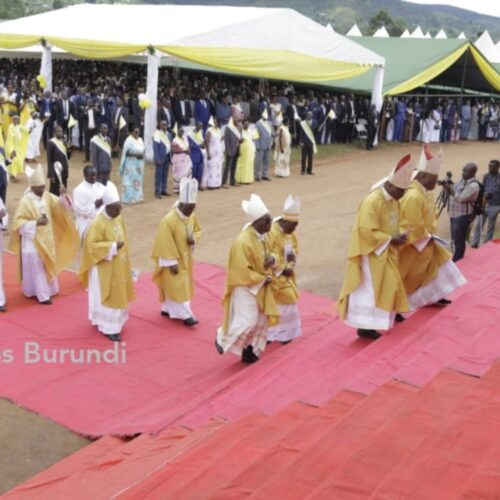
Bujumbura : CNEB warns of socio-economic challenges and reiterates the role of churches as Easter and elections approach
SOS Médias BurundiBujumbura, April 19, 2025 – With Easter approaching and in a tense political and economic context, the National Council of Churches of Burundi (CNEB) expresses its concern about
Bujumbura : CNTS employees go on strike
Employees of the National Blood Transfusion Center CNTS gathered within the SYNAPA union began an indefinite strike movement on Monday. They are demanding their unpaid salaries for the months of

Burundi: mkutano wa maaskofu wa Burundi unaohusu umaskini uliokithiri wa kaya
Maaskofu wa kanisa katoliki nchini Burundi wamekasirishwa na kupanda kwa bei nchini humo. Katika taarifa kwa vyombo vya habari iliyotangazwa kwa umma baada ya mkutano wa kawaida wa kikao mwezi